You can run an SEO competitor analysis with DataForSEO by asking Claude for the keywords your competitors rank for and you do not. Then filter that list to your topic. I reran the analysis behind this DataForSEO hub on 13 November 2026, against two publishers in the niche. It took 7 calls and cost about $0.10. The raw gap was 115 keywords and 41,940 searches a month. Only 15 keywords, worth 9,050 searches, belonged to the topic. The filter mattered more than the pull.
Disclosure: links to DataForSEO in this post are affiliate links. If you sign up through them, I may earn a commission on every successful sale, at no extra cost to you.
Which DataForSEO endpoints do you need for competitor analysis?
Three DataForSEO Labs endpoints cover most competitor analysis: competitors domain, domain intersection and ranked keywords. Domain intersection does the main work, because it can return the keywords one site ranks for and another does not.
| Endpoint | Question it answers | Calls in this run |
|---|---|---|
| Competitors domain | Which sites share the most keywords with a domain? | 1 |
| Domain intersection, intersections off | What does a competitor rank for that I do not? | 3 |
| Domain intersection, intersections on | What do we both rank for, and who wins? | 1 |
| Ranked keywords | What do I rank for in this topic today? | 2 |
The 7 calls returned 133 rows. At DataForSEO (affiliate link) Labs list rates from 27 October 2026, $0.012 per task plus $0.00012 per row, that is about $0.10. Each extra competitor adds roughly one call.
How do you find your real SEO competitors?
Choose competitors by topic, then use the overlap data to check your choice. The sites that share the most keywords with you are often platforms, not businesses competing for the same reader.
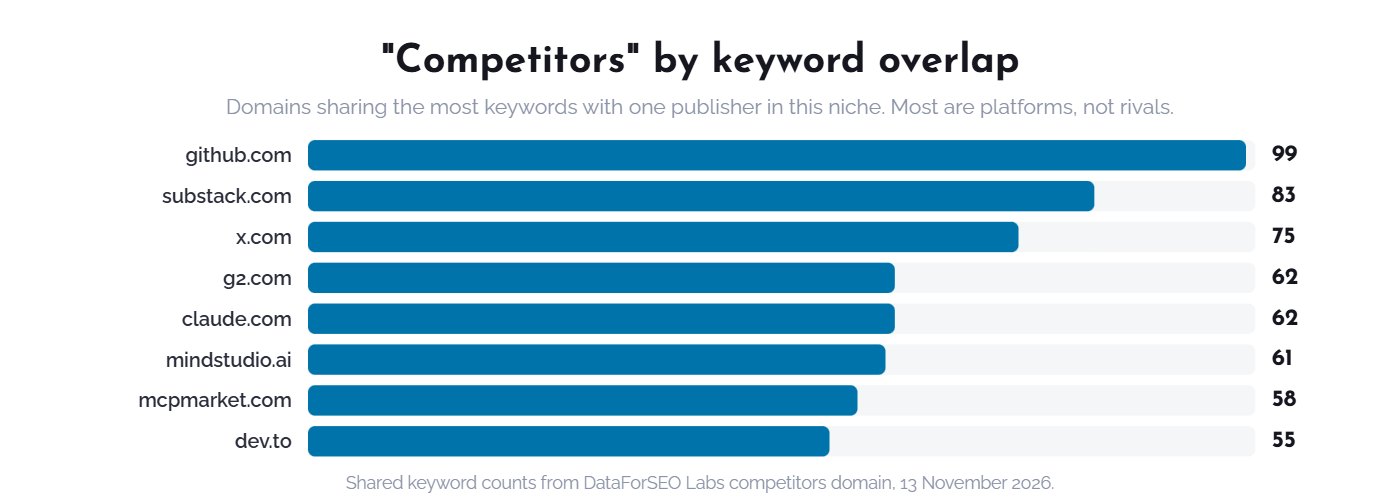
For ryandoser.com, one of the two publishers I compared against, the top overlapping domains were github.com, substack.com, x.com and g2.com. That happened with the endpoint’s large-site exclusion switched on. The other publisher I chose, nextgrowth.ai, did not appear in the top 10 at all. Overlap tells you who shows up in the same results, which is useful, but you still pick the rivals.
What does a keyword gap analysis show?
A keyword gap analysis shows the searches your competitors rank for and you do not. Most of the raw list belongs to their other topics, so filter it before you plan anything.
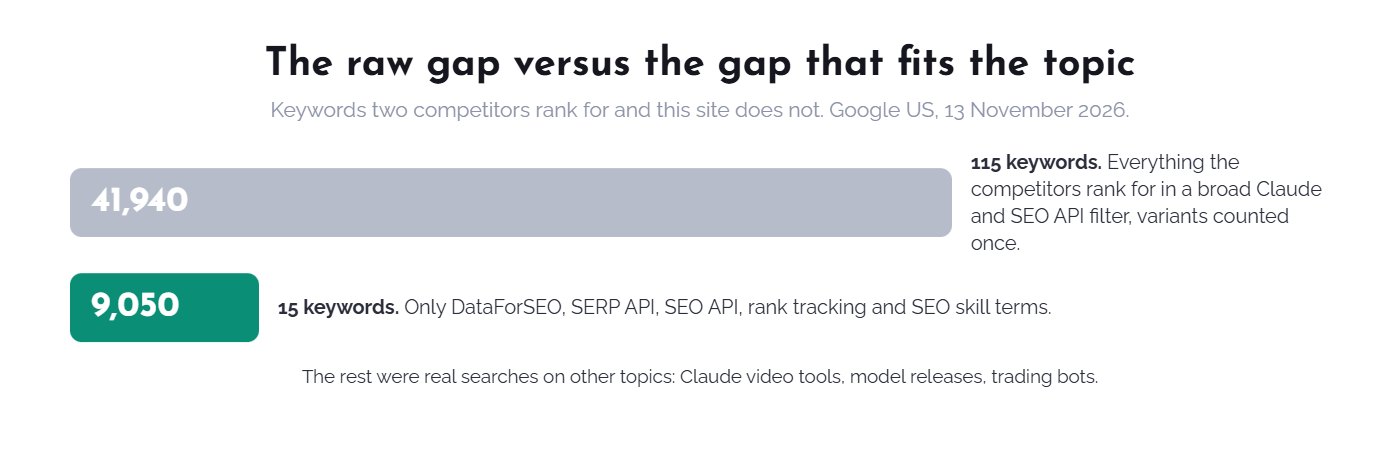
I filtered the pull to Claude, MCP and SEO API terms, which returned 115 keywords. The largest were “claude agent teams” at 4,400 searches and “claude code router” at 2,900. Those are real searches, but they belong to the competitors’ wider Claude coverage, not to DataForSEO workflows. Narrowed to the topic, 15 keywords remained.
| Keyword | Monthly searches | Difficulty | Best competitor position |
|---|---|---|---|
| dataforseo | 4,400 | 9 | 22 |
| free rank tracking software | 1,600 | 61 | 24 |
| agency rank tracking | 1,300 | No data | 30 |
| claude seo skill | 480 | 3 | 35 |
| dataforseo api | 320 | 24 | 26 |
| dataforseo mcp | 210 | 18 | 19 |
| best serp api | 170 | 22 | 63 |
| cheap rank tracking | 110 | 6 | 26 |
| claude code seo skill | 110 | 5 | 41 |
| best seo api | 70 | 8 | 26 |
| dataforseo pricing | 70 | No data | 25 |
| dataforseo serp api | 70 | 33 | 25 |
| free seo api | 70 | 21 | 12 |
| dataforseo backlinks api | 40 | 10 | 14 |
| dataforseo mcp server | 30 | 6 | 16 |
Neither competitor held a top-10 position on any of these 15 keywords. The best was 12, for “free seo api”. A gap where nobody ranks well yet is an open topic, which is a stronger signal than the volume alone.
Check the monthly history before you rank the list. “free rank tracking software” reports 1,600 searches, but that average comes from 8,100 in February and March and 170 to 590 in other months. “dataforseo” reports 4,400, while its last four months ran 6,600 to 8,100. One number per keyword hides both stories.
What about the keywords you both rank for?
The “you both rank, they win” table comes from domain intersection with intersections switched on. It is only as current as the database’s last crawl of your site.
In this run it came back empty, because the database’s snapshots for christopherjanb.com dated from July to September 2026. The hub launched on 27 October, so its pages were not yet in the data. For your own positions, Search Console is current. Use DataForSEO Labs for competitors, and check the snapshot dates before reading a zero as “not ranking”.
How did this analysis shape the content plan?
The October version of this analysis set the order of the posts in this hub. Each open gap became a post.
- “dataforseo mcp” and “dataforseo mcp server” became the MCP setup guide.
- “dataforseo pricing” became the pricing post, built on 30 days of real spend.
- “dataforseo serp api” and the rank tracking terms became the rank tracking post.
- “dataforseo backlinks api” became the backlink analysis post.
- “claude seo skill” became the Claude SEO skill pack page.
What can go wrong in a competitor analysis?
Most errors come from reading the tool’s output too literally. These came up in this one run.
- The competitor list includes the target. Competitors domain returned 10 rows when asked for 20, and the first row was the target site itself.
- Language labels misfire. “dataforseo” was tagged as Spanish and “dataforseo mcp” as Galician. A language filter would drop them.
- Difficulty is often missing. 26 of the 115 keywords had no difficulty score. Treat that as unknown, not easy.
- Empty is not zero. An empty result reported its total as null rather than 0. Report it as no data.
- Variants inflate totals. “mcp market” and “mcp marketplace” shared one monthly history, so I counted their volume once. My keyword research post covers this in more detail.
How do you run a competitor analysis in Claude?
Name your competitors, define your topic, then ask for the gap and the overlap separately. Claude does the pulls and the merging, and you decide which gaps deserve a page.
- Connect the data. Follow my DataForSEO MCP setup guide.
- Check the field. Try: “Run competitors domain for [competitor]. Remove platforms and the site itself, and tell me who else covers the same topic.”
- Pull the gap. Try: “Use domain intersection with intersections off for [competitor] against [my site], filtered to keywords containing [topic terms]. Merge variants with identical monthly history.”
- Read it properly. Try: “Sort by volume, show each keyword’s 12-month range and the competitor’s best position, and mark keywords where nobody is in the top 10.”
- Map it to pages. Try: “Group the remaining gaps into page ideas, one intent per page, and list which existing pages could cover any of them.”
My free Claude SEO skill pack turns this into a repeatable step, with a DataForSEO keyword research add-on for the gaps you choose. If you need the data, open a DataForSEO account (affiliate link). More guides are in the DataForSEO + Claude hub.