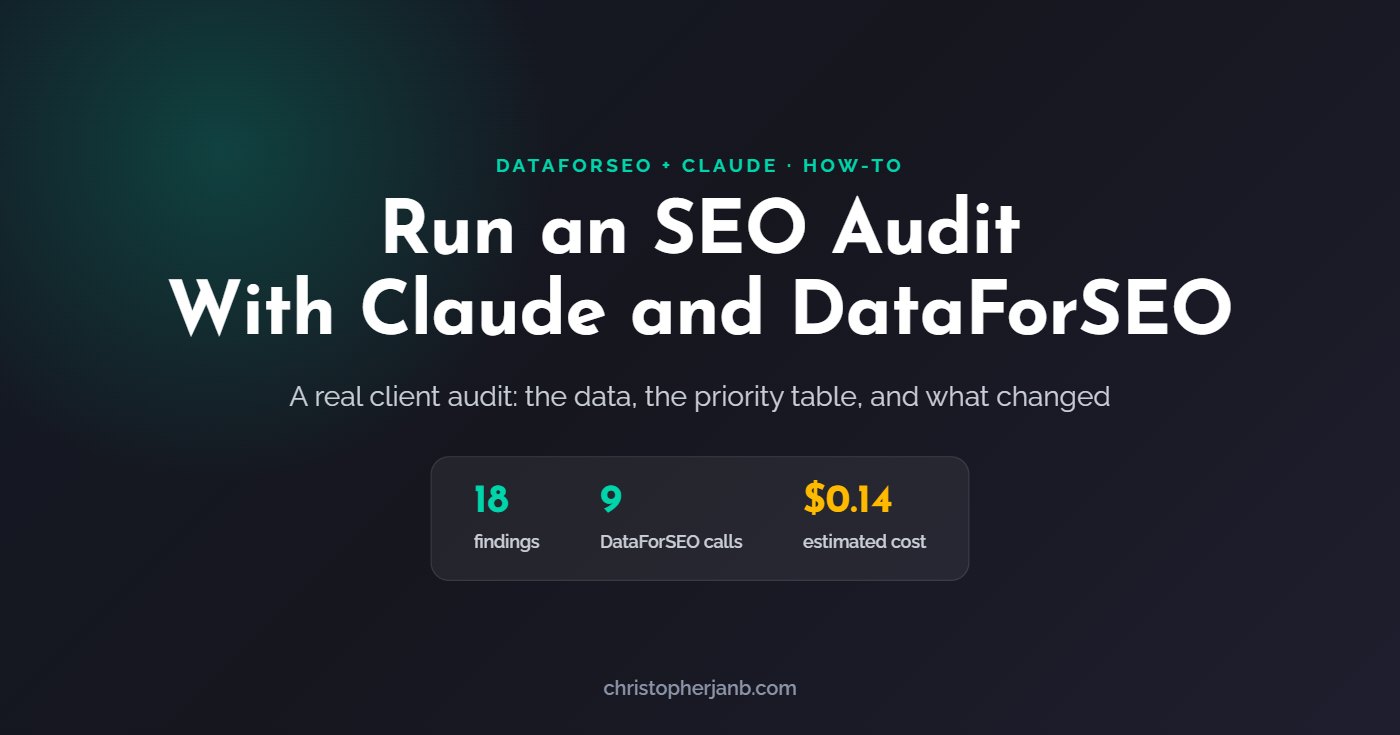
To run an SEO audit with Claude, give it your Search Console data and live market data from DataForSEO. Then have it sort every finding into one of four buckets and rank them by impact against effort. I ran this on a client account on 13 November 2026. It produced 18 findings and a top-10 priority list, using 9 DataForSEO calls that cost about $0.14 at list rates. The market data also changed the advice for the client’s most important keyword.
Disclosure: links marked “affiliate link” in this post go to DataForSEO and SE Ranking. If you sign up through them, I may earn a commission on every successful sale, at no extra cost to you. The client is the same anonymized ecommerce brand from my client month walkthrough, so names, products and markets are left out.
What does an SEO audit with Claude include?
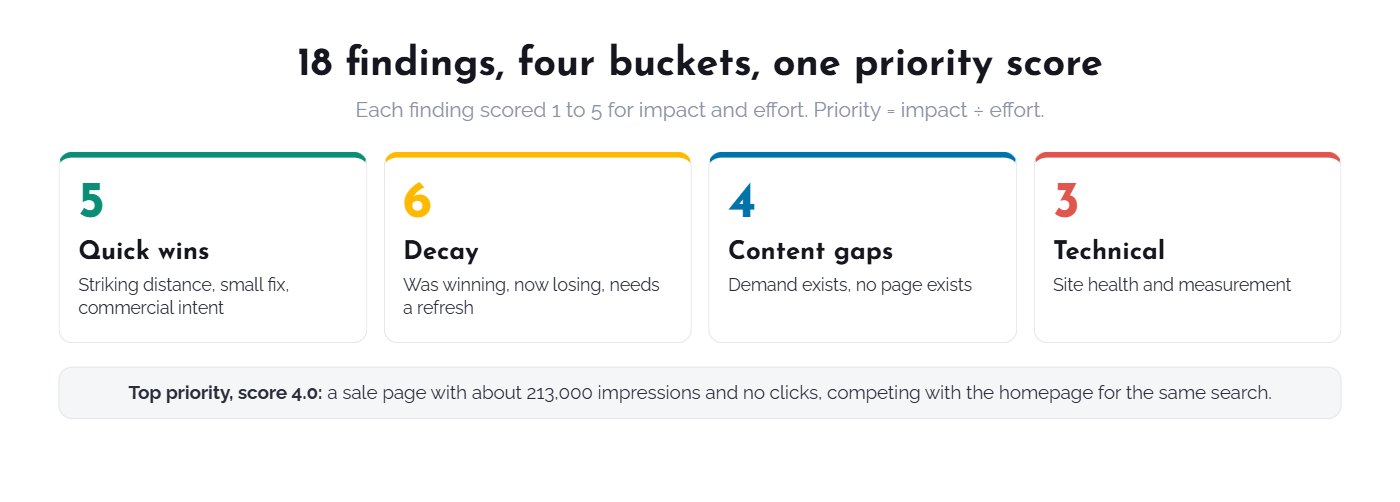
An SEO audit with Claude covers search trends, decaying pages, cannibalization, technical issues and AI search visibility. Every finding then goes into exactly one of four buckets and gets an impact and effort score.
| Bucket | What belongs there | Findings in this audit |
|---|---|---|
| Quick win | Striking distance, a small fix and commercial intent | 5 |
| Decay | A page that was winning and is now losing | 6 |
| Content gap | Demand exists, but no page covers it | 4 |
| Technical | Site health and measurement problems | 3 |
Each finding is scored 1 to 5 for impact and 1 to 5 for effort, and priority is impact divided by effort. The scoring is a judgement call, so the audit shows the evidence for each score. That lets you, or the client, disagree with it in a specific way.
Which DataForSEO endpoints feed the audit?
Four DataForSEO endpoints fed this audit: keyword overview, live results, ranked keywords and backlinks summary. Search Console supplied the site’s own clicks and positions, and GA4 supplied sessions.
| Endpoint | Question it answered | Calls | Estimated cost |
|---|---|---|---|
| Keyword overview | How much demand sits behind the striking-distance queries? | 1 (20 keywords sent, 18 returned) | $0.014 |
| SERP API, live | What does page one look like for the top 5 opportunities? | 5 | $0.010 |
| Ranked keywords | What do the client and its main competitor rank for? | 2 (300 rows each) | $0.096 |
| Backlinks summary | What is the link profile, and is any of it broken? | 1 | $0.024 |
| Total | 9 | About $0.14 |
Costs use DataForSEO (affiliate link) list rates from 27 October 2026, and your usage statistics show the actual charge. The audit had no crawl this month, because no crawl project was set up for this client. With one, you would add a crawler export or an audit tool such as SE Ranking (affiliate link) for broken pages and duplicate titles. My Screaming Frog MCP guide shows the crawler route.
What did the audit find?
The audit found 18 issues, and the top one scored 4.0: a sale page with about 213,000 impressions and no clicks, competing with the homepage for the same search. Here is the top 10, anonymized.
| # | Finding | Bucket | Impact | Effort | Priority |
|---|---|---|---|---|---|
| 1 | Sale page: about 213,000 impressions, 0 clicks, and the homepage ranks for the same search | Quick win | 4 | 1 | 4.00 |
| 2 | Click-through falling on the main category term in the home market, from 2.76% to 2.00% | Quick win | 3 | 1 | 3.00 |
| 3 | GA4 shows more key events from ChatGPT visitors (342) than sessions (320) | Technical | 2 | 1 | 2.00 |
| 4 | An accessory category at positions 6 to 20 on terms with 5,400 monthly searches | Quick win | 3 | 2 | 1.50 |
| 5 | The search result shows no price, while competitors show price ranges | Quick win | 3 | 2 | 1.50 |
| 6 | A product page down two windows in a row (120, 107, then 81 clicks) | Decay | 3 | 2 | 1.50 |
| 7 | 221 backlinks flagged as broken, pointing to 139 pages | Technical | 3 | 2 | 1.50 |
| 8 | A guide falling for four windows (424, 331, 251, then 172 clicks) | Decay | 3 | 2 | 1.50 |
| 9 | A guide at 0.22% click-through, with AI Overviews on its queries | Decay | 3 | 2 | 1.50 |
| 10 | A second product category stuck at an average position of 15.8 | Quick win | 4 | 3 | 1.33 |
Each window is 28 days, and the audit compared 14 October to 10 November 2026 with the period before. The third finding is a measurement problem, not a ranking one. A report built on those conversion numbers would overstate what AI assistants send, so it is cheap to fix first.
How did DataForSEO change the audit?
DataForSEO changed the advice for the client’s main category term and added findings Search Console cannot show. Six of the 18 findings came only from the market data.
- It changed the main recommendation. Search Console showed the homepage slipping from position 6.0 to 10.9 on the main category term, with clicks down from 65 to 9. That reads as “win it back”. The live results showed all 10 organic places held by large retailers and marketplaces, with neither the client nor its main competitor ranking. The finding became a product listings and category page task, and its effort score rose to 4.
- It sized the sale opportunity. The sale-related searches peaked last November at 480 and 1,900 searches a month, against yearly averages of 50 and 210. That turned the top finding into a deadline.
- It added findings Search Console cannot see. The ranked keywords comparison added three content gaps where the main competitor ranks and the client has no page. The backlinks summary added 221 links flagged as broken. A closer check afterwards found that almost all came from one scraper site, leaving one page worth redirecting. My backlink analysis post shows that check. The live results added the missing price in the search result.
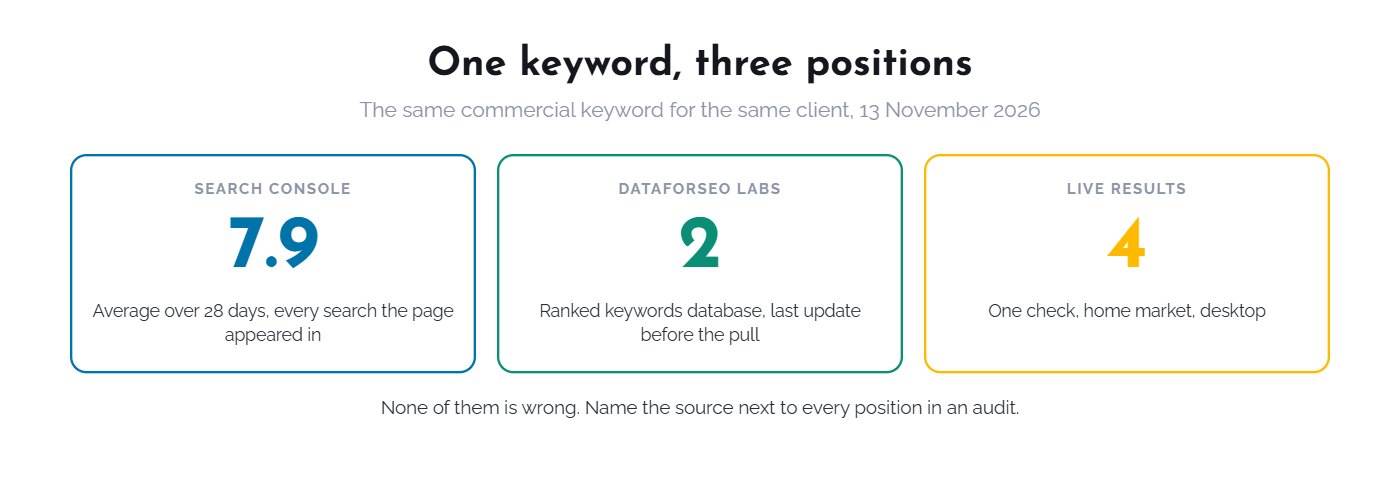
The sources also disagreed. For one commercial keyword, Search Console reported an average position of 7.9, the DataForSEO Labs database showed 2, and a live check showed 4. Each measures something different, so the audit names the source next to every position. My rank tracking post shows how much a single live check can move.
What can’t an automated SEO audit tell you?
An automated audit cannot tell you why an anomaly happened, which pages are off limits, or whether a fix suits the business. This run left five open questions that needed a person.
- Unexplained impressions. Most of the sale page’s impressions came from outside the client’s market, and the data does not say why.
- Pages under a test. This client has 54 posts frozen for a refresh experiment. The audit could not tell which ones, so it marked every blog finding “possibly frozen”.
- AI Overview citations. Two of the three AI Overviews in the live results returned no references, so citation status stayed unverified.
- Timing. Google’s November 2026 core update began on 10 November, the last day of the window, according to Search Engine Roundtable. It could not explain these declines, but it will shape the next read.
- Business fit. The audit could not check whether the client sells the products behind the three content gaps.
How do you run an SEO audit with Claude yourself?
Connect your data, give Claude a fixed procedure, and review the top-10 table before anything gets planned. The procedure matters more than the prompt, because it makes every month comparable.
- Connect the data. Add Search Console through an MCP server or an export, then follow my DataForSEO MCP setup guide.
- Set the windows. Compare equal periods. Search Console data arrives a few days late, so end the window where the data is complete.
- Name the market. Tell Claude which country to check live results in. This client’s numbers changed a lot between all countries and its home market.
- Classify and score. Try: “Put every finding in one bucket: quick win, decay, content gap or technical. Score impact and effort from 1 to 5, cite the evidence and source for each, and show a top-10 table.”
- Stop at the table. Read the top 10 and fix the scores you disagree with before turning it into a monthly plan.
My free pack includes this procedure as seo-audit, the first of four stages that run a client month, with an optional DataForSEO step built in. Get the free Claude SEO skill pack. For what happens after the audit, see the Claude SEO guide and my post on automating SEO reporting. More guides are in the DataForSEO + Claude hub.