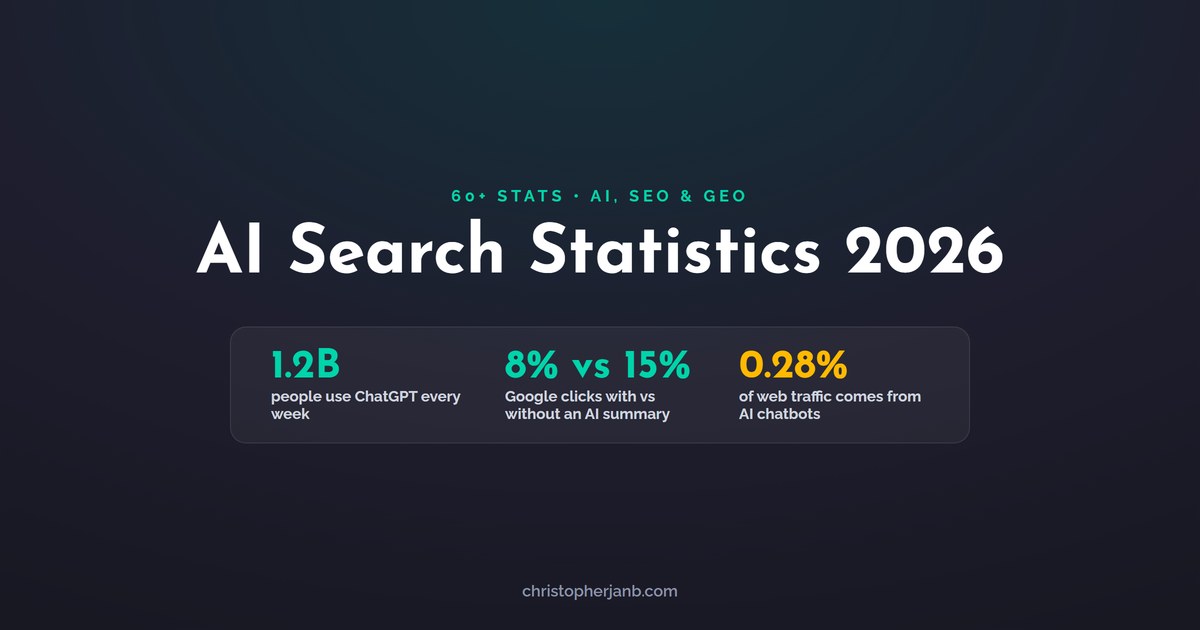
AI search is now a mass channel, but it still sends little traffic. ChatGPT has more than 1.2 billion weekly users, and Google’s AI Overviews reach 2.5 billion people a month. Yet AI chatbots sent just 0.28% of web traffic across 74,752 sites in March 2026, and Google searches that show an AI summary get about half the clicks.
This page collects the AI, SEO and GEO (generative engine optimization) statistics I trust. Some come from six studies I ran in 2026. The rest come from primary sources such as Pew Research Center, Google, OpenAI, Ahrefs, Semrush and Adobe. Every number links to where it was published, with its date and sample.
Last updated October 26, 2026. Each third-party statistic was checked against its primary source on that date. Alphabet reports Q3 results on October 28, 2026, and I’ll refresh the Google figures after that.
What are the most important AI search statistics for 2026?
These 12 numbers summarize where AI search stands. The sections below give the detail and the sources.
- 1.2 billion+ people use ChatGPT every week. (OpenAI, October 2026)
- 2.5 billion+ people use Google’s AI Overviews every month. (Google, June 2026)
- Google users clicked a result on 8% of visits when an AI summary appeared, versus 15% without one. (Pew Research Center, July 2025)
- 68.01% of US Google searches ended without a click in January to April 2026. (SparkToro, June 2026)
- AI chatbots sent 0.28% of total web traffic across 74,752 sites in March 2026. (Ahrefs, May 2026)
- AI-referred Shopify sessions that start on a product page convert at nearly 50% higher rates than organic search. (Shopify, May 2026)
- 38% of pages cited in AI Overviews also rank in Google’s top 10, down from about 76% in July 2025. (Ahrefs, March 2026)
- 79% of the sources AI engines cited when recommending products were third-party sites. (My study, 1,648 citations, July 2026)
- In 2 of 3 categories, the brand ranking #1 on Google lost its lead in AI recommendations. (My study, August 2026)
- 51% of B2B software buyers now start research with an AI chatbot more often than with Google, up from 29% a year earlier. (G2, April 2026)
- 53% of US consumers distrust or lack confidence in AI search and summaries. (Gartner, September 2025)
- About half of new English-language web articles are primarily AI-generated (49.9% in Q1 2026). (Graphite, May 2026)
How many people use AI search?
More than a billion people use each of the major AI search products. ChatGPT reports 1.2 billion weekly users, while Google’s AI Overviews, AI Mode and the Gemini app each report more than a billion monthly users.
| Product | Users | Source and date |
|---|---|---|
| Google AI Overviews | 2.5 billion+ a month | Google, June 2026 |
| ChatGPT | 1.2 billion+ a week | OpenAI, October 21, 2026 |
| Google AI Mode | 1 billion+ a month | Alphabet Q2 2026 earnings, July 2026 |
| Gemini app | 1 billion+ a month | Google, August 2026 |
These are company-reported numbers, and weekly and monthly users can’t be compared directly. Survey data shows how far use has spread:
- 44% of US adults use ChatGPT, up from 34% a year earlier. Pew surveyed 5,119 adults in February 2026, and the 2026 question also listed other chatbots, so the trend isn’t strictly like-for-like. (Pew Research Center, June 2026)
- 42% of US adults use AI chatbots to search for information. (Same Pew survey)
- 60% of US adults say they ever read the AI summaries at the top of search results. (Pew Research Center, June 2026)
- Half of US consumers already use AI-powered search, and 44% of those users call it their primary and preferred source, ahead of traditional search at 31%. (McKinsey, 1,927 US consumers surveyed August 2025)
- “Seeking information” grew from 14% to 24% of ChatGPT consumer messages between July 2024 and July 2025. (OpenAI, Harvard and Duke working paper, September 2025)
- Weekly use of AI chatbots for news rose from 7% to 10% across 48 markets. (Reuters Institute Digital News Report 2026, about 97,500 respondents)
Google search hasn’t shrunk. Google says it handles more than 5 trillion searches a year (Google, May 2025), and it held 89.94% of worldwide search engine referrals in September 2026, with Bing at 5.29% (Statcounter, which measures referrals, not searches).
How do AI Overviews affect clicks from Google?
Clicks drop when an AI Overview appears. Studies using different methods put the loss for the top result at roughly half, and users rarely click the links inside the summary itself.
- Users clicked a traditional result on 8% of visits with an AI summary, versus 15% without one. They clicked a link inside the summary on just 1% of visits. (Pew Research Center, browsing data from 900 US adults, 68,879 searches, March 2025)
- The top-ranking page’s average desktop CTR is 58% lower when an AI Overview appears. This is a correlation across 300,000 keywords, comparing December 2025 with December 2023. (Ahrefs, February 2026)
- Position-1 organic CTR falls from 20.02% to 9.69% on US desktop when an AI Overview is present. (Advanced Web Ranking, July 2026 data)
- Organic CTR for informational queries with AI Overviews fell 61% between June 2024 and September 2025. (Seer Interactive, 3,119 terms across 42 organizations)
- Brands get 35% more organic clicks when they’re cited in an AI Overview than when they’re not cited on the same kind of query. (Same Seer study)
- DMG Media told the UK competition regulator its UK desktop CTR fell 89%, from 25.23% to 2.79%, on searches with an AI Overview. This is one publisher’s own keywords. (DMG Media submission to the CMA, August 2025)
How often AI Overviews appear depends on the query:
- 18% of Google searches produced an AI summary, rising to 53% for searches of 10 words or more. (Pew Research Center, March 2025)
- AI Overviews appeared for 6.49% of queries in January 2025, peaked at 24.61% in July and settled at 15.69% in November. (Semrush, 10M+ keywords)
- AI Overviews are spreading beyond informational queries. Informational queries made up 91.3% of AI Overview triggers in January 2025 and 57.1% in October. (Same Semrush study)
Zero-click searches are rising:
- 68.01% of US Google searches ended without a click in January to April 2026, up from 60.45% in 2024. The two years use different data panels. (SparkToro, Similarweb data, June 2026)
- Only 0.34% of Google searches moved into AI Mode in January to April 2026. (Same SparkToro study)
- 92% to 94% of AI Mode searches were zero-click. (Semrush, US desktop clickstream, May to July 2025)
Google disagrees with the overall picture. It says total organic click volume from Search has been “relatively stable” year over year, but it hasn’t published numbers to support that. (Google, August 2025)
How much traffic does AI send to websites?
Not much yet. AI platforms send well under 2% of website traffic in every dataset I found, though that traffic more than doubled in a year.
- AI chatbots sent 0.28% of total web traffic across 74,752 sites in March 2026. ChatGPT sent 2.7 million of the 3.5 million chatbot visits. (Ahrefs, May 2026)
- AI referrals were 1.08% of all website traffic across 13,770 brand domains in 10 industries, and 87.4% of those referrals came from ChatGPT. (Conductor, US data, May to September 2025)
- AI chatbots made up 0.4% of search, social and AI-chatbot referrals in September 2026. Search made up 91% and social 8.61%. (Statcounter)
- AI platforms drove 770.7 million referral visits a month worldwide between June 2025 and May 2026, up 117.4% year over year. (Similarweb, September 2026)
- AI traffic to US retail sites rose 693.4% in the 2025 holiday season. (Adobe, January 2026)
- AI-referred orders on Shopify grew nearly 13x year over year in Q1 2026. (Shopify, May 2026)
AI crawlers also take far more than they send back. In 2025, Anthropic’s crawlers requested roughly 25,000 to 100,000 pages for every visit they referred from June onward, OpenAI peaked at 3,700:1 in March, and Perplexity stayed below 200:1 from September. Google rose from just over 3:1 to as high as 30:1 by April. (Cloudflare Radar 2025 Year in Review)
Does AI traffic convert better than organic search?
In most recent datasets, yes, though the size of the gap depends on what it’s compared with.
- AI-referred sessions that start on a product page convert at nearly 50% higher rates than organic search, and AI orders carry 14% higher average order values. (Shopify, Q1 2026)
- During Prime Day 2026, AI-referred shoppers converted 40% better than non-AI channels, a reversal from 23% worse during the 2025 event. (Adobe, June 2026)
- On ahrefs.com, AI search visitors were 0.5% of traffic but converted 23x better than organic visitors, producing 12.1% of signups. This is one SaaS site. (Ahrefs, June 2025)
- Semrush says the average AI search visitor is worth 4.4x a traditional organic visitor, based on conversion rate. It doesn’t disclose the sample. (Semrush, July 2025)
Where do AI engines get their answers?
From third-party sites more than from brands, though the share depends on how a study defines “brand” and on what’s being asked. Product questions lean heavily on reviews and roundups.
My own data on product recommendations:
- 79% of the sources AI engines cited when recommending products were third-party sites, and 21% were the brands’ own websites. (My study, 1,648 citations from AI Overviews, Perplexity and Gemini, July 2026)
- The third-party share rises with how consumer the category is: 49% for project management software, 90% for mattresses and 93% for VPNs. (Same study)
- Editorial “best of” articles were the largest source type at 31%, ahead of review sites (21%), YouTube (12%) and Reddit and forums (6%). (Same study)
Each engine leans on different source types. This is my per-engine cut of the same 1,648 citations (study, August 2026):
| Source type | Google AI Overviews | Perplexity | Gemini |
|---|---|---|---|
| YouTube and video | 29% | 6% | 3% |
| Review and comparison sites | 27% | 47% | 32% |
| Editorial “best of” articles | 11% | 18% | 17% |
| Reddit and forums | 7% | 1% | 3% |
The remaining citations fall into other types. ChatGPT isn’t in the table because its API rarely returned linked sources for product questions.
Larger third-party datasets:
- YouTube is the most-cited domain in Google AI Overviews, with 22.9% of citations to the top 50 domains. Reddit leads AI Mode with 17.9%. (Ahrefs, AI Overviews and AI Mode, US, September 2026)
- Muck Rack attributes 84% of AI citations to earned media. (Muck Rack, 25M+ links from ChatGPT, Claude and Gemini, May 2026)
- Profound finds about 57% of AI citations go to brand sites, with ChatGPT the lowest of the major engines at 47%. (Profound, 11.84 billion citations across 8 models, April to July 2026)
- ChatGPT cited Reddit in close to 60% of responses in early August 2025, then about 10% by mid-September. Citation sources can shift within weeks. (Semrush, 230K+ prompts, November 2025)
Questions about people and services work differently. In my study of “best SEO expert in the Philippines” questions, 51% of ChatGPT’s citations and 55% of Google AI Overview citations pointed to the expert’s or agency’s own website. Perplexity and Claude took 43% of their citations from third-party roundups. (My study, 767 citations, October 2026)
Does ranking #1 on Google get you cited or recommended by AI?
Ranking helps, but it doesn’t decide the outcome. Most AI Overview citations come from pages outside Google’s top 10, and in my brand studies the Google leader often lost the AI recommendation.
Citation overlap with Google’s top 10:
- 38% of pages cited in AI Overviews also rank in the top 10, down from about 76% in July 2025. Part of the drop comes from Ahrefs’ improved parsing. (Ahrefs, 863K SERPs, March 2026)
- 57% of AI Overview citations go to pages outside the top 10, and even a position-1 page is cited only around 25% of the time. (Conductor, about 168 million citations, June to August 2026)
- Only 12% of links cited by ChatGPT, Gemini and Copilot appear in Google’s top 10 for the same prompt. (Ahrefs, 15,000 queries, August 2025)
Brand recommendations, from my two studies (every prompt run five times per engine on ChatGPT, AI Overviews, Perplexity and Gemini):
| Brand (category) | Google rank | AI rank | AI share of voice |
|---|---|---|---|
| Casper (mattresses) | #1 of 5 | #5 of 5 | 4% |
| NordVPN (VPNs) | #1 of 5 | #4 of 5 | 20% |
| Asana (project management) | #1 of 5 | #1 of 5 | 21% |
| monday.com (project management) | #2 of 5 | #5 of 5 | 17% |
| MailerLite (email marketing) | #2 of 4 | #4 of 4 | 21% |
- Nectar had the least Google traffic of five mattress brands and won the AI recommendation with 28% share of voice. (My study, August 2026)
- NordVPN had 3.5 times the organic traffic of the next VPN brand, yet all five VPNs landed between 19% and 21% AI share of voice. (Same study)
- EmailOctopus had the smallest search footprint of four email platforms and finished third in AI, ahead of MailerLite, which had about seven times its search presence. (My study, July 2026)
What drives AI visibility?
Mentions across the web predict AI visibility better than backlinks do. Fresh content and clear, citable facts help, while schema markup on its own hasn’t shown a measurable lift.
- YouTube mentions had the strongest correlation with brand visibility in AI (about 0.737), and branded web mentions correlated at 0.66 to 0.71. Link metrics correlated very weakly. (Ahrefs, 75,000 brands across ChatGPT, AI Mode and AI Overviews, December 2025)
- GEO methods such as citing sources, adding quotations and adding statistics raised visibility in generative engine answers by up to 40% in a 10,000-query benchmark. (Aggarwal et al., KDD 2024)
- Pages cited by AI assistants are 25.7% fresher on average than pages in organic results. (Ahrefs, about 17 million citations, July 2025)
- Adding schema markup produced no major uplift in AI citations on any platform tested. (Ahrefs, 1,885 pages against controls, May 2026)
- For people, a page that states the role and the country gets cited. The specialists Google’s AI Overviews named most often had “SEO Specialist” and “Philippines” in the title tag of the cited page, and link authority didn’t predict who was named. (My study, October 2026)
- Publishing a price gets you quoted. All five managed IT providers that ChatGPT or AI Overviews cited on pricing questions publish specific prices, while only 19% of the 70 providers I checked do. (My study, October 2026)
How are buyers using AI to research purchases?
Most business buyers now use AI somewhere in their research, and many start there. Trust hasn’t caught up with use.
- 51% of B2B software buyers start research with an AI chatbot more often than with Google, up from 29% a year earlier. (G2, 1,076 buyers, March 2026)
- 94% of business buyers use AI during their buying process. (Forrester, about 18,000 global buyers, January 2026)
- 53% of US consumers distrust or lack confidence in AI search and summaries. (Gartner, 377 consumers, September 2025)
How are marketers and SEOs responding to AI search?
Budgets are moving toward AI visibility, and most SEOs expect fewer clicks. Several of these surveys come from vendors that sell AI visibility tools, which is worth keeping in mind.
- AI chatbots top the list of channels marketers plan to increase investment in (37.7%), narrowly ahead of paid social (37.4%) and website, blog and SEO (35.4%). (HubSpot 2026 State of Marketing, 1,500+ marketers)
- Enterprises put an average of 12% of their digital budgets into AEO in 2025, and 94% plan to increase that in 2026. (Conductor, 250+ enterprise digital leaders)
- 77% of SEO professionals worry that AI answers will reduce website clicks. (Search Engine Journal State of SEO 2026, 371 SEOs, September 2025)
- Prediction: traditional search engine volume will drop 25% by 2026. (Gartner, February 2024) No primary source I found measures 2026 search volume against this prediction, and Google reports query growth.
- Prediction: brands’ organic search traffic will fall 50% or more by 2028. (Gartner, December 2023)
In one industry, research searches are already falling. All eight managed IT research and pricing searches I tracked fell in US Google volume, by 13% to 68%, comparing the 12 months to August 2026 with the 12 months before. (My study, DataForSEO data)
How much online content is AI-generated?
About half of new web articles, but far less of what ranks or gets cited.
- 49.9% of new English-language web articles were primarily AI-generated in Q1 2026, after peaking at 50.9% in Q4 2025. (Graphite, 55,400 Common Crawl articles, three AI detectors, May 2026)
- 86% of articles ranking in Google Search are written by humans, and 82% of articles cited by ChatGPT and Perplexity are. (Graphite, 31,493 keywords, October 2025)
Why do AI search statistics disagree?
Because studies measure different things. Before quoting a number, check its denominator, its panel and who funded it. These are the disagreements that matter most:
- Earned media versus brand sites. Muck Rack says 84% of AI citations are earned media, Profound says about 57% go to brand sites, and my product study found 79% third-party. They classify sources differently and ask different questions. For people and services, own sites dominate; for products, third parties do.
- How many AI Overview citations rank in the top 10. Ahrefs says 38% and Conductor’s data implies about 43%. Some studies count per citation and others per keyword, so check which one you’re quoting.
- How much AI traffic sites get. Ahrefs measured 0.28%, Statcounter 0.4% of search, social and AI referrals, and Conductor 1.08% for large brand domains. Enterprise samples run higher.
- How many clicks AI Overviews cost. Figures range from about 50% (Pew, Ahrefs, Advanced Web Ranking) to 89% for one publisher’s own keywords (DMG Media). Google says click volume is stable but hasn’t published data.
- AI Mode’s reach versus its use. Google reports more than a billion monthly AI Mode users, while SparkToro measured only 0.34% of US Google searches moving into AI Mode. Google counts AI Overviews and AI Mode as one experience, which likely explains part of the gap.
- Vendor research. Ahrefs, Semrush, Conductor, Profound, Muck Rack and Graphite sell tools or services in this market. Their data is still useful, but Pew, Gartner, Forrester, McKinsey and the Reuters Institute have less at stake.
How were these statistics collected?
Third-party statistics come only from primary sources: the publisher’s own study, announcement or filing. I didn’t use statistic roundups. On October 26, 2026, each number was checked against its source page for the exact figure, date, sample and what it measures, and figures I couldn’t confirm were left out. Predictions are labeled as predictions.
My own studies used buyer-style prompts across several AI engines and logged every brand or person named and every source cited:
| Study | Published | Engines | Sample |
|---|---|---|---|
| Does good SEO get you recommended by AI? | July 17, 2026 | ChatGPT, AI Overviews, Perplexity, Gemini | 4 email platforms, 12 prompts, 5 runs per engine |
| Where does AI get its recommendations? | July 24, 2026 | AI Overviews, Perplexity, Gemini | 3 categories, 21 prompts, 1,648 cited sources |
| Does AI recommend the brand that ranks #1 on Google? | August 6, 2026 | ChatGPT, AI Overviews, Perplexity, Gemini | 3 categories, 15 brands, 7 prompts, 5 runs per engine |
| Which sources do AI engines cite? | August 13, 2026 | AI Overviews, Perplexity, Gemini | The 1,648 citations, split by engine |
| What does co-managed IT cost in 2026? | October 15, 2026 | ChatGPT, AI Overviews | 70 provider websites, 5 pricing prompts |
| Who AI recommends as the best SEO expert in the Philippines | October 26, 2026 | ChatGPT, Perplexity, Gemini, Claude, AI Overviews | 6 prompts, 105 answers, 767 cited links |
AI answers change between runs and over time, so every number here is a snapshot from its study date.
What do these statistics mean for SEO and GEO?
SEO still matters, because Google sends most search traffic and AI engines cite pages they can find. But ranking no longer guarantees a recommendation, so GEO (generative engine optimization) is now its own job.
Four things I take from the data:
- Measure AI visibility separately from rankings. Most AI Overview citations come from outside the top 10, and the Google leader lost the AI recommendation in two of my three categories.
- Earn mentions where AI looks. Web and YouTube mentions correlate with AI visibility far more than links, and product answers lean on reviews and roundups.
- Make your own site state the facts. For people and services, ChatGPT and AI Overviews read the provider’s own site first, so say who you are, where you are and what you charge.
- Judge AI traffic by quality, not volume. It’s under 2% of traffic in every dataset, but it converts better in most of them.
If you want these measurements run for your own brand, that’s what my AI Search Visibility service does. For the full method, see my AI search optimization guide.
How should I cite these statistics?
Cite the original source and its date, linked above, and link to this page if it helped you find it. For my own numbers, cite the study, for example: “79% of the sources AI engines cited when recommending products were third-party sites (Christopher Jan Benitez, 1,648 citations, July 2026).”
FAQ
How many people use AI search in 2026?
ChatGPT has more than 1.2 billion weekly users (OpenAI, October 2026), and Google’s AI Overviews reach more than 2.5 billion people a month (June 2026). In the US, 44% of adults use ChatGPT and 42% use AI chatbots to search for information (Pew, February 2026).
Do AI Overviews reduce clicks?
Yes. Pew found Google users clicked a result on 8% of visits when an AI summary appeared, versus 15% without one, and Ahrefs found the top result’s desktop CTR is 58% lower when an AI Overview shows.
How much website traffic comes from AI?
Under 2% in every dataset I found. Ahrefs measured 0.28% across 74,752 sites in March 2026, and Conductor measured 1.08% across 13,770 brand domains. AI referral visits more than doubled in a year, according to Similarweb.
What percentage of AI citations come from third-party sites?
It depends on the question and the definition. In my study of product recommendations, 79% of 1,648 citations were third-party. Muck Rack attributes 84% of AI citations to earned media, while Profound finds about 57% go to brand sites.
How often is this page updated?
When a major source publishes new data and when I publish a new study. The next updates are Alphabet’s Q3 2026 results and my 90-day re-run of the Philippines SEO expert study in January 2027.