I've now run two studies on this. The first showed that ranking well in Google doesn't get you recommended by AI, the two ladders barely lined up. The second showed why: 79% of the sources AI cites to build a recommendation are third parties, not your own website.
Both studies left one question sitting there unanswered. If the brand that ranks #1 isn't the one AI recommends, then who is?
So I picked three categories, took the single most SEO-dominant brand in each, and asked four AI engines who they'd actually recommend. The famous name lost all three times.
The Setup
I chose categories where a household name owns Google, then measured whether that dominance survives in AI:
- Project management software, focal brand monday.com (the one running Super Bowl-adjacent ad budgets).
- Mattresses, focal brand Casper (the brand that basically invented the bed-in-a-box category).
- VPNs, focal brand NordVPN (the most-advertised VPN on the planet).
Each category had the focal brand plus four real competitors. I pulled every brand's U.S. organic traffic from DataforSEO to build the SEO ladder, then ran 7 buyer-style prompts ("best project management software," "best mattress for back pain," "best VPN for streaming," and so on) across ChatGPT, Google AI Overviews, Perplexity, and Gemini, five times each, and measured share of voice: out of all the brand recommendations AI made, what percentage went to each brand.
Non-determinism is real, so nothing here rests on a single answer. Every prompt ran five times per engine and the results are the aggregate.
The Finding: The Famous Name Lost Every Time
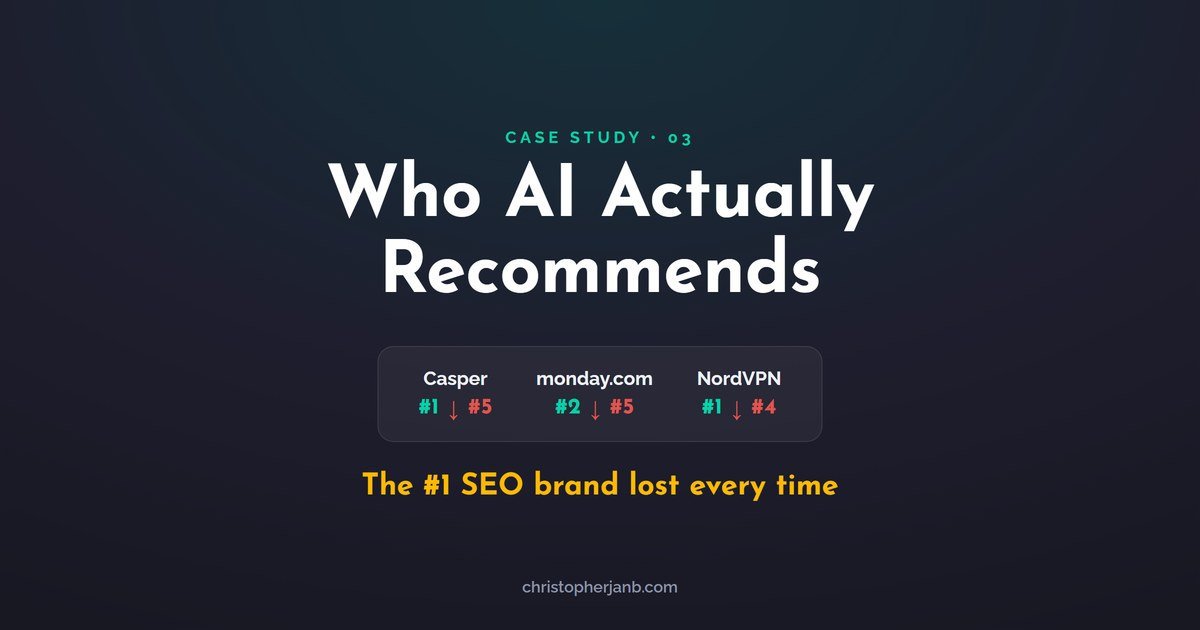
Here is the whole study in one picture. Left side is where each brand ranks in Google. Right side is where AI actually recommends it.
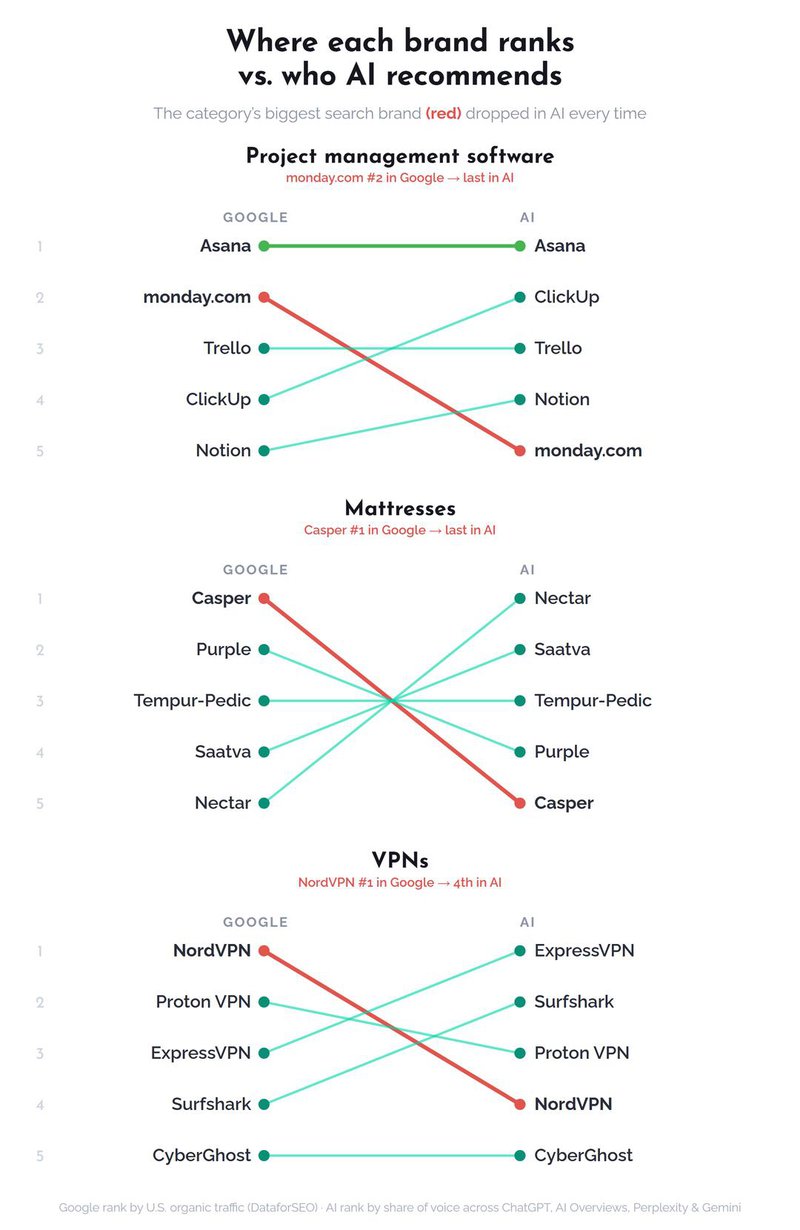
Every focal brand, the biggest SEO name in its category, fell:
- monday.com: #2 in Google, dead last in AI.
- Casper: #1 in Google, dead last in AI.
- NordVPN: #1 in Google by a mile, 4th of 5 in AI.
Meanwhile the brands with the smallest search footprints climbed. Two of them took the #1 AI spot outright. Let me show you each category, because the three tell slightly different versions of the same story, and the differences matter.
Mattresses: A Near-Total Inversion
This one is the cleanest. The SEO ladder and the AI ladder are almost perfect mirror images.
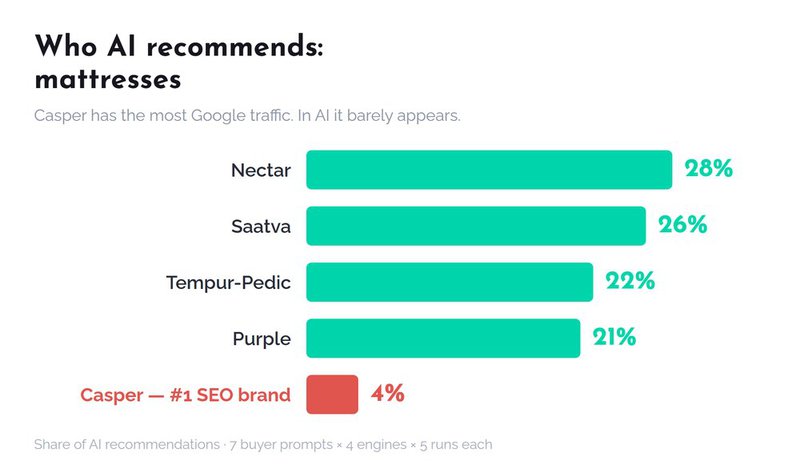
| Brand | Google traffic | SEO rank | AI share | AI rank |
|---|---|---|---|---|
| Nectar | $330K | 5, last | 28% | 1 |
| Saatva | $370K | 4 | 26% | 2 |
| Tempur-Pedic | $473K | 3 | 22% | 3 |
| Purple | $819K | 2 | 21% | 4 |
| Casper | $1.11M | 1 | 4% | 5, last |
Casper has the most organic traffic in the category by a wide margin. In AI, it showed up in exactly one of seven prompts, once, on a single engine. It is functionally invisible when someone asks ChatGPT or Perplexity for a mattress. Nectar, the weakest brand in the group on Google, wins the AI recommendation outright.
If you only watched your Google rankings, you'd think Casper was crushing it. In the place buyers are increasingly asking, it has almost no presence at all.
VPNs: The Great Flattening
VPNs behaved differently, and that's exactly why I'm glad this category was in the study.
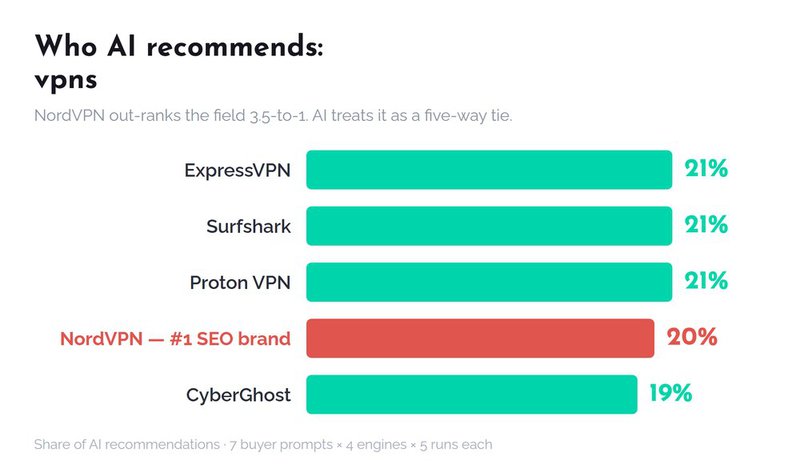
| Brand | Google traffic | SEO rank | AI share | AI rank |
|---|---|---|---|---|
| ExpressVPN | $324K | 3 | 21% | 1 |
| Surfshark | $221K | 4 | 21% | 2 |
| Proton VPN | $370K | 2 | 21% | 3 |
| NordVPN | $1.28M | 1 | 20% | 4 |
| CyberGhost | $37K | 5, last | 19% | 5 |
NordVPN outspends and out-ranks this entire field. It has 3.5 times the organic traffic of the next brand and roughly 80,000 ranking keywords. In AI, all of that collapses into a dead heat. Every VPN sits within two points of every other one, and NordVPN lands 4th.
Nobody got destroyed here the way Casper did. But look at what happened to the advantage. NordVPN spent years and a fortune building a search lead that AI simply ignores. It treats the category as a five-way tie and hands the top slots to smaller brands. A commanding SEO position bought NordVPN nothing in the AI answer.
Project Management: The Nuance
The PM category is the one that keeps me honest, because it contains the study's one real exception.
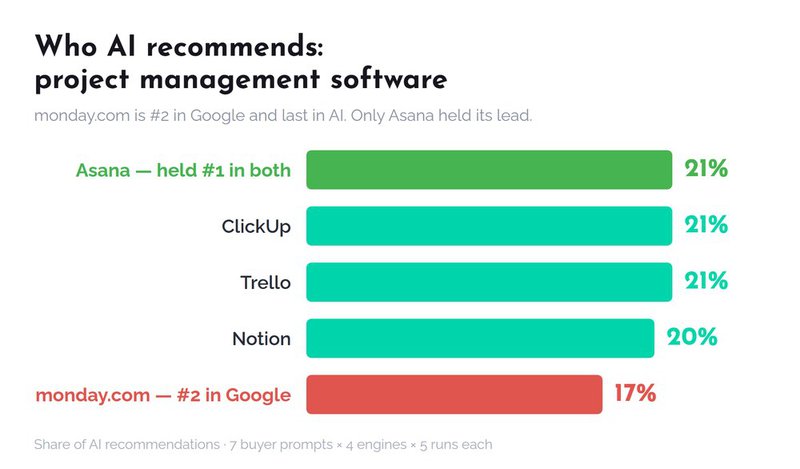
| Brand | Google traffic | SEO rank | AI share | AI rank |
|---|---|---|---|---|
| Asana | $777K | 1 | 21% | 1 |
| ClickUp | $157K | 4 | 21% | 2 |
| Trello | $206K | 3 | 21% | 3 |
| Notion | $144K | 5, last | 20% | 4 |
| monday.com | $328K | 2 | 17% | 5, last |
Two things are happening. First, my focal brand monday.com, #2 in Google, came in dead last in AI, right on script. ClickUp and Notion, both weaker in search, beat it.
Second, and this is the honest exception: Asana ranks #1 in Google and holds #1 in AI. So SEO dominance can carry into AI. But look at the condition. Asana isn't merely strong in search, it's the outright leader by a wide margin, and it has the deep third-party review presence to match. Being #2, like monday, offered no protection at all. The takeaway isn't "rankings never transfer." It's "only true category dominance transfers, and even then it's the third-party coverage riding alongside it doing the work, not the ranking itself."
Why This Keeps Happening
Put the three categories together and the mechanism from my second study explains all of it.
Google ranks your page. You can win it largely on your own property, with your content, your links, your technical health. That's why Casper, monday, and NordVPN dominate search: they've each poured resources into their own websites for years.
AI doesn't rank your page. It assembles a recommendation from what the rest of the web says about you, the "best of" listicles, the review labs, the Reddit threads, the YouTube round-ups. And on that battlefield, none of these famous brands is winning. Nectar and Saatva get the mattress-review love. ExpressVPN and Surfshark own the VPN affiliate ecosystem. ClickUp and Notion get talked about constantly. The famous brands optimized the one surface AI mostly ignores, their own site, and under-invested in the surfaces AI actually reads.
That's the whole thing. AI recommendations track third-party reputation, and third-party reputation is not the same asset as search rankings. You can lead one and lose the other, and most brands don't even know there are now two scoreboards.
What This Means For Your Brand
If you're the biggest name in your category, do not assume you're safe in AI. Casper was the biggest name and finished last. Go check.
If you're not the biggest name, this is the best news you'll read this quarter. The AI recommendation isn't locked up by whoever has the fattest SEO budget. Nectar and ClickUp prove a smaller brand can win it outright, by being the one reviewers and communities actually talk about.
Either way, the work is the same, and it's off your website:
- Find out where you actually stand across ChatGPT, AI Overviews, Perplexity, and Gemini. Your Google rank tells you nothing about this.
- Earn the third-party coverage that AI reads, the category review sites, the "best of" listicles, the relevant subreddits and YouTube channels.
- Track it as its own scoreboard, separate from rankings, because the two now move independently.
That's exactly what my AI Search Visibility service does: measure where you show up across every major engine, then earn the placements that move you up. If you're the category's biggest name and you're not sure whether AI recommends you, that's the first thing I'd check, and it's a quick thing to find out.
FAQ
Does ranking #1 on Google mean AI will recommend me?
No. Across three categories, the most SEO-dominant brand lost in AI every time, twice finishing dead last. The only brand that held its #1 spot in both was an outright category leader with deep third-party review coverage, and even there it's the coverage doing the work, not the ranking.
Why does AI recommend smaller brands over famous ones?
Because AI builds recommendations from third-party sources, review sites, editorial "best of" lists, forums, and video, rather than from a brand's own website. Smaller brands that earn strong review coverage can out-perform famous brands that rely on their search rankings. In this study, the lowest-traffic mattress brand won its category's AI recommendation outright.
How do I find out if AI recommends my brand?
Run your key buyer prompts across ChatGPT, Google AI Overviews, Perplexity, and Gemini, several times each to account for non-determinism, and measure your share of voice against competitors. That measurement is the first step of the AI Search Visibility service.
Is SEO still worth it if AI ignores my rankings?
Yes. SEO still drives search traffic and keeps you eligible to be cited. But it's now one of two separate jobs. Ranking wins Google. Earning third-party coverage wins the AI recommendation. Treating them as the same task is why so many strong-ranking brands are invisible in AI.
Related guides: GEO vs SEO, how to show up in ChatGPT, how to rank in Google AI Overviews, and LLM SEO.