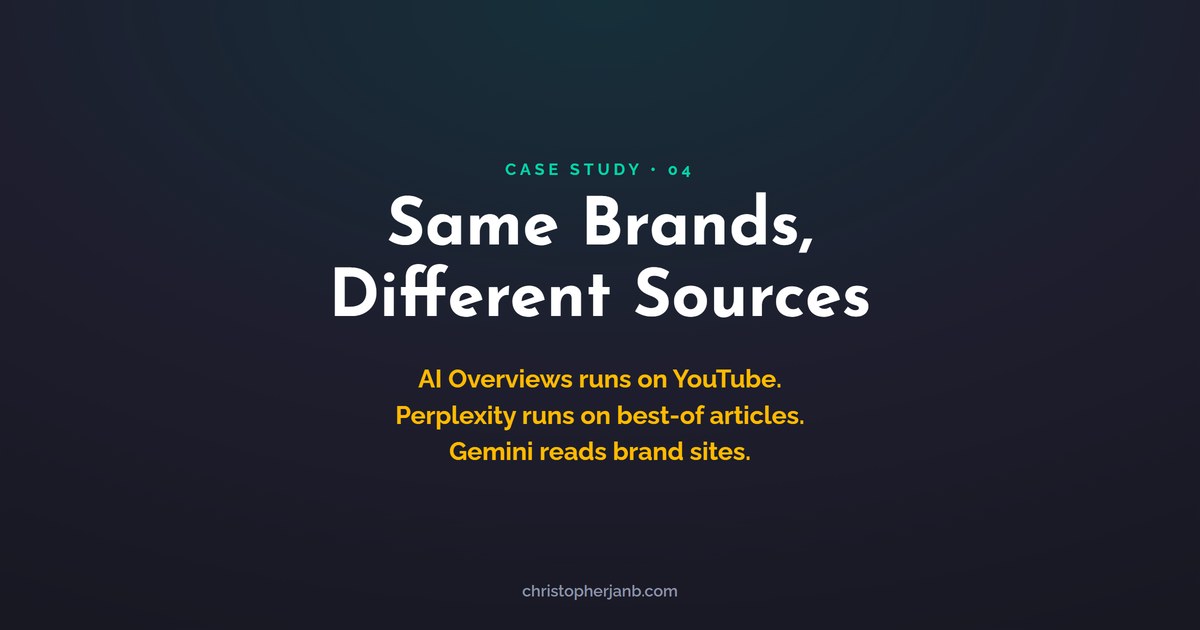
I pulled 1,648 sources that AI engines cited when they recommended products. Then I checked something that surprised me. The engines mostly agree on which brands to name. But they build those same recommendations from completely different kinds of sources. One engine reads YouTube. Another reads best-of articles. A third reads brand sites. Same answer, different receipts.
Correction (October 26, 2026): An earlier version of this study published per-engine numbers from a classifier that labeled only the 40 most-cited domains, which left 16% to 34% of each engine’s citations unclassified. I recounted all 1,648 citations with one complete domain map. The YouTube and Reddit numbers held. The review, editorial and brand-owned numbers changed, and so did the findings for Perplexity and Gemini. The table, charts and advice below are the corrected version.
The Setup
I looked at three buying categories: project management software, mattresses, and VPNs. I ran product recommendation prompts through three engines: Google AI Overviews, Perplexity, and Gemini. Then I did two separate counts.
I ran two separate counts:
- Share of voice. Which brands each engine recommended, and how often.
- Source mix. The source behind every recommendation. I sorted all 1,648 citations by type: YouTube and video, editorial “best-of” articles, review and comparison sites, brand-owned sites, Reddit, and everything else.
Two honest notes before the numbers:
- ChatGPT is left out of the source cut. When I call it through the API, it rarely returns linked source URLs, so I cannot count what I cannot see.
- Gemini’s citations were resolved first. They arrive as redirect URLs, not real domains, so I resolved each one to the real site before counting. The Gemini numbers reflect actual sites, not Google’s wrapper links.
This is the fourth study in the series. It builds on two things I found earlier. In where AI gets its recommendations, I found that 79% of AI’s cited sources are third-party, not brand-owned. In who AI recommends, I found the SEO leader often loses in AI. This study connects them. It shows the mechanics underneath.
The Engines Agree on Who to Recommend
Here is the part that made me stop and re-run the count.
The engines largely agree on the brands. When I lined up the recommendations, each major brand landed with a roughly even share of voice across engines. Call it about 20% each for the top names in a category. AI Overviews, Perplexity, and Gemini were not fighting over who to name. They were reading from the same short list of winners.
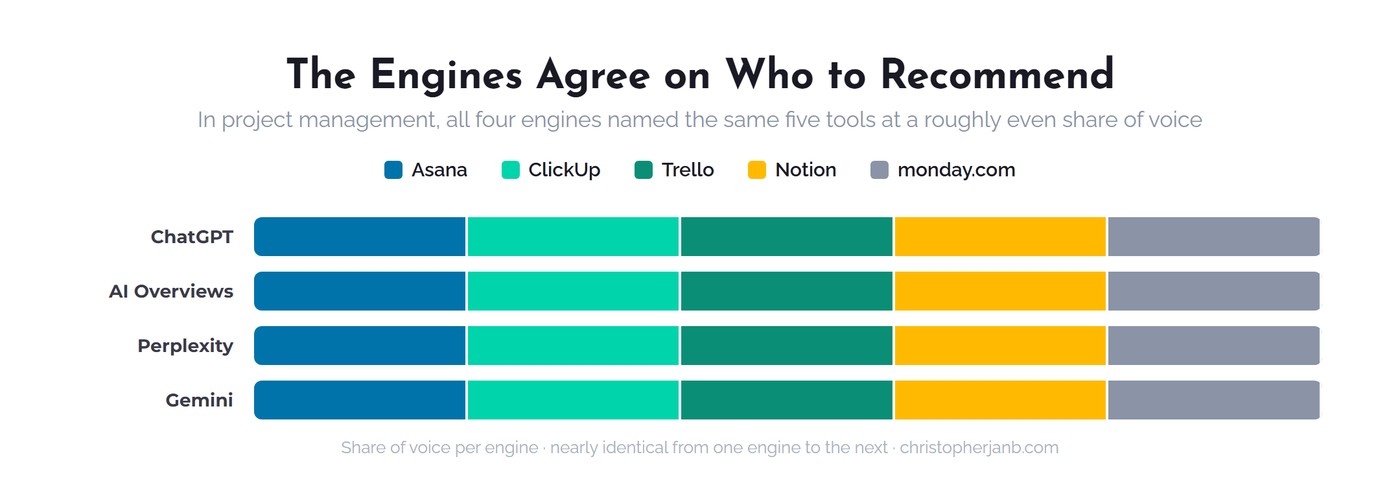
That tracks with what I found in who AI recommends. The brands that win tend to win everywhere. Reputation carries across engines. If the market already treats you as a top option, most engines will too.
So if you only measured share of voice, you would think GEO is one game. Get recommended, and you get recommended everywhere. Simple.
It is not simple. Because the agreement stops the moment you ask why.
But They Cite Completely Different Sources
Same brands. Different reasons. Here is the source mix for each engine.
| Source type | AI Overviews | Perplexity | Gemini |
|---|---|---|---|
| YouTube / video | 29% | 6% | 3% |
| Editorial “best-of” articles | 19% | 50% | 27% |
| Review & comparison sites | 16% | 23% | 22% |
| Brand-owned sites | 18% | 12% | 32% |
| 7% | 1% | 3% | |
| Everything else (other forums, retailers, other sites) | 12% | 8% | 13% |
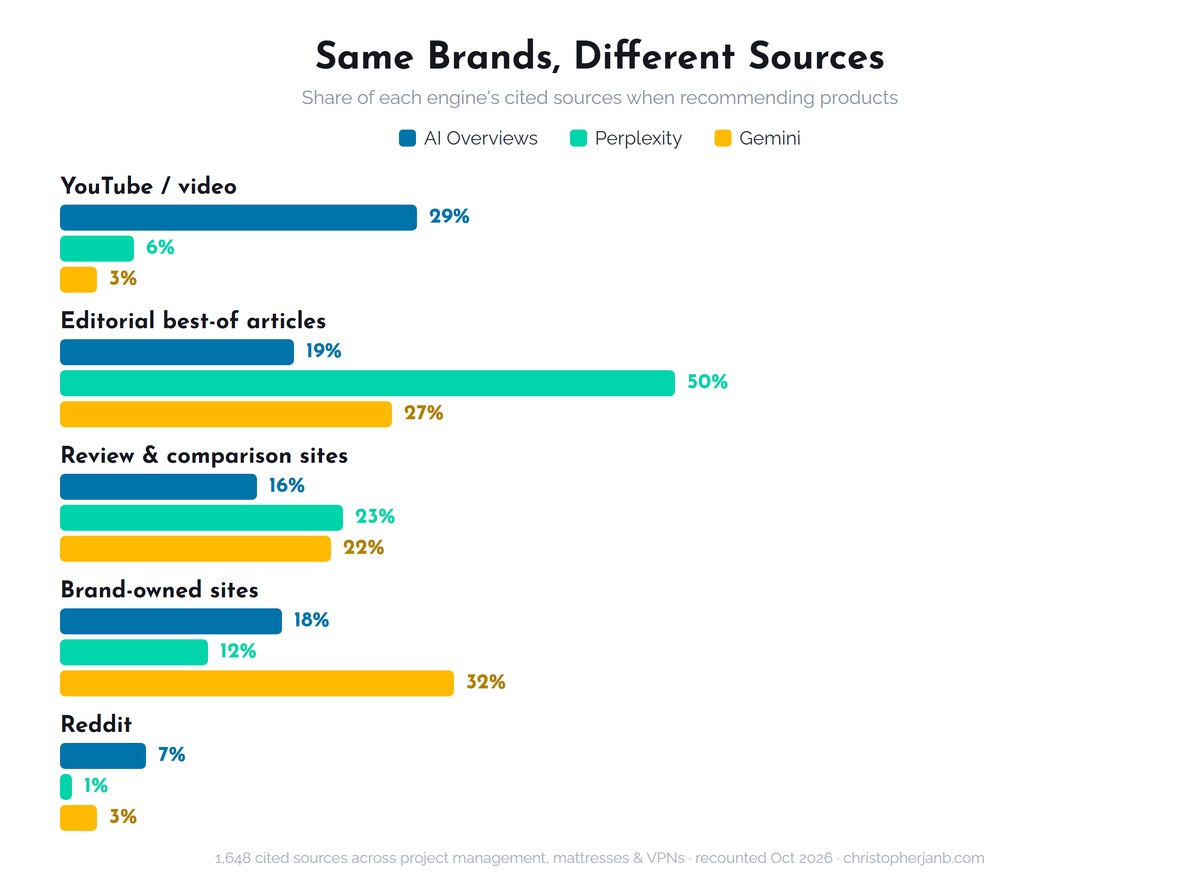
Read across any row and the gaps jump out. YouTube is 29% of AI Overviews sources and 6% of Perplexity sources. Editorial best-of articles are half of Perplexity’s sources and 19% of AI Overviews’. Brand-owned sites are 32% of Gemini’s sources, almost three times Perplexity’s 12%. Reddit matters a little to AI Overviews and almost nothing to Perplexity.
The same brand can get recommended by AI Overviews because of a video, by Perplexity because of a best-of roundup, and by Gemini because of its own product page. The recommendation looks identical to the buyer. The path to earning it is not.
That changes how you should think about GEO work. You are not optimizing for one machine. You are feeding different diets to different engines.
AI Overviews Runs on YouTube
Almost one in three AI Overviews sources is a video. 29%. No other engine comes close.
This lines up with something obvious once you see it. Google owns YouTube. Google surfaces video in a lot of places already. So when AI Overviews assembles a product answer, video is right there in the pantry.
The kind of video that pulls weight depends on the category:
| Category | Video that earns the citation |
|---|---|
| Project management software | A walkthrough showing the tool in use |
| Mattresses | An unboxing or a firmness test |
| VPNs | A speed test on camera |
If you have been treating YouTube as a nice-to-have, this flips it. For AI Overviews, video is a primary ingredient. A brand with strong video coverage and a brand with none can look very different to this one engine, even when everything else is equal.
AI Overviews also draws on editorial best-of articles (19%), brand sites (18%) and review sites (16%), and it pulls from Reddit at 7%, more than the other two engines. So the recipe is video first, then a spread of articles, brand pages and reviews, plus a little community talk. I wrote more about the mechanics in how to rank in Google AI Overviews.
Perplexity Runs on Best-Of Articles and Reviews
Perplexity is the mirror image. It barely touches video at 6%. Half of everything it cites (50%) is an editorial best-of article, and another 23% comes from review and comparison sites. Together, that’s nearly three of every four sources.
So Perplexity is reading editorial roundups, review sites and “X vs Y” pages. It wants third-party judgment from the pages that already do the comparing.
Brand-owned sites are 12% of its sources, and Reddit is almost nothing at 1%.
Gemini is different again.
That is the practical split for Perplexity: roundups and reviews, not video.
Gemini Reads Brand Sites
Gemini gives a brand’s own pages far more weight than the other two engines. Brand-owned sites are its biggest single source at 32%, almost three times Perplexity’s share. Editorial best-of articles (27%) and review sites (22%) follow, and video is only 3%.
So Gemini still reads third-party coverage, but your own product and comparison pages are part of its answer in a way they aren’t for Perplexity.
That is the practical split. AI Overviews wants video. Perplexity wants roundups and reviews. Gemini reads your own site alongside them. One brand, three different reasons to get named.
What This Means for Your GEO Strategy
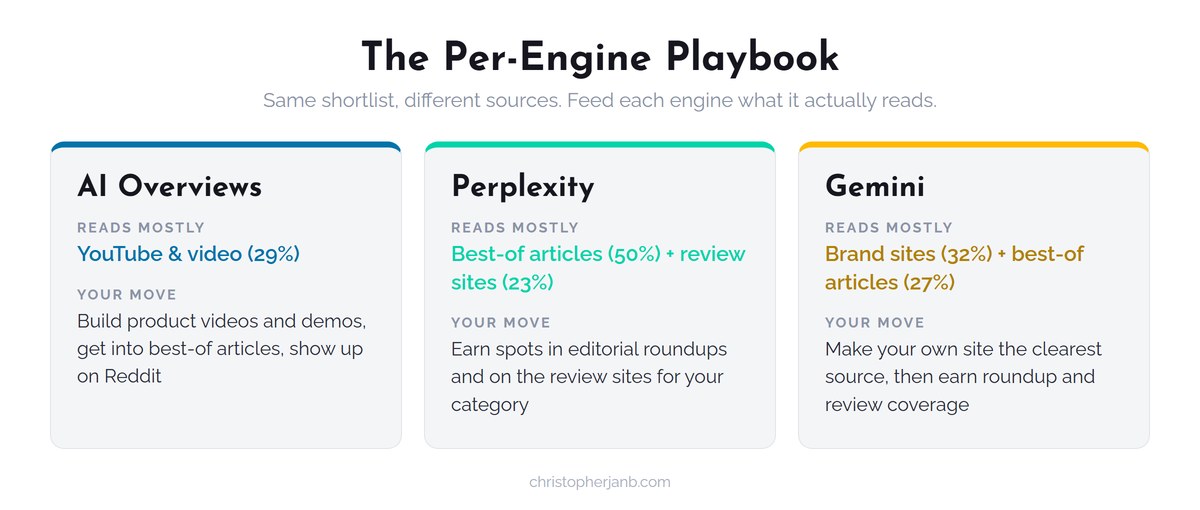
The headline for me is this. Share of voice tells you if you are winning. Source mix tells you how to win, and it is different per engine. You cannot run one playbook and expect all three engines to pick you up.
So split the work by engine. Here is how I do it.
If You Want to Win AI Overviews
Feed the engine what it eats. Video first.
- Build real YouTube coverage. Product walkthroughs, comparisons, honest demos. Not one polished ad, but a body of useful video.
- Get into best-of listicles. Editorial roundups are its second-biggest source at 19%.
- Show up on Reddit. It is a small slice at 7%, but AI Overviews uses it more than the other engines do. Real threads, real answers, not spam.
If your category has thin video coverage, that is your opening. Video is where AI Overviews is hungriest and where many brands are weakest.
If You Want to Win Perplexity
Feed it roundups and reviews.
- Get into the editorial best-of articles that rank in your space. They’re half of what Perplexity cites.
- Get listed and reviewed on the big third-party sites. For software, that means G2 and Capterra. For consumer products, the review outlets that own your category.
- Earn comparison coverage. “Best X” and “X vs Y” pages are what this engine pulls from most.
Video will barely move Perplexity. Spending your whole budget on YouTube and expecting Perplexity to notice is a mismatch. Match the spend to the diet.
If You Want to Win Gemini
Start with your own site, then earn the same coverage Perplexity wants.
- Make your product and comparison pages the clearest answer on the web: specs, pricing, who it’s for, and how it compares. Gemini cites brand sites for 32% of its sources.
- Earn roundup and review coverage too. Best-of articles and review sites are nearly half of Gemini’s sources.
If you want the full framework behind all of this, my AI search optimization pillar walks through the method start to finish, and how to show up in ChatGPT covers the engine I had to leave out of this source cut.
How to Find Your Own Per-Engine Gaps
You do not have to guess. You can measure where you show up, engine by engine, and see which source types are carrying your competitors.
Here is the process I use.
- Pick your core buying prompts. The real questions your buyers type. “Best project management software for agencies.” “Most durable mattress for side sleepers.” Whatever fits your category.
- Run each prompt through AI Overviews, Perplexity, and Gemini separately. Do not blend the results. The whole point is the difference between them.
- For every recommendation, log the source. Note the type: video, review site, best-of article, forum, or brand page.
- Compare your source footprint to the winners. If competitors own the YouTube sources in AI Overviews and you have none, that is your AI Overviews gap. If they own the best-of and review coverage in Perplexity and you do not, that is your Perplexity gap. If Gemini cites their product pages and not yours, that is your Gemini gap.
Each gap has its own fix. That is the value of splitting by engine instead of averaging everything into one score.
If you want this run for you, done properly with the redirect resolving and the source classification handled, that is exactly what my AI Search Visibility service does. I measure where you show up per engine, find the source gaps, and hand you the work that closes them.
For more numbers like these, my AI search statistics page collects 60+ stats on AI search, SEO and GEO, from this study series and from third-party research.
FAQ
Do all AI engines use the same sources?
No. In my study they agreed on the brands but split hard on sources. AI Overviews pulled 29% of its sources from YouTube. Perplexity pulled 50% from editorial best-of articles and 23% from review sites, and only 6% from video. Gemini cited brand sites most, at 32%. Same recommendations, different source types behind them.
Which matters more for AI visibility, YouTube or review sites?
It depends on the engine you care about. YouTube matters most for Google AI Overviews, where video is 29% of sources. Best-of articles and review sites matter most for Perplexity, at 73% combined. Gemini leans on brand sites (32%) as well as articles and reviews. If you serve buyers across all three, you need video, third-party coverage and a strong site of your own.
How do I know which engine my buyers use?
Ask them, and check your analytics for referral traffic from each engine. Then weight your work toward the engines that actually send you buyers. If most of your traffic comes through Perplexity, invest in roundup and review coverage first. If it’s Gemini, start with your own product and comparison pages. If AI Overviews drives your category, build video.
Related guides: GEO vs SEO, how to show up in ChatGPT, how to rank in Google AI Overviews, and LLM SEO.