Ask ten SEOs how to do AI search optimization and you’ll get ten versions of the same checklist. Add schema. Write clear headings. Answer the question early. All fine advice. Almost none of it backed by data.
I got tired of the guessing, so I spent the last few months measuring it. Four studies. Four AI engines. 1,648 cited sources pulled apart and categorized. Dozens of buyer-intent prompts, each run five times per engine because AI answers change between runs.
This page is the summary of everything those studies found, and the playbook that falls out of them. The short version: AI search optimization is a different job than SEO, most of the work happens off your website, and the engine you’re optimizing for changes what you should do first.
What Is AI Search Optimization?
AI search optimization is the work of getting your brand named and cited in AI-generated answers, the ones people get from ChatGPT, Google’s AI Overviews, Perplexity, and Gemini, instead of only ranking in traditional search results.
It goes by several names. Generative engine optimization (GEO). Answer engine optimization (AEO). LLM SEO. People argue about the labels, but they describe the same job: when a buyer asks an AI “what’s the best X,” your brand is in the answer.
The reason it’s a separate discipline, and not just SEO with extra steps, is the part almost nobody measures. So let me show you what the data says.
Does Ranking Well on Google Get You Recommended by AI?
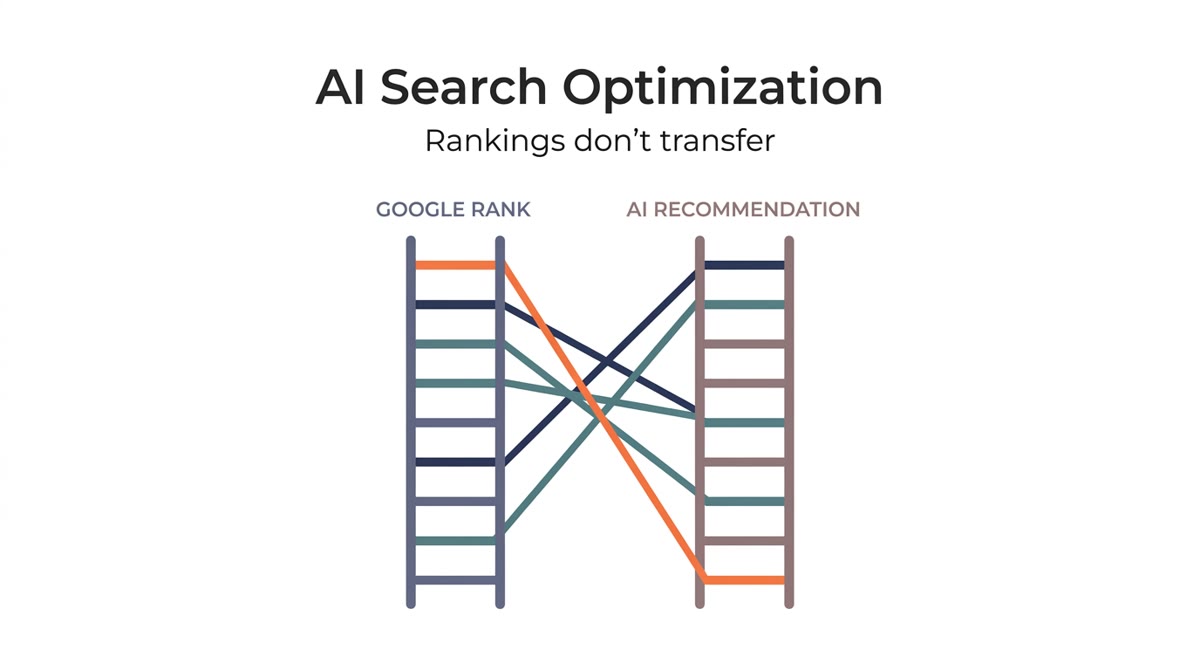
Not reliably. When I ranked four email marketing platforms by Google performance and then measured their share of voice in AI answers, the two orders barely agreed.
The most comfortable assumption in marketing right now is “we rank well, so AI will recommend us.” I tested that assumption on four email marketing platforms, ranking them by Google performance first, then measuring their share of voice across ChatGPT, AI Overviews, Perplexity, and Gemini.
The two scoreboards nearly inverted. MailerLite, the strongest challenger in Google with seven times the search footprint of the smallest brand, finished dead last in AI answers. EmailOctopus, the weakest in search, out-recommended it.
Then I ran the same test on three categories where a household name owns Google. The famous brand lost every time:
| Focal brand | Google rank | AI rank |
|---|---|---|
| Casper (mattresses) | #1 | Last of 5 |
| monday.com (project management) | #2 | Last of 5 |
| NordVPN (VPNs) | #1, by 3.5x traffic | 4th of 5 |
Casper has over $1.1M in monthly organic traffic value, the most in its category by a wide margin. Across seven mattress prompts, it appeared in exactly one AI answer, once, on a single engine. Nectar, the weakest brand on Google, won the AI recommendation outright.
Two separate scoreboards. Most brands are only watching one of them.
What Do AI Engines Base Their Recommendations On?
Mostly on third parties. Of 1,648 sources AI cited when recommending products, 79% were media articles, review sites, Reddit, YouTube, and other third-party pages, and 21% were brand sites.
If rankings don’t decide the recommendation, what does? I pulled every source AI cited across 1,648 recommendations and categorized each one.
79% of the sources were third parties. Editorial “best of” articles (31%), review sites and test labs (21%), YouTube (12%), Reddit and forums (6%). Only 21% came from the recommended brand’s own site, and much of that was blog content, not product pages.
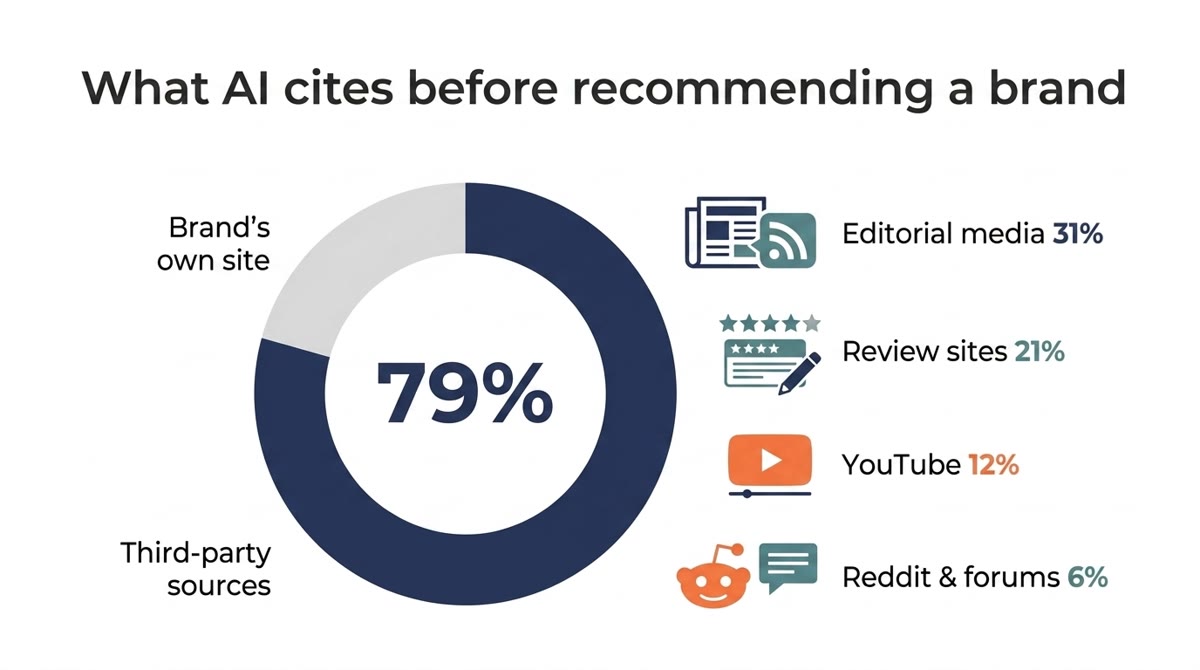
The gradient by category is the part that should change your budget. In project management software, third parties made up 49% of citations. In mattresses, 90%. In VPNs, 93%. The more consumer the category, the less your own website matters to the answer.
This is why the inversions in finding #1 happen. Google ranks your page. AI assembles a recommendation from what the wider web says about you, the listicles you’re in, the reviews you’ve earned, the threads where real users vouch for you. You can win Google almost entirely on your own property. You cannot win AI there.
Do ChatGPT, Perplexity, Gemini, and AI Overviews Use the Same Sources?
No. The engines mostly agree on which brands to name, but they build those answers from different source types, so each engine needs a slightly different off-site mix.
Here’s the layer under all of it, from my source-mix comparison across engines. The engines mostly agree on which brands to name. They just build those recommendations from completely different source types.
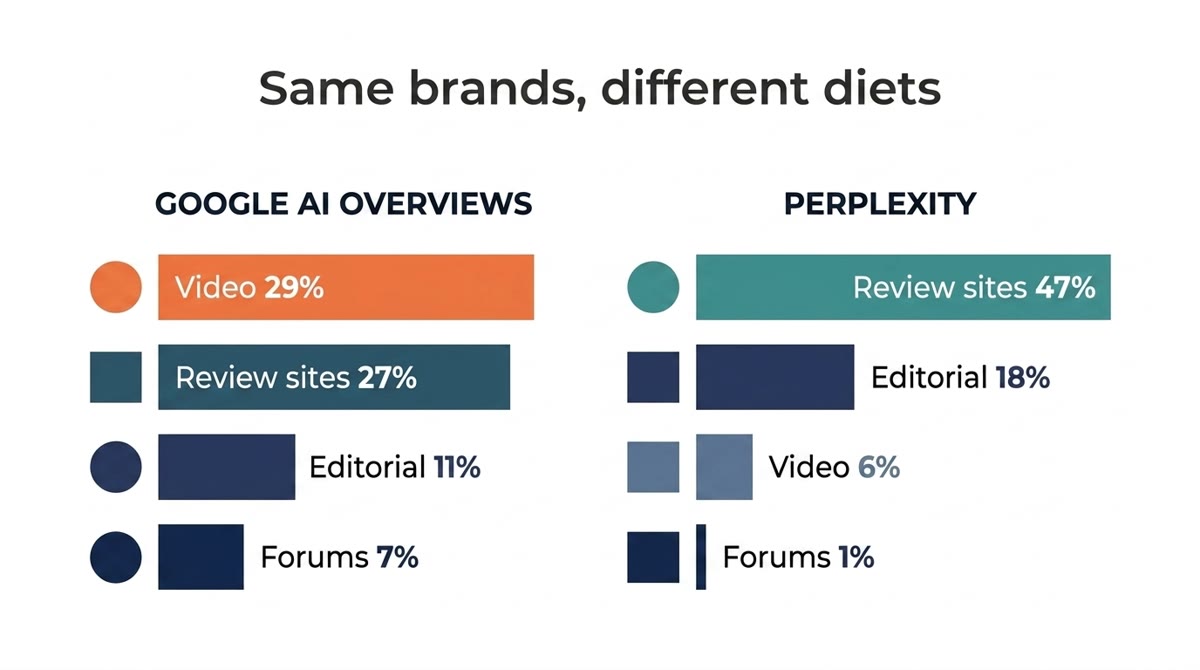
- Google AI Overviews runs on video. 29% of its citations were YouTube, plus 27% review sites and the most Reddit of any engine at 7%. Google owns YouTube, and it shows.
- Perplexity runs on reviews and comparisons. 47% of its citations were review and comparison sites. Video barely registers at 6%.
- Gemini sits in between, leaning on review sites (32%) and editorial articles (17%).
- ChatGPT is the honest asterisk. Through the API it rarely returns linked sources, so I can measure who it recommends but not what it reads.
So “optimize for AI search” is really “feed different diets to different engines.” A brand with strong video coverage and no review presence looks great to AI Overviews and invisible to Perplexity. Same brand, opposite outcomes.
How Do You Optimize for AI Search?
Treat on-site work as eligibility and off-site work as the lever. Keep pages crawlable, answer-first, and fresh, then earn mentions on the third-party sites each engine cites.
Everything above collapses into a two-part playbook, and the parts are not equal.
On-site: stay eligible
Your site still has to be crawlable, credible, and clear, or you fall out of the answer pool entirely. This is the part Google’s own AI optimization guide covers, and it boils down to work you should already be doing:
- Put the direct answer at the top of each section, under a heading that states the question.
- Write in short, parseable sentences. One idea per sentence. LLMs reward it, and so do readers.
- Keep your best pages fresh. AI engines lean heavily toward recently updated sources.
- Publish something the models can’t already generate: original data, firsthand tests, real numbers. Commodity explainers get read, not cited.
Notice what that last point implies. The four studies this pillar sits on are themselves the strategy. Original research is the most reliably cited content type I’ve found, including by the AI Overview that currently sits on top of this exact keyword.
For the engine-specific version of this work, see my guides to showing up in ChatGPT and ranking in Google AI Overviews. The crawler and structure details, including which AI bots to allow, are in my LLM SEO technical guide.
Off-site: earn the recommendation
This is where the 79% lives, and it’s a different to-do list than SEO gives you:
- Get into the “best of” listicles for your category. Editorial roundups were the single biggest citation bucket at 31%.
- Get reviewed by the sites AI already trusts. In my data the citations concentrated in a short, nameable list per category, not a random long tail. Find yours and pitch them.
- Treat YouTube as an AI Overviews channel. A walkthrough, a test on camera, an unboxing. For Google’s AI surfaces, video is a primary ingredient, not a nice-to-have.
- Show up where real users compare options. Reddit matters modestly to AI Overviews and almost nothing to Perplexity, so weigh it by the engine your buyers use.
How Do You Measure AI Visibility?
Measure share of voice: run the same buyer prompts across ChatGPT, Perplexity, Gemini, and Google AI Overviews several times, and count how often your brand is named versus competitors.
You can’t fix what you haven’t measured, and this is the discipline most brands skip. The method I use on every study, and on client work, is share of voice:
- Write 7 to 12 buyer-intent prompts, the questions your customers actually ask.
- Run each prompt across ChatGPT, AI Overviews, Perplexity, and Gemini.
- Run every prompt five times per engine and average. A single AI answer tells you almost nothing, because the answers shift between runs.
- Record which brands get named and which get cited with a link, then compute each brand’s slice of all mentions.
Track that number next to your rankings, separately. If you want to see what the output looks like in practice, my AI Overviews case study walks through a real engagement.
Where This Is Heading
I’ll keep updating this page as the studies grow. What the data has already settled, at least for me: AI search optimization is not a rebrand of SEO. It’s reputation work, measured like search. Your rankings keep you eligible. What the rest of the web says about you decides whether you’re the answer.
AI Search Optimization FAQ
What is AI search optimization called?
You’ll see three names used interchangeably: generative engine optimization (GEO), answer engine optimization (AEO), and LLM SEO. They all describe the same practice, getting your brand named and cited in AI-generated answers across tools like ChatGPT, Google AI Overviews, Perplexity, and Gemini.
Is AI search optimization replacing SEO?
No. SEO keeps your pages eligible, AI engines have to be able to crawl and trust them at all. But in my testing, ranking strength explained almost none of the difference in who AI recommends. Treat them as two jobs: SEO earns the ranking, AI search optimization earns the recommendation.
Does ranking #1 on Google get me recommended by AI?
Not reliably. In my three-category study, the most SEO-dominant brand lost the AI recommendation every time. Casper ranked #1 for mattresses on Google and finished last in AI share of voice. The correlation between Google position and AI visibility was close to zero below the mega-brand tier.
How long does AI search optimization take to work?
Longer than on-page SEO changes, because the levers are third-party. Earning placements in listicles, reviews, and video coverage runs on outreach timelines, weeks to months. Measure your share of voice before you start so you can see movement.