To show up in ChatGPT, get mentioned on the third-party sites it trusts, keep your pages crawlable by OAI-SearchBot, and put a direct answer at the top of every section. There is no ranked position to win, only sources it reaches for.
I get asked some version of the same question every week. “How do I do chatgpt seo so my site ranks number one in ChatGPT?” The question sounds reasonable. It also contains the biggest misconception in this whole space, and it will send you down the wrong path for months if you let it.
So let me knock it down first, then show you what actually works.
Can You Rank Number One in ChatGPT?
No. ChatGPT does not rank pages in positions. It writes a new answer each time and cites or names a few sources, so the goal is to be one of those sources.
The myth goes like this. ChatGPT is a search engine. Search engines rank pages. So there must be a way to be the number one result in ChatGPT, the same way you fight for position one on Google.
There isn’t. ChatGPT does not hand out ranked positions. There is no page two. When someone asks it a question, it writes a fresh answer and folds a few sources into that answer. Sometimes it names brands with no links at all. Your goal is not to rank. Your goal is to be one of the sources it reaches for, and to be spoken well of when it does.
That is a different game with different rules. To play it, you have to understand where ChatGPT is actually getting its information. And that comes down to two separate systems.
Where Does ChatGPT Get Its Information?
ChatGPT pulls from two places: training memory, which is what the model learned before its cutoff, and live search, which fetches pages from OpenAI’s search index when a question needs current information.
| Training memory | Live search | |
|---|---|---|
| What it is | What the model learned before its training cutoff | Pages ChatGPT fetches and cites for a specific question |
| How fast it changes | Months, with each new model | Days, once a page is crawled |
| What feeds it | Mentions of your brand across the web | Pages in OpenAI’s search index, crawled by OAI-SearchBot |
| How to influence it | Earn third-party mentions | Stay crawlable and answer questions directly |
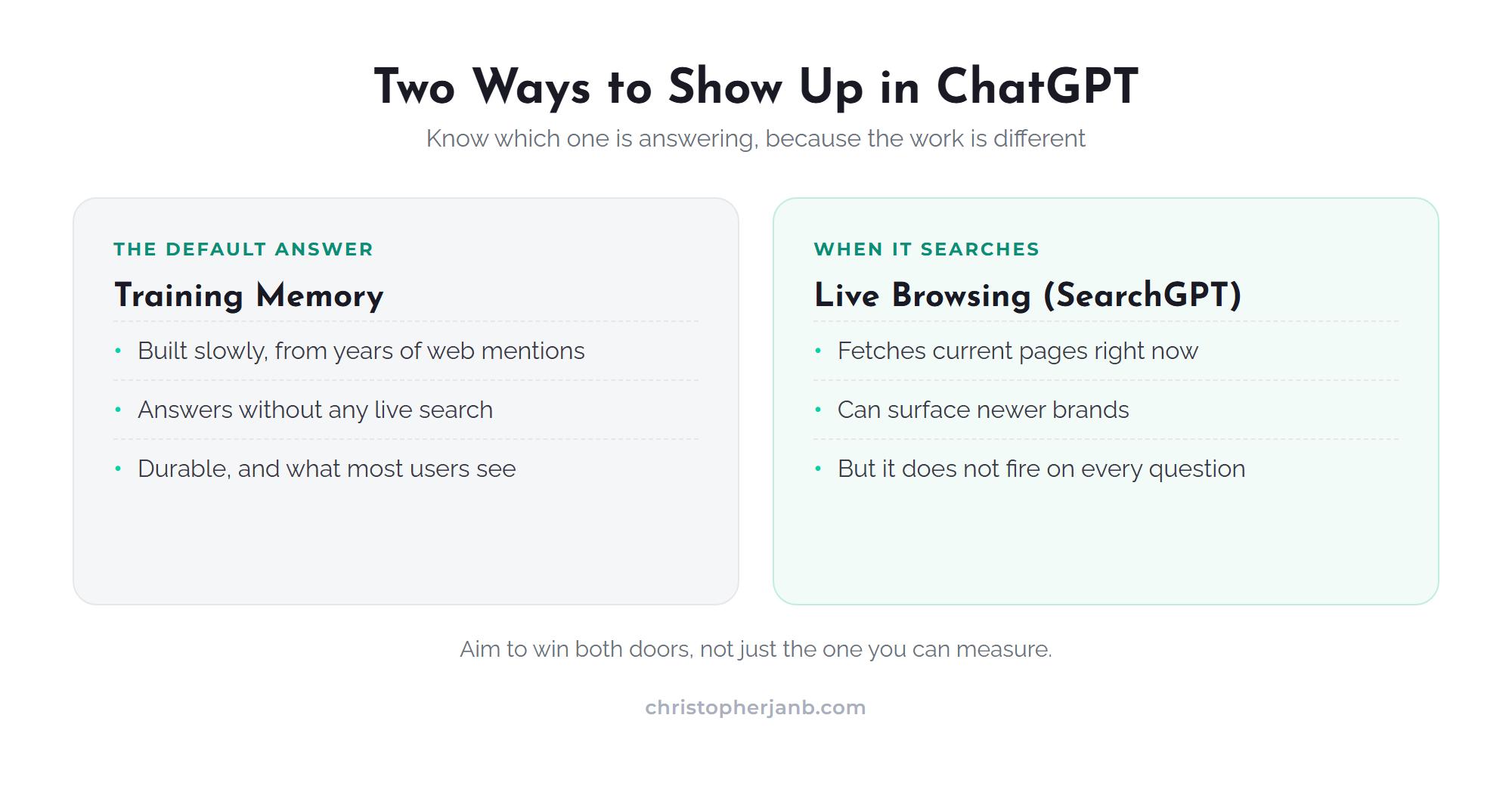
Training Memory
The first is what the model already knows. During training, it read an enormous slice of the web and formed associations. Not exact pages it can quote, more like impressions. If your brand showed up often enough, in enough places, connected to the right topics, the model carries a vague sense that you exist and what you are known for.
This is why a well-known brand gets named in answers even when ChatGPT is not browsing the web at all. It is running on memory. You cannot edit that memory directly. You build it slowly, over months, by being mentioned in a lot of places the model learned from. And training data has a cutoff date, so anything published last week is invisible to it.
Live Browsing
The second system is live browsing, which OpenAI calls search. When ChatGPT decides a question needs current information, it goes and fetches pages in real time, reads them, and cites a handful in its answer. This is the part that behaves a little more like search. It can pick up something you published yesterday. It leans on pages that are easy to read and clearly answer the question.
Here is the catch most guides skip. These two systems can disagree. The model might “remember” you as a leader in your space from training, then browse the web, find a competitor’s fresher page, and cite them instead. You want to win on both fronts.
One honest note about how I study this. When I test ChatGPT through its API, it rarely hands back clean source URLs. So I do not rely on one answer. I run the same prompt many times, across many phrasings, and read the patterns in what gets named and cited. One answer is an anecdote. Forty answers is data. And in my own citation study, most of the sources ChatGPT leaned on were third-party pages, not the brand’s own site (here is what I found).
Now the practical part.
What Actually Improves ChatGPT Visibility?
Third-party mentions move it most, followed by direct answers, clear structure, crawl access, and consistent brand facts. Keyword stuffing and one-off screenshots do nothing.
Most of the effort I see people spend on ChatGPT visibility goes to the wrong things. Here is how I split it.
What Moves It
Getting mentioned on third-party sites. This is the big one. Reviews, roundups, comparison posts, Reddit threads, industry blogs. Both systems reward it. Training memory is built from these mentions, and live browsing cites them constantly. If you do one thing, do this.
Answering the actual question in the first two sentences. When ChatGPT browses, it wants the answer, not a warm-up. Put the direct answer at the top of the section, then explain. Pages that make the model dig get skipped.
Clear structure it can lift from. Headings that match real questions. Short paragraphs. A plain table when you are comparing things. A short FAQ. None of this is fancy. It just makes your page easy to read and easy to quote.
Being crawlable at all. If your robots file blocks OAI-SearchBot, you are invisible to live browsing. If your content only appears after heavy JavaScript, it often does not get read. Check this once. It is a five-minute fix that quietly blocks everything else.
Consistent facts about your brand across the web. Same description, same claims, same numbers everywhere you appear. Mixed signals confuse both the memory and the live read.
What Wastes Your Time
Keyword density and old on-page tricks. There is no keyword you can stuff to become the top ChatGPT result, because there is no top result.
Chasing a single answer. You ask once, see your name, and celebrate. Or you do not see it and panic. Ask it again tomorrow and the answer shifts. One screenshot proves nothing.
Obsessing over your own homepage copy. Your site matters, but the model is often citing what other people wrote about you. You cannot self-declare your way into the answer.
Publishing thin pages fast to look fresh. Freshness helps only when the page is genuinely useful. A pile of shallow posts does not build training memory and does not earn live citations.
Waiting for instant results. Training memory moves on a scale of months. If you got mentioned somewhere great today, the model may not carry it until its next training cycle. Live browsing can pick you up faster, but only if the crawlable, quotable groundwork is there.
How Do You Check If ChatGPT Mentions Your Brand?
Ask ChatGPT a buyer’s question that leaves out your brand name, 5 or 6 times in fresh sessions. Note which brands and sources appear, then ask what your brand is known for.
You do not need a tool to start. Here is what I do for a new client in about fifteen minutes.
Open a fresh ChatGPT session so past chats do not skew it. Then ask the kind of question a real buyer would ask, not a question with your name in it. Something like “what are the best options for [your category] for a small B2B team?” Do not mention the brand. You want to see if it comes up on its own.
Run that same question five or six times. Reword it each time. “Who should I look at for [category]?” Then “recommend a few [category] providers.” Watch two things. Does your brand get named, and which sources does it cite when it browses.
Then flip it. Ask directly, “what is [your brand] known for?” This tests training memory. If the answer is vague or wrong or mixes you up with someone else, your memory footprint is thin or muddled. That is a mention problem, not a website problem.
Write down what you see. Which competitors show up every time. Which third-party sites get cited again and again. Those cited sites are your target list. If a roundup keeps getting quoted and you are not in it, that is a specific, winnable job for next quarter.
That is the whole loop. Ask like a buyer, repeat, read the patterns, and note the sources. Do it monthly and you will feel the memory shift before any dashboard confirms it.
What Should You Do Next?
If you want the full method for measuring this across ChatGPT, Perplexity, Gemini, and Google’s AI answers, with a real share-of-voice number instead of a gut feel, I laid it out in my guide to AI search optimization.
And if you would rather not run the tracking and the third-party outreach yourself, that is the work I do. You can see how my AI Search Visibility service works and whether it fits what you are trying to do.
The short version is this. Stop trying to rank in ChatGPT. Start trying to be the brand it already knows and the source it reaches for. Those are the two levers, and now you know which one you are pulling.
ChatGPT SEO FAQ
Does ChatGPT SEO replace regular SEO?
No. Traditional SEO still gets your pages indexed and crawlable, which is a prerequisite for live browsing to find you. Think of it as the floor, not the whole building.
How long until I show up in ChatGPT answers?
Live browsing can pick up a fresh, crawlable page within days. Training memory is slower and moves in months, tied to the model’s training cycles. Plan for the long version.
Can I pay to appear in ChatGPT answers?
Not for the organic answers. You earn your way in through mentions, useful content, and being easy to cite. There is no ad slot that puts you in the recommendation itself.