You can automate keyword research by connecting DataForSEO to Claude and giving it seed keywords. Claude pulls the data, removes duplicates, clusters the terms and returns a keyword map. My last test used 2 seeds, 9 API calls and 78 rows, for about $0.07. Pulling the data is the easy part. Reading it correctly is where automated research goes wrong, so this guide covers both.
Disclosure: links to DataForSEO in this post are affiliate links. If you sign up through them, I may earn a commission on every successful sale, at no extra cost to you.
Which parts of keyword research can you automate?
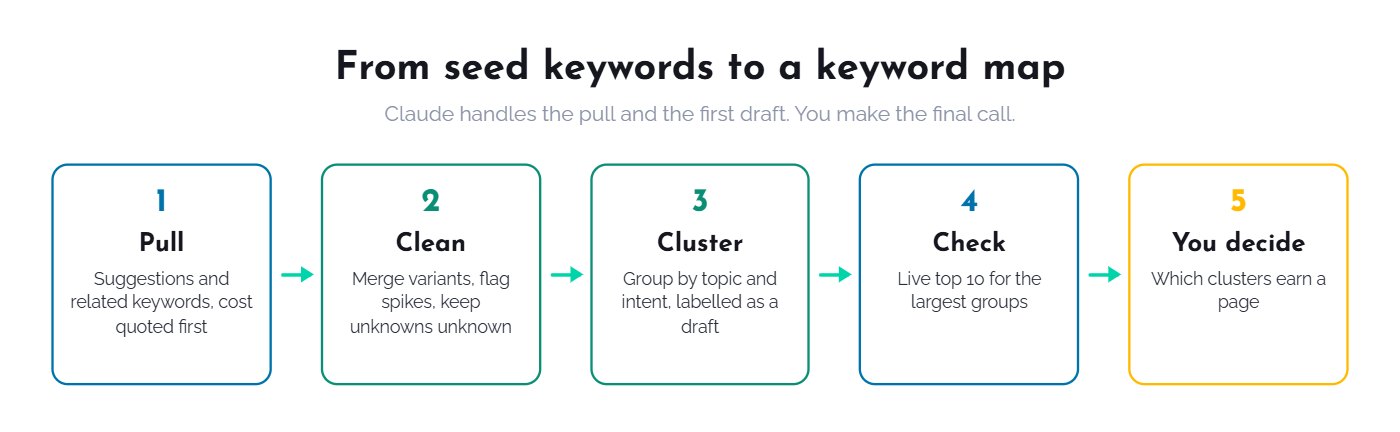
You can automate data collection, deduplication, metric lookups and first-draft clustering. Choosing which clusters fit the business, and which deserve a page, should stay with you.
| Stage | Automate it? | Why |
|---|---|---|
| Expanding seed keywords | Yes | An API returns the list in seconds |
| Volume, difficulty and intent lookups | Yes | The fields come back with each row |
| Removing duplicates and close variants | Yes, then review | Code finds candidates, and a person confirms the meaning matches |
| First-draft clusters | Yes, then review | Claude reads the words well, but it does not know your business |
| Choosing what to publish | No | This depends on your offer, authority and capacity |
Which DataForSEO endpoints do you need for keyword research?
Keyword Suggestions and Related Keywords cover most keyword research in DataForSEO. Keyword Overview fills gaps, Keyword Ideas finds adjacent topics, and the live SERP API checks what actually ranks. DataForSEO (affiliate link) works as a keyword research API with no subscription, and you pay per call.
| Endpoint | What it returns | Example cost |
|---|---|---|
| Keyword Suggestions | Terms containing your seed | 100 rows: $0.024 |
| Related Keywords | Google’s related searches, by depth | 50 rows: $0.018 |
| Keyword Overview | Metrics for a list you supply | 20 keywords: $0.0144 |
| Keyword Ideas | Terms from the same category as your seed | 100 rows: $0.024 |
| SERP API, live | The current Google results | One top-10 query: $0.002 |
Costs use DataForSEO’s list rates from 27 October 2026. Suggestions and Related Keywords already include volume, difficulty and intent, so an Overview call on the same rows pays twice. Treat Keyword Ideas as a separate list. For the seed “seo reporting”, its top results included “google keyword planner” and “bing webmaster tools”, from a pool of 83,675 terms.
How do you run keyword research in Claude?
Connect the DataForSEO MCP server, then ask Claude for the data, a cleanup and a draft map. No code is needed, and the first run takes one conversation.
- Connect the data. Follow my DataForSEO MCP setup guide. New accounts get $1 of trial credit, which covers several runs like the one below.
- Pull the list. Try: “Pull keyword suggestions and related keywords for [seed] in the United States. Tell me the estimated cost first.”
- Clean it. Try: “Find keywords that are the same search worded differently, and count their volume once. Show me which ones you merged.”
- Draft the map. Try: “Group these by topic and intent. Show total demand, the difficulty range and a suggested page for each group.”
- Check the top groups. Try: “Pull the live top 10 for the main keyword in the five largest groups. Does an AI Overview appear, and what kind of pages rank?”
What does the keyword map look like?
The output is one row per topic cluster, with deduplicated demand, a difficulty range, intent and a live results check. Here is part of a real run from 5 November 2026, using the seed “keyword clustering” for the United States.
| Cluster | Main keyword | Demand, counted once | Difficulty | Intent | AI Overview |
|---|---|---|---|---|---|
| Clustering tools | keyword clustering tools | 880 | 5 to 19 | Commercial | Yes |
| What it is and how to do it | keyword clustering | 780 | 27 to 28 | Informational | Yes |
| Technical methods | semantic keyword clustering python | 130 | 3 to 32 | Informational | Yes, loaded separately |
| Free tools | free keyword clustering tool | 120 | 16 to 17 | Informational | Not checked |
The run also exposed what automation should not decide alone. One cluster of 16 queries around a single small vendor’s name showed about 810 searches a month, and most of those series only began around March 2026. That may be real interest, or it may be automated queries. I would verify it before building a page on it. The second seed, “keyword research automation”, returned just one row at about 10 searches a month, so the wording people use matters more than the topic.
What goes wrong with automated keyword data?
Automated keyword data goes wrong when you treat each row as independent and exact. Five problems showed up in my own pulls, and each one can change what you decide to publish.
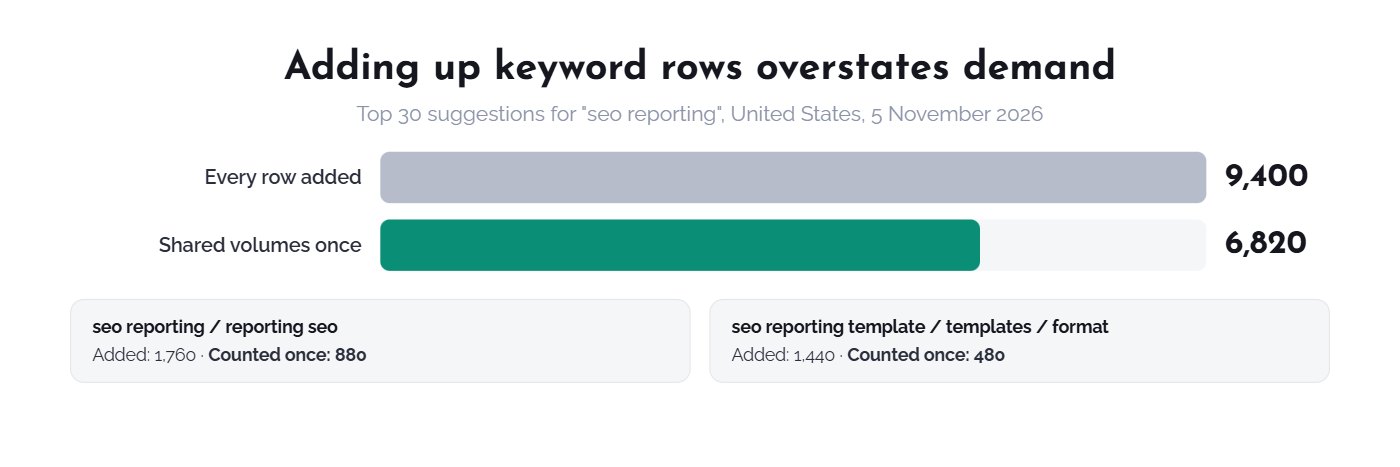
- Variants share one volume. “automate keyword research” and “automated keyword research” both show 50 searches, with identical monthly history. The top 30 suggestions for “seo reporting” add up to 9,400 searches, but counting each shared volume once gives 6,820. In the clustering run, adding “tool” and “tools” would have put that cluster at 1,470 instead of 880.
- Difficulty is rough. That same “automate” pair scores 5 and 18. “free seo reporting tool” scores 73, while “seo reporting tool free” scores 42. Read difficulty as a range across the cluster.
- One number hides the trend. “how to automate keyword research” reports 70 searches, yet its monthly history shows 170 to 210 from July to September 2026 and 10 to 30 a year earlier. “seo tips” jumps from 390 in October 2025 to 450,000 in September 2026, which deserves suspicion. Always look at the monthly series.
- Missing is not zero. I sent 9 terms to Keyword Overview and got 5 back. “dataforseo keyword research” returned nothing, although Google shows results for it. Report those terms as no data.
- Language labels misfire. DataForSEO tagged “seo checker” as German and “seo audit” as Spanish in a US English pull. A filter on that field would delete both.
The keyword data itself was stable in my test. I ran the same Suggestions call twice on 5 November 2026, and all 30 rows matched, in the same order, with the same values.
Can live search results show which keywords belong on one page?
A single pull of live results cannot reliably show which keywords belong on one page. When I pulled the same keyword twice, within about half an hour, the results barely matched themselves.
| Keyword | Pages shared with its own first pull |
|---|---|
| ai visibility tools | 3 of 9 |
| keyword grouping tool | 2 (from 8 and 9 results) |
| geo audit | 0 of 9 |
That is why I label automated groups as topic clusters and do not call them SERP-tested. Live results are still useful for seeing page types and AI Overviews, as long as you treat each pull as one snapshot. My keyword grouping guide shows how to run this control yourself. I do not yet know whether the variation comes from Google or from how the results are collected.
How much does automated keyword research cost?
Automated keyword research with DataForSEO costs cents per run, not dollars. My two recorded sessions cost about $0.07 and $0.31 at list rates, excluding the top-up and any Claude plan.
| Run | Calls | Estimated cost |
|---|---|---|
| Two seeds, 78 rows, 5 live results pages (5 November 2026) | 9 | About $0.07 |
| Research for this DataForSEO hub, including competitor pulls (26 October 2026) | 19 | About $0.31 |
Both figures are estimates, because API responses do not report their cost. Your dashboard’s usage statistics show the actual charge. DataForSEO has a $50 minimum top-up, and my pricing post breaks down 30 days of real spend. The hub research became a 66-keyword map that set the order of this content plan.
Should you use Claude, Make, n8n or Python?
Use Claude when you want to question the data as you go. Use Make or n8n when the same pull should run on a schedule, and Python when you need large volumes or full control.
| Route | Setup | Best for | Weak spot |
|---|---|---|---|
| Claude and the DataForSEO MCP | Connect once | Research you want to read and adjust | You check its reasoning on every run |
| Make or n8n with DataForSEO | Build or copy a workflow | Scheduled pulls into a spreadsheet | Rules are fixed in advance, so odd data passes through |
| Python and the API | Write and maintain code | Large lists and custom logic | You own every bug |
I run the Claude route, so that row comes from my own work. The Make and n8n rows come from their published templates. They can also call an AI model for clustering, so the routes overlap.
How do you make this repeatable?
Save the process as a Claude skill, so every run quotes its cost, handles shared volumes and stops before content work. My free pack includes one for this, dataforseo-keyword-research, alongside five skills that run a full client month.
Get the free Claude SEO skill pack. If you still need the data, open a DataForSEO account (affiliate link) and try one seed on the trial credit. For where this fits in the wider setup, read the Claude SEO guide.