LLM SEO is the practice of making your pages easy for large language models to retrieve, parse, and cite. It comes down to three jobs: let AI search crawlers in, write in self-contained chunks, and build clear entity signals.
A large language model does not rank a list of ten links and hand you the choice. It reads a set of sources and writes a single answer. That one difference is the whole reason llm seo exists as its own discipline. When you optimize for Google, you are competing for a position in a list. When you optimize for a model, you are competing to be one of the few sources it reads before it composes its reply, and then to be the one it names. This piece is the technical reference for that work. I will walk through the mechanism, the crawl layer, the way to structure content so a model can parse it, the entity signals that make a model trust you, and then a copy-paste checklist you can run against any page.
If you want the strategy-level view first, I keep that in the AI search optimization pillar. This article stays under the hood.
Does LLM SEO Target Training Data or Live Retrieval?
LLM SEO targets live retrieval. Training data is frozen at a cutoff you cannot edit, while retrieval fetches current pages at the moment someone asks a question.
There are two ways your content can end up inside a model’s answer, and they are not the same thing.
The first is training. A model learns patterns from a huge body of text scraped at some point in the past. If your page was in that body, the model may carry a fuzzy memory of it. You cannot edit that memory. You cannot see it. By the time a model ships, the training window has closed, and anything you publish today will not be in it for months, if ever. Training is not a channel you can operate.
The second is retrieval. This is the one that matters for your day-to-day work. When someone asks ChatGPT, Perplexity, or Google’s AI Overviews a live question, the system often runs a search, fetches a handful of current pages, and reads them right then to build the answer. Your page competes in that fetch. This is the layer you can influence this week, because it runs against the live web, not a frozen snapshot.
Most of what people call llm seo is really retrieval optimization. So the rest of this guide is about making sure a model can reach your page, read it cleanly, and quote it correctly at the moment of the question.
How Do LLMs Choose Which Sources to Cite?
LLMs choose sources through retrieval-augmented generation (RAG). They turn the question into searches, fetch candidate pages, split them into chunks, score the chunks, and cite the best match.
The technical name for the retrieval process is RAG, short for retrieval-augmented generation. It is worth understanding as a pipeline, because each stage is a place you can win or lose.
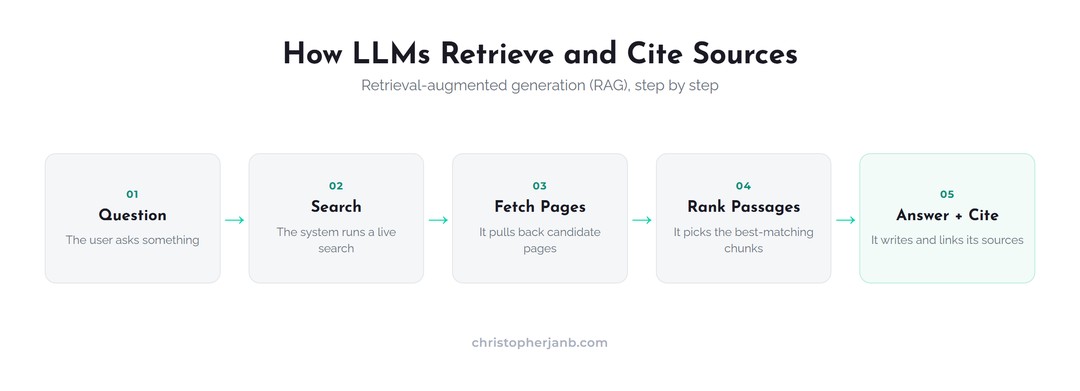
Here is the sequence. A user asks a question. The system rewrites that question into one or more search queries. It runs those queries against a search index and pulls back a set of candidate pages. It fetches those pages and breaks them into chunks, usually a few paragraphs each. It scores the chunks for relevance to the question. Then it feeds the top chunks into the model as context, and the model writes an answer grounded in that context, often with a citation back to the source.
Read that chain again and notice where your work lands. You need to be in the search index, which is classic SEO. You need to survive the fetch, which is the crawl layer I cover next. You need your page to break into clean, self-contained chunks, which is content structure. And you need to be the chunk that scores highest for the exact question, which is entity clarity and specificity. Every section below maps to one of those stages.
Which AI Crawlers Should You Allow in robots.txt?
Allow the AI search crawlers (OAI-SearchBot, Claude-SearchBot, and PerplexityBot) if you want to be cited. Blocking training crawlers like GPTBot and ClaudeBot only keeps you out of future model training.
You cannot be retrieved live if the retrieval crawler cannot fetch your page. This is the part almost every content-first guide skips, and it is the part that quietly blocks people.
Different AI companies run different bots, and they announce themselves with different user agent strings in your server logs and your robots.txt. Most companies now run separate bots for training, for building their search index, and for fetching a page when a user asks. Here is how the main ones split, according to each company’s own documentation:
| Company | Training | Search index | User-requested fetch |
|---|---|---|---|
| OpenAI | GPTBot | OAI-SearchBot | ChatGPT-User |
| Anthropic | ClaudeBot | Claude-SearchBot | Claude-User |
| Perplexity | none listed | PerplexityBot | Perplexity-User |
| Google-Extended (a robots.txt token, not a crawler) | Googlebot | Googlebot |
The distinction that trips people up is training versus retrieval. Blocking a training bot like GPTBot or ClaudeBot keeps your content out of future model training. It does not remove you from live answers. Blocking a search bot like OAI-SearchBot, Claude-SearchBot, or PerplexityBot is different. OpenAI says sites that block OAI-SearchBot will not be shown in ChatGPT search answers. You cannot be cited in an answer built from an index you refused to join.
The user-requested fetchers work differently again. ChatGPT-User and Perplexity-User visit a page because a person asked about it, and both companies say robots.txt rules may not apply to those visits.
Google-Extended is its own case. It is a robots.txt token that controls whether your content is used to train Gemini models and to ground answers in Gemini apps and Vertex AI. Google says it does not affect your inclusion or ranking in Google Search. It is also not the control for AI Overviews. Those are part of Search, so they follow your normal Googlebot rules and snippet controls like nosnippet and max-snippet.
My rule of thumb is simple. If you want AI visibility, allow the search bots. Block training bots only if you have a specific reason, and know which kind of bot you are blocking before you write the rule. Check your actual robots.txt against these user agents, because a blanket Disallow rule or an old plugin default can be silently shutting the door.
Does llms.txt Help LLM SEO?
Not measurably yet. llms.txt is a proposed standard, and Google states that no AI text files are needed to appear in AI Overviews.
You will hear about llms.txt. It is a proposed standard, a plain-text file you place at the root of your site to point AI systems at your most important content in a clean format. The idea is reasonable. The honest status is that adoption is early. No major model provider has confirmed that llms.txt is a ranking or citation factor. I have not seen evidence that it moves retrieval today.
So I treat it as a low-cost bet, not a lever. It takes an hour to add. If it becomes a real signal later, you are ready. But do not add it and expect citations to appear, and do not prioritize it over the crawl and structure work that actually moves the needle right now.
How Should You Structure Content for LLMs?
Write self-contained chunks: a question-style heading, the direct answer in the first one or two sentences, one idea per short paragraph, and all key text present in the raw HTML.
Once a model fetches your page, it chunks it. Your job is to make each chunk stand on its own, because the model may pull one paragraph out of your page and use nothing else around it.
Front-load the answer. If a section asks a question, answer it in the first sentence or two, then explain. A chunk that opens with the direct answer scores better than one that buries it under three paragraphs of throat-clearing.
Use a real heading structure. One clear topic per H2 or H3, phrased the way a person would ask it. Headings are strong chunk boundaries. When your headings match real questions, your chunks line up with real queries.
Keep sentences and paragraphs tight. A chunk that is one dense wall of text is hard to extract cleanly. Short paragraphs, each holding one complete idea, give the retriever clean units to pull.
There is one technical trap worth naming. AI crawlers read raw HTML. Many do not execute JavaScript. If your key content only appears after a script runs, or it sits behind a tab, an accordion, or a “read more” toggle that loads on click, a bot may see an empty container. View your page’s raw HTML source, not the rendered page, and confirm your actual content is in there as text. This single check catches more invisible-content problems than anything else I run.
Structured data helps too. Clean schema markup, FAQ and article types especially, gives a machine an explicit map of what each part of your page means. It is not magic, but it removes ambiguity, and removing ambiguity is most of this job.
Why Do LLMs Trust Some Sources More Than Others?
LLMs favor sources they can tie to a clear, consistent entity. Consistent business names, named authors with credentials, and mentions on third-party sites all strengthen that entity.
Relevance gets you into the candidate set. Trust decides whether you get named. Models lean toward sources they can identify as a known, consistent entity, so entity signals are how you earn the citation.
Be specific and consistent about who you are. Your business name, the people who write your content, their credentials, and your area of expertise should read the same way across your site and across the wider web. A model builds a picture of an entity from many mentions. Contradictions weaken that picture.
This is where off-site work matters more than people expect. Around 79% of the sources AI cites are third-party pages, not the brand’s own site. So a model’s view of you is shaped mostly by what other credible sites say about you. Getting mentioned in a roundup, a review, or an industry publication does two things. It builds the entity, and it puts you in more of the third-party pages a model is likely to fetch. Unlinked brand mentions count here. The model is reading text, and your name in that text is a signal even without a hyperlink.
Depth on your own site supports the same goal. When you cover a topic thoroughly across a connected set of pages, you become a stronger candidate for the specific questions inside that topic. That is standard topical authority, and it carries straight over into retrieval.
LLM SEO Checklist
Run these 14 checks in order, from crawl access to citation signals. The crawl checks at the top are pass or fail.
Run this against any page you want cited. It is ordered by the RAG pipeline, from crawl to citation. Copy it into your own docs.
- Confirm your robots.txt does not block OAI-SearchBot, Claude-SearchBot, or PerplexityBot if you want to be cited in AI search answers.
- Decide training bots (GPTBot, ClaudeBot, Google-Extended) separately, and know that blocking them does not remove you from live answers or Google Search.
- Check server logs for OAI-SearchBot, ChatGPT-User, PerplexityBot, and Claude-SearchBot to confirm the bots actually reach you.
- View raw HTML source and verify your main content is present as text, not injected by JavaScript.
- Remove key content from click-to-load tabs, accordions, and “read more” toggles, or make it load in the HTML.
- Front-load the direct answer in the first two sentences of each section.
- Write headings as the questions people actually ask, one topic each.
- Keep paragraphs to one idea so each chunk stands alone.
- Add clean schema markup, article and FAQ types where they fit.
- Keep your business name, authors, and credentials consistent across every page.
- Show real author expertise on the page, not just a byline.
- Earn third-party mentions, linked or unlinked, on credible sites in your field.
- Keep publish and update dates accurate, and refresh pages that have gone stale.
- Optionally add an llms.txt file as a low-cost bet, with no expectation of a ranking effect yet.
Work top to bottom. The crawl items at the top are pass-fail. If a bot cannot fetch you, nothing below it matters.
How Does LLM SEO Relate to GEO and SEO?
LLM SEO is the technical layer of GEO, and it sits on top of classic SEO, because AI search systems still retrieve pages from search indexes.
This article is the technical floor. The strategy that sits on top of it changes by engine, and I keep separate guides for the two that matter most, showing up in ChatGPT and ranking in Google AI Overviews. If you are still weighing how this relates to the search work you already do, the GEO vs SEO comparison draws the line between them.
If you would rather have this audited and built for you, that is the work I do through my AI Search Visibility service.
LLM SEO FAQ
Does blocking GPTBot hurt my Google rankings?
No. GPTBot is OpenAI’s training crawler and has nothing to do with Google Search. Blocking it does not change your Google ranking, and it does not remove you from ChatGPT search answers either, because those use OAI-SearchBot. Google-Extended works the same way on Google’s side. Google says it does not affect Search inclusion or ranking.
Is llms.txt worth adding right now?
It is a low-cost bet, not a lever. llms.txt is an emerging proposed standard, and no major model has confirmed it as a ranking or citation factor. Add it if you have a spare hour, but do not expect it to produce citations, and do not choose it over your crawl and content structure work.
Why can AI tools not see my content even though it loads in my browser?
Your browser runs JavaScript. Many AI crawlers read only raw HTML and do not execute scripts. If your content is injected by JavaScript or hidden behind a click, the bot sees an empty container. Check your raw HTML source and make sure the text is actually there.
What is the difference between training and retrieval for LLM SEO?
Training is the frozen text a model learned from in the past, which you cannot edit or influence on any useful timeline. Retrieval is the live fetch a model runs to answer a current question. Retrieval is the part you optimize for, because it reads the web as it is today.