To rank in Google AI Overviews, first get your page into the organic top 10 for the query, then format your key answers so Google can lift them: a 2 to 3 sentence answer under a question heading, tight lists, and small comparison tables.
Last week I fetched the same query twice, about ten minutes apart, and got two different results. The first pull showed an AI Overview. The second showed none. Same keyword, same location, same device setting. Nothing had changed except the clock. This happens constantly in my tracking, and it is the first thing you have to accept before you spend a single hour learning how to rank in AI Overviews. The feature is not a fixed slot you win once. It flickers. So the real question is not whether you appeared today. It is how often you get pulled across many samples of the same query.
Do You Need to Rank in the Top 10 to Appear in AI Overviews?
In practice, yes. Google builds AI Overviews from pages it already ranks, and in my tracking most cited URLs sit in the organic top 10 for the same query.
I pull live AI Overview data through DataforSEO’s SERP API with the async overview flag turned on. That flag matters because Overviews load after the main results, and a normal scrape misses them. When I run a keyword, I do not run it once. I sample it several times over a few hours or days, then look at the pattern.
The pattern is noisy. A query might return an Overview on four fetches out of six, then vanish on the next two. If you check a rank tracker once and see no Overview, you have not learned much. You have taken one photo of a moving thing.
But under the noise, one signal stays steady. The pages cited inside Overviews skew hard toward strong organic positions. When I line up the cited URLs against where those same pages rank in the classic blue links, most of them sit in the top 10. A page ranking third organically shows up in the Overview far more than a page ranking thirtieth. In practice, cracking the top 10 is close to a prerequisite. Not a guarantee. A prerequisite. I saw the same pattern in my AI Overviews SEO case study, where the pages that earned Overview citations were the ones already ranking well.
This is the part that separates Google’s feature from a tool like ChatGPT. AI Overviews are grounded in Google Search. The system starts from Google’s own index and its ranking signals, then builds a summary on top. It is not reaching for some separate pile of trusted sources. It is reaching for pages Google already decided were good. So your organic ranking is not a side project you do alongside AI work. It is the entry ticket.
How Does Google Choose AI Overview Sources?
Google decides whether to show an Overview, draws from pages already ranking for the query and close variations, lifts short passages that answer sub-questions, and links back to those sources.
Here is the flow I see in the data, start to finish.
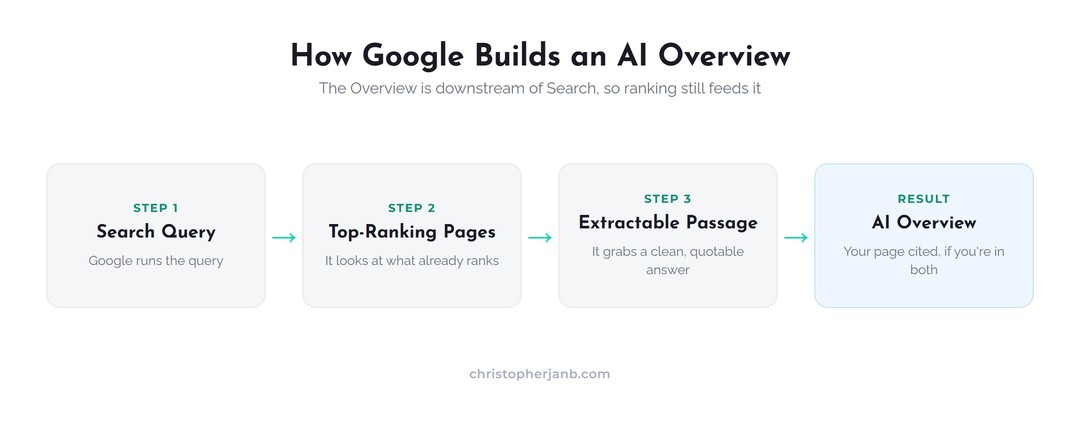
Google reads the query and decides whether it wants to trigger an Overview at all. Informational and how-to queries trigger more often than transactional ones. Then it looks at the pages already ranking well for that query and nearby variations. From those pages, it lifts short passages it can quote or paraphrase. It stitches those passages into one answer and links back to the sources.
Two things fall out of this.
First, you cannot skip the ranking step. If your page is not in the running organically, it is not in the pool Google draws from. Every “AI Overview hack” that ignores your organic position is skipping the load-bearing part.
Second, being cited by an Overview does not mean the Overview trusts your brand. It means one specific passage on your page answered one specific sub-question cleanly. Google is not endorsing your whole site. It grabbed a sentence. Your job is to make more of those grabbable sentences.
It also helps to know the citation pool is not dominated by brand sites. A large share of what AI systems pull leans on third-party sources rather than the brand’s own pages. I broke down the numbers in a separate piece on where AI gets its recommendations, and the short version is that reviews, roundups, and independent explainers do a lot of the heavy lifting. If you only ever optimize your own domain, you are fighting for a smaller slice than you think.
Which Content Formats Get Cited in AI Overviews?
Four formats get cited most in my tracking: direct answer passages, numbered or bulleted lists, comparison tables, and one-sentence definitions placed right under a heading.
| Format | Best for | How to write it |
|---|---|---|
| Direct answer passage | “What”, “why”, and “how much” questions | 2 to 3 sentences directly under a question heading |
| Numbered list | Processes and steps | One action per item, in order |
| Bulleted list | Requirements, types, and features | Short, parallel items |
| Comparison table | “X vs Y” and “best for” queries | Clear rows and columns, no merged cells |
| Definition | “What is” queries | One sentence right after the heading |
The through-line is extractability. Google is not rewarding your best paragraph. It is rewarding your most liftable one. A brilliant idea buried in a wall of text is invisible to this system. The same idea, written as a labeled answer under a question heading, becomes usable.
AI Overview Optimization Checklist
Work through these 8 steps in order. Ranking comes first, because no formatting change helps a page Google does not already rank.
This is the working list I run against a page when the goal is Overview citation. Do these in order.
- Rank in the top 10 first. If the page is not there, no format trick will save it. Fix the ranking before you touch anything else.
- Match one page to one clear question. Overviews answer specific sub-questions. A page trying to cover ten loosely related things gives Google nothing sharp to lift.
- Put the answer first. Under each heading, lead with the direct answer in two or three sentences. Add the nuance after. Do not make the reader, or the model, dig for it.
- Write headings as real questions. Use the phrasing a person would type or say. Then answer that exact question in the lines below it.
- Add one liftable structure per section. A short list, a small table, or a labeled definition. Give Google a clean block to pull.
- Keep the page current. Freshness shows up in what gets cited. A visible last-updated date and genuinely revised content beat a stale page on the same topic.
- Cover the topic fully. Pages that answer the main question and the obvious follow-ups get pulled more. Thin pages get skipped even when they rank.
- Earn outside mentions. Since so much of the citation pool is third-party, being referenced on other credible sites feeds the same signals Google already trusts.
None of these are exotic. That is the point. Ranking in AI Overviews is mostly strong SEO plus deliberate formatting for extraction. The teams that struggle are usually looking for a separate trick when the fundamentals are the trick.
If you want the wider view of how this connects across engines, not just Google, I laid that out in my guide to AI search optimization. And if you are still deciding how much of your effort should go to classic rankings versus generative results, my breakdown of GEO vs SEO walks through where they overlap and where they split.
Do AI Overview Citations Bring Clicks?
Not always. An AI Overview answers the question on the results page, so many readers never click. Track AI referral traffic as its own GA4 segment instead of blending it into organic.
Now the uncomfortable part. Getting cited does not mean getting a click.
An Overview answers the question on the results page. Plenty of people read the summary, feel satisfied, and never visit your site. You earned the citation and got no session out of it. That is the zero-click reality, and pretending it does not exist leads to bad reporting.
So I stop measuring this the old way. Impressions and average position do not capture what an Overview citation is worth. Instead, I track AI referral traffic as its own segment.
In GA4, I build a segment for sessions that arrive from AI sources. You isolate the referrers tied to AI experiences and generative results, then watch that segment on its own over time. The number starts small. It is meant to. What matters is the trend and the quality. Is that segment growing month over month? When those visitors land, do they behave like people who already trust you, moving deeper into the site or converting at a decent rate?
That is a different scoreboard from raw clicks, and it is the honest one. A citation that sends fewer but warmer visitors can be worth more than a mid-page organic link that sends colder traffic. You will only see that if you separate the segment out. Lumped into “organic,” it disappears.
The full picture, then, is this. Rank in the top 10, because Google builds Overviews from pages it already ranks. Format your best answers so they are easy to lift. Sample your queries more than once, because the feature fluctuates and one check lies to you. Then measure the payoff as its own GA4 segment instead of expecting it to show up as ordinary organic clicks.
If you would rather have this tracked and optimized for you, with real sampling instead of a single snapshot, that is exactly what my AI Search Visibility service does. Either way, treat AI Overviews as a moving target measured over many samples, not a slot you win once and forget.
AI Overviews FAQ
Do I need special schema or an llms.txt file to appear in AI Overviews?
No. Google’s own documentation says there are no additional requirements to appear in AI Overviews, and no special markup or AI text files are needed. A page has to be indexed and eligible to show in Google Search with a snippet. Everything else is normal SEO and clear formatting.
Can I stop my content from appearing in AI Overviews?
Yes, with the same controls you use for search snippets. Google points to nosnippet, data-nosnippet, max-snippet, or noindex. Blocking Google-Extended does not do it, because AI Overviews are part of Search.
Does ranking number one guarantee an AI Overview citation?
No. Strong rankings put you in the pool Google draws from, but the Overview quotes the passage that answers the question most cleanly. A lower-ranking page with a sharper answer can be cited over you.
Where do AI Overview clicks show up in Search Console?
In the Performance report under the Web search type, mixed in with your regular results. That is why I track AI referral traffic as its own GA4 segment as well.