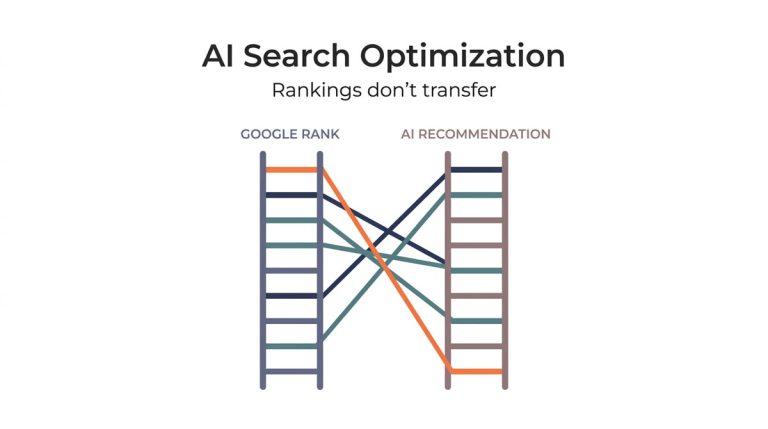
In an earlier study, I showed that good SEO doesn’t guarantee AI visibility. Brands that dominate Google can still get left out when buyers ask ChatGPT. That raised the obvious question: if ranking your own pages isn’t what earns the recommendation, what is?
So I went and looked at the receipts.
I analyzed 1,648 sources that AI actually cited when recommending products, across three engines and three popular categories. The pattern is blunt: AI barely recommends you based on your own website. It recommends you based on what everyone else says about you.
The Headline: 79% of AI’s Sources Are Third Parties
Here’s the whole study in one chart.

Of every source AI pulled from to build a recommendation, 79% were third parties, media articles, review sites, Reddit, YouTube, and only 21% were the brand’s own website. And that 21% flatters brands, because a big chunk of it isn’t product pages at all. It’s companies’ own listicle blogs (more on that below).
Put simply: for roughly every seven sources AI uses to decide what to recommend, only one is the brand’s own site.
The Method
I kept this reproducible on purpose:
- Three popular categories where people genuinely ask AI for recommendations: project management software, mattresses, and VPNs. Each has a different third-party ecosystem, so the finding isn’t a quirk of one niche.
- 21 buyer-style prompts (“best project management software,” “best mattress for back pain,” “best VPN for streaming,” and so on).
- All four major engines: ChatGPT, Google AI Overviews, Perplexity, and Gemini. Each prompt was run several times per engine.
- Instead of tracking brand mentions this time, I captured every source URL each answer cited, then categorized the domains: the brand’s own site, editorial media, review sites, community forums, YouTube, retailers, or other.
Two honest limits. ChatGPT returned answers but almost no linked sources through its API, so it couldn’t contribute citations. Gemini wrapped its citations in redirect URLs, so I resolved those to their real domains (580 of 584 resolved) before counting. The 79% figure is across AI Overviews, Perplexity, and Gemini.
What Kinds of Sources Win
Break the citations down by type and the story sharpens:
- Editorial media, 31%. “Best of” articles from TechRadar, CNET, Forbes, PCMag, and the like. The single biggest bucket.
- Review sites and test labs, 21%. NapLab, Sleepopolis, Mattress Nerd, security.org, dedicated reviewers.
- The brand’s own site, 21%. And often the blog, not the product page.
- YouTube, 12%. Video reviews and explainers, the single most-cited domain in the whole study.
- Reddit and forums, 6%. Real people comparing options.
- Everything else (info sites, retailers) made up the rest.
Editorial, review, and community sources together dwarf owned content. That’s the machinery behind an AI recommendation, and none of it is your homepage.
The More Consumer the Category, the Less Your Site Matters
The overall average hides a sharp gradient. I broke the third-party share out by category.

- Mattresses: 90% third-party. The names you’d expect, Casper, Purple, Saatva, and Nectar, still came up, but almost entirely through review labs and “best of” articles. Their own sites were nearly invisible in the AI answers.
- VPNs: 93% third-party. Even more lopsided. The household names, NordVPN, ExpressVPN, and Surfshark, surfaced through affiliate reviews and Reddit threads far more than through their own pages. This category runs on other people’s recommendations.
- Project management software: 49% third-party. The one category where “brand” citations were close to half. But look closer and most of those aren’t product pages. They’re SaaS companies publishing their own “best project management tools” listicles (Paymo, Zapier, Wrike, Toggl). Even the biggest names, Notion, Asana, and monday, mostly showed up inside other people’s roundups, not on the strength of their own pages.
So the true rate of “AI cites the actual product page” is even lower than 21% across the board. In consumer categories, it rounds to almost nothing.
The Sources AI Actually Cites
This is the part you can act on. AI’s recommendations don’t come from a random long tail. They concentrate in a short, nameable list of places.

YouTube was the most-cited source in the entire study. After it came TechRadar, Reddit, NapLab, CNET, security.org, Mattress Nerd, PCMag, Forbes, and Sleep Foundation. If you’re in one of these categories and you’re not present on those sources, you are not in the conversation AI is having with your buyers.
This is a different to-do list than SEO gives you. It isn’t “optimize your title tags.” It’s “get reviewed, get listed, get talked about on the sources AI trusts.”
Why This Happens
Google and AI answer different questions, and this study is the proof.
Google ranks your page against a query. It rewards your on-page work, your links, your technical health. So you can win Google largely on your own property.
An AI assistant isn’t ranking your page. It’s assembling a recommendation, and it builds that recommendation from what it can find said about you across the open web: the listicles you’re included in, the reviews you’ve earned, the comparisons people write, the threads where real users vouch for you. Your own site is one voice in that chorus, and a quiet one.
That’s why the first study came out the way it did. You can rank beautifully and still lose in AI, because the thing AI reads to make its pick lives mostly on other people’s domains.
What This Means for Your Brand
If you want to show up when buyers ask AI, the work moves off your website:
- Earn placements on the sources AI cites. Get into the “best of” listicles, onto the review sites, into the YouTube round-ups for your category. That is the lever.
- Treat reviews and third-party mentions as an AI-visibility channel, not just reputation management. They’re literally what AI reads.
- Don’t mistake ranking for being recommended. They’re now two separate jobs, and this is the one most brands aren’t doing on purpose.
None of this means SEO is dead. Your site still has to be crawlable, credible, and clear. But your on-page work is table stakes now, not the finish line. The recommendation is won out in the wider web.
That off-site, get-mentioned-and-cited work is exactly what my AI Search Visibility service is built to do, measure where you show up across every engine, then earn the placements that move you. If your rankings aren’t turning into AI recommendations, this is why, and it’s fixable.
FAQ
How does AI decide what to recommend?
It assembles an answer from sources across the web, weighted heavily toward third parties: editorial “best of” articles, review sites, community discussion like Reddit, and video. In this study, 79% of cited sources were third parties rather than the recommended brand’s own website.
Does my own website still matter for AI search?
Yes, but less than most people assume. Your site needs to be crawlable and credible to stay eligible, but it made up only about a fifth of the sources AI cited, and much of that was blog content, not product pages. The recommendation is won mostly off your site.
What is answer engine optimization (AEO)?
Answer engine optimization is the practice of getting your brand named and cited in AI-generated answers rather than only ranking in traditional search results. It’s sometimes called generative engine optimization (GEO). Based on this data, a big part of it is earning third-party mentions, not just optimizing your own pages.
How do I get cited by AI?
Get present on the sources AI actually pulls from in your category: the review sites, the “best of” listicles, the relevant subreddits, and YouTube. Then measure whether it’s working across ChatGPT, AI Overviews, Perplexity, and Gemini. That measurement and outreach is what the AI Search Visibility service handles.