SEO earns your page a position in search results. GEO (generative engine optimization) earns your brand a mention or citation inside AI answers from ChatGPT, Google AI Overviews, Perplexity, and Gemini. Most businesses need both, weighted by how their buyers decide.
Last month a client showed me a Google Search Console screenshot they were proud of. Their main product page ranked in the top three for every term that mattered, yet when I asked ChatGPT the exact question their buyers ask, the brand was nowhere in the answer. That gap is the whole story behind geo vs seo, and it is why I stopped treating the two as the same job.
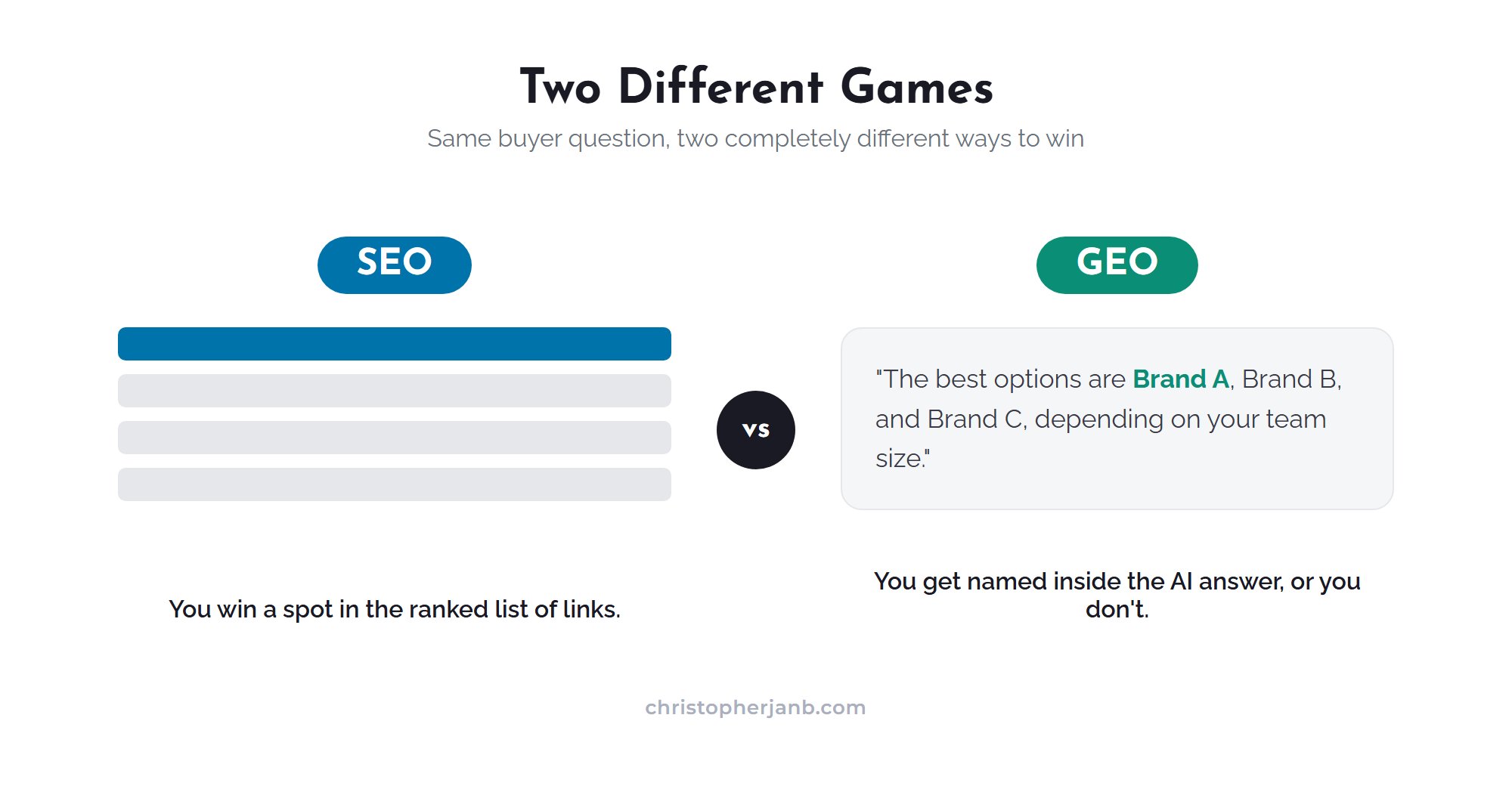
SEO is the work of ranking a page in a list of blue links. GEO, or generative engine optimization, is the work of getting your brand named inside the answer an AI writes when someone asks a question. They sound like cousins. In my testing they behave like strangers.
What Is the Difference Between GEO and SEO?
SEO optimizes a page to rank in Google and Bing. GEO optimizes your brand to be named in AI answers, which draw mostly on third-party sources. Here is the full comparison.
| SEO | GEO | |
|---|---|---|
| What you win | A position in a ranked list of links | A mention inside a written AI answer |
| Where it shows up | Google and Bing results pages | ChatGPT, Google AI Overviews, Perplexity, Gemini |
| What the machine rewards | Your page and its backlinks | What the whole web says about you |
| Who decides | A ranking algorithm sorting pages | A model summarizing sources it trusts |
| How you measure | Rank, clicks, impressions | Share of voice, citations, mentions |
| What moves it | On-page work, links, technical health | Third-party coverage, clarity, being quoted |
SEO asks “does this page deserve to rank.” GEO asks “when the model builds an answer, does your name come up.” A page can win the first contest and lose the second on the same day.
Does Ranking #1 in Google Get You Into AI Answers?
Not reliably. In my test across mattresses, project management software, and VPNs, the brand that leads Google lost the AI answer in two of three categories.
I did not want to argue this from theory, so I ran a test across three categories that have nothing in common: mattresses, project management software, and VPNs. I took seven buyer prompts per category, ran each one across four engines (ChatGPT, Google AI Overviews, Perplexity, and Gemini), and repeated every prompt five times to filter out noise. Then I compared who won in AI against who dominates Google. You can read the full breakdown in who AI recommends.
The pattern held in two of three categories. The brand that owns search lost in AI.
Take mattresses. Casper has more Google traffic than any other mattress brand. It is the name most people would guess. In my AI test it held a 4% share of voice and appeared in one of seven answers. Nectar, the smallest of the group in search, came out on top. The search leader and the AI leader were not close. They were opposites.
Project management told the same story. monday.com sits at number two in Google for the category. In AI answers it finished last in the set I tested. Its search strength did nothing for it once a model was doing the recommending.
VPNs were the cleanest example. NordVPN out-ranks its category by roughly three and a half to one in organic search. It is not a small player pretending. It is the giant. In AI it landed fourth. The ranking muscle simply did not carry over.
One brand held the top spot in both worlds. Asana was number one in Google for project management and number one in AI. When I looked at why, the answer was not its own site. It was the wall of third-party coverage around it. Review sites, roundups, and comparison articles that mention Asana without Asana writing a word of them. That is the tell. Roughly 79% of the sources AI engines cite are third-party pages, not the brand’s own site, which I dug into separately in where AI gets its recommendations.
This was not a one-off. I ran an earlier version of the test on email marketing tools, and the two ladders nearly flipped upside down. The search order and the AI order barely agreed. If you want that one, it is here: does SEO mean AI visibility.
Why Do SEO and GEO Pick Different Winners?
SEO ranks the page you own. GEO summarizes what the whole web says about you, and about 79% of the sources AI engines cite are third-party pages, not brand sites.
Once you see the data, the reason is not mysterious.
SEO judges your page. Google looks at your URL, your content, your links, and it decides where your page belongs in a sorted list. You are the thing being ranked. You control most of the inputs.
GEO judges your reputation. When a model writes an answer, it is not sorting your page against ten others. It is pulling from everything it has read about the category and building a summary. Your own website is one voice among hundreds. What the rest of the web says about you carries more weight than what you say about yourself.
That is why Casper can dominate search and vanish in AI. Casper’s site is strong. Casper’s presence in other people’s content is thin relative to its size. The model does not care how good your landing page is if the sources it trusts keep naming someone else.
So SEO rewards the page you own. GEO rewards the story other people tell about you. Different inputs, different winners.
Should You Focus on GEO or SEO?
It depends on how your buyers decide. B2B SaaS and agencies should treat GEO as a core channel, local businesses should keep most of their weight on SEO, and most others need both.
| Business type | Priority | Why |
|---|---|---|
| E-commerce and DTC | Both, weighted to SEO | Search still sells product, but “best X for Y” questions are moving into AI answers |
| B2B SaaS | GEO as a core channel | Buyers ask AI for a shortlist before they search |
| Local and service businesses | SEO first | Local and “near me” intent still runs through search and maps |
| Publishers and affiliate sites | Both | SEO feeds the traffic, GEO decides whether you get quoted |
| Agencies and consultants | GEO first | AI shortlists of agencies are built from third-party mentions |
The honest answer to “SEO or GEO” is “it depends on what you sell and how people buy it.” Here is how I actually decide, by business type.
E-commerce And DTC Brands
Search still moves product here, so do not walk away from SEO. But your category is exactly where AI answers are eating the “best X for Y” moment. If a shopper asks ChatGPT for the best mattress for side sleepers and you are not in the answer, you lost the sale before they reached a page. Keep your SEO, and put real effort into third-party coverage: reviews, roundups, and comparison pieces that name you. The Casper result is your warning label.
B2B SaaS
This is where GEO matters most and where the divergence is widest. Buyers ask AI to shortlist tools before they ever run a search. monday.com and NordVPN both prove that a strong search position will not save you here. If you are in a crowded software category, treat GEO as a first-class channel, not a bonus. Your goal is to be the name that shows up in “top tools for X” content across the web, the way Asana is.
Local And Service Businesses
SEO still earns its keep here. Local intent, maps, and “near me” searches are not going away, and AI answers for local queries are thinner and less settled. I would keep the weight on SEO and local signals, then add light GEO by making sure directories, local roundups, and review platforms describe you clearly. You do not need to win every AI answer. You need to not be missing from your own city.
Publishers And Affiliate Sites
Your traffic model is the one most exposed to AI answers, because a good answer can satisfy the reader without a click. SEO gets you the ranking that feeds the traffic. GEO decides whether the model quotes you or quotes past you. Focus on being the source worth citing: original data, clear claims, and specifics a model can lift. Vague content gets summarized away.
Agencies And Consultants
You are selling trust, and trust is now partly decided inside AI answers. When a prospect asks ChatGPT to name good agencies in your niche, that answer is built almost entirely from third-party mentions. Your own site barely counts. This is a GEO problem wearing an SEO costume. Get named in industry lists, podcasts, and other people’s content.
How Do You Decide Between GEO and SEO?
Ask one question: do your buyers ask an AI to recommend a shortlist before they decide? If yes, prioritize GEO, because search rank alone will not protect you. If they still browse and click through a results page, SEO carries more of the load, with GEO as the hedge.
Most businesses I work with need both, but rarely in equal measure. The mix depends on how your specific buyer behaves, not on which acronym is trending.
The mistake I see most is assuming a strong SEO position already covers the AI side. The data says it does not. The brands winning search are often invisible in AI, and the fix is a different kind of work. If you want to see where your brand actually stands inside AI answers before you spend a dollar changing anything, that measurement is what my AI Search Visibility service is built to do.
For the broader playbook that ties both sides together, start with my guide to AI search optimization.
GEO vs SEO FAQ
Is GEO replacing SEO?
No, and I would be careful with anyone who says it is. SEO still drives the majority of qualified traffic for most businesses. GEO is a second channel that behaves differently and needs its own work. You run both.
Can good SEO help my GEO?
A little, but less than you would hope. Some ranking signals overlap, so strong SEO can nudge AI visibility. My rank-flip data shows the overlap is weak. Search leaders lose in AI all the time, which means SEO alone is not enough to win the answer.
How do I even measure GEO?
You track share of voice, mentions, and citations across the main engines instead of rank and clicks. The question changes from “where does my page rank” to “when the model answers, how often is my brand named and cited.”
If I only have budget for one, which comes first?
Start with the one your buyers use to decide. If they ask AI for a shortlist, prioritize GEO. If they still browse a results page, prioritize SEO. Then add the other as budget allows, because the brands winning long term are showing up in both.