This is the sixth study in my series on how AI engines choose their sources. The first five looked at who and what AI recommends. This one tests the advice that SEOs, including me, give for getting cited: answer the question first, keep paragraphs short, add numbers, dates and an author, and so on.
I scored pages against 15 of those best practices, then compared the pages Google’s AI Overviews, ChatGPT and Perplexity cited with the pages they read or ranked and then skipped.
Do AEO Best Practices Get Your Page Cited by AI?
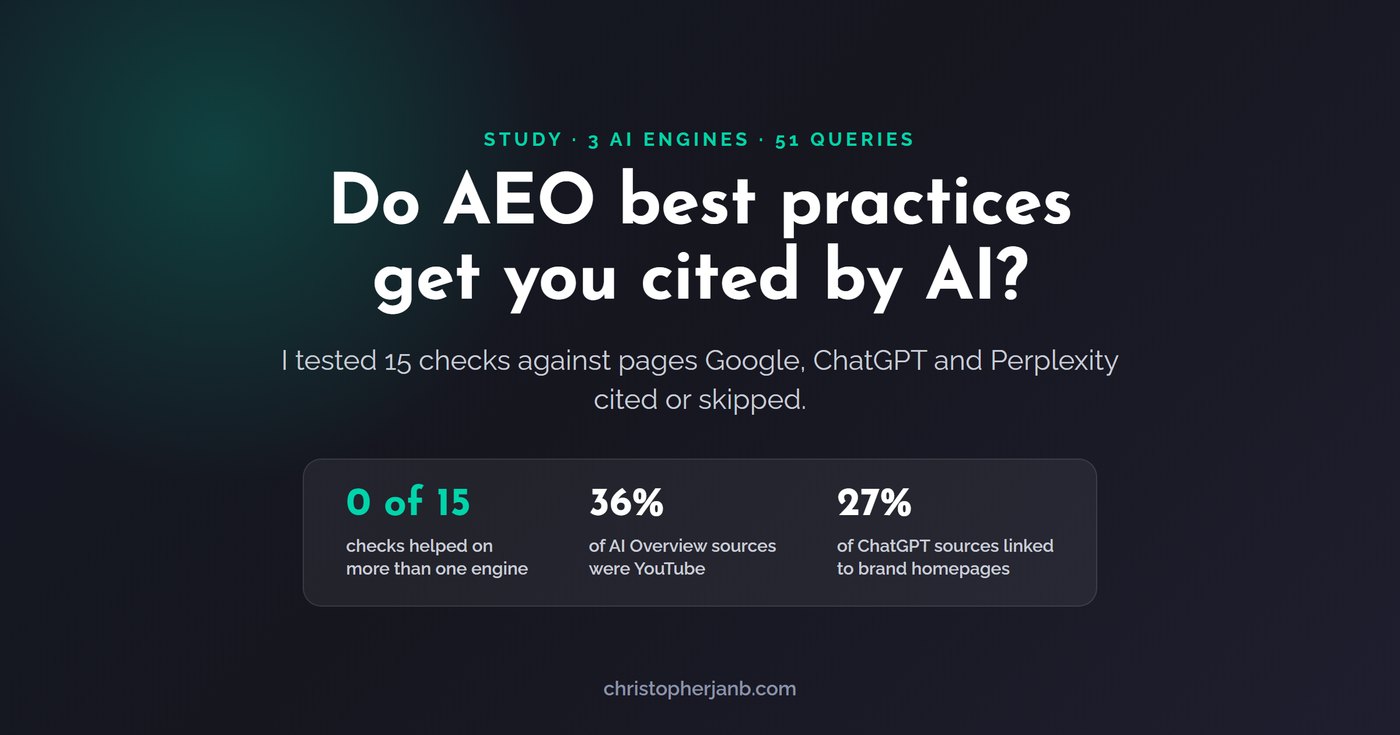
No. Across 51 queries and three engines, pages that followed more AEO best practices were not cited more often than pages the same engine read and skipped.
A cited page beat a skipped page on these best practices 44% of the time on Google’s AI Overviews, 41% on ChatGPT and 55% on Perplexity. A coin flip is 50%. Only ChatGPT’s result sits clearly away from 50%, and it points the wrong way: ChatGPT’s cited pages followed fewer best practices than the pages it read and passed over.
What did differ was the type of source each engine picked. Google leaned on YouTube for 36% of its AI Overview sources. 27% of ChatGPT’s sources were brand homepages, mostly links to the brands it recommended. Perplexity cited longer articles.
Before the details, one disclosure. My own guides recommend several of these practices. My guide to ranking in Google AI Overviews says “Put the answer first,” and my AI search optimization guide says to keep pages “crawlable, answer-first, and fresh.” This study is me testing that advice, and the section on what to do now says what I’d change.
How I Ran the Study
I picked 51 US searches:
- 21 commercial searches from my earlier studies, such as “best VPN for privacy”, “best mattress for side sleepers” and “best project management software for agencies”.
- 30 informational searches, such as “what is a roth ira”, “how to unclog a drain” and “what is schema markup”.
On November 10, 2026, I ran them through three engines using DataForSEO:
- Google AI Overviews: one desktop search per query, with the top 10 results and the AI Overview pulled in the same request. 49 of the 51 searches showed an AI Overview.
- ChatGPT: the consumer ChatGPT interface with web search switched on, run twice per query.
- Perplexity: the Sonar model through Perplexity’s API, run twice per query.
ChatGPT and Perplexity both return two lists: the pages they read while searching, and the pages they cited in the answer. That gives a clean comparison. For each query, I compared the pages an engine cited with the pages it read and then didn’t cite. For Google, which doesn’t expose what it read, I compared cited pages with top-10 pages for the same search that the AI Overview skipped.
Then I scored every page with the same 15 checks:
- Access: AI search bots allowed in robots.txt, no noindex or nosnippet rules, main content present without JavaScript.
- Easy to quote: question headings answered in one sentence, the answer near the top, direct statements instead of hedged ones, short paragraphs, a sensible number of headings, tables or lists.
- Specific and sourced: numbers and dates, named entities, links to sources.
- Dated and attributed: publish and update dates in the page’s structured data, a named author, valid structured data.
These checks are the AEO Checker I built, run as a script. The whole data pull cost $1.11.
Five notes before the numbers:
- This is one day of data, US only. AI answers change from day to day, so this is a snapshot.
- Perplexity was tested through its API, not the Perplexity app most people use.
- I scored web pages only. YouTube videos, Reddit threads and other platform pages were left out of the scoring, because their structure isn’t something a site owner controls. About 22% of the remaining pages refused or blanked my fetcher, mostly with a 403 error, so they couldn’t be scored either.
- Some checks are estimates. Hedging, named entities and “answer near the top” are measured with text rules, not by a person reading the page.
- I report one number throughout: the chance that a cited page scores higher than a skipped one. Statisticians call it AUC. 0.50 means the score tells you nothing, above 0.50 means cited pages scored higher, below 0.50 means they scored lower. Each result comes with a 95% range.
Did Cited Pages Follow More AEO Best Practices?
Cited pages did not follow more AEO best practices on any of the three engines. Their average score was the same as, or lower than, the pages each engine skipped.
| Engine | Compared with | Cited pages (avg score) | Skipped pages (avg score) | Chance a cited page scores higher |
|---|---|---|---|---|
| Google AI Overviews | Top-10 pages the AI Overview skipped | 64.9 (180 pages) | 68.0 (201) | 0.44 (0.38 to 0.50) |
| ChatGPT | Pages it read but didn’t cite | 64.8 (364) | 69.0 (540) | 0.41 (0.37 to 0.44) |
| ChatGPT | Google top-10 pages it didn’t cite | 64.8 (364) | 67.8 (208) | 0.43 (0.38 to 0.48) |
| Perplexity | Pages it read but didn’t cite | 65.6 (226) | 63.3 (183) | 0.55 (0.49 to 0.60) |
| Perplexity | Google top-10 pages it didn’t cite | 65.6 (226) | 68.3 (207) | 0.47 (0.41 to 0.52) |
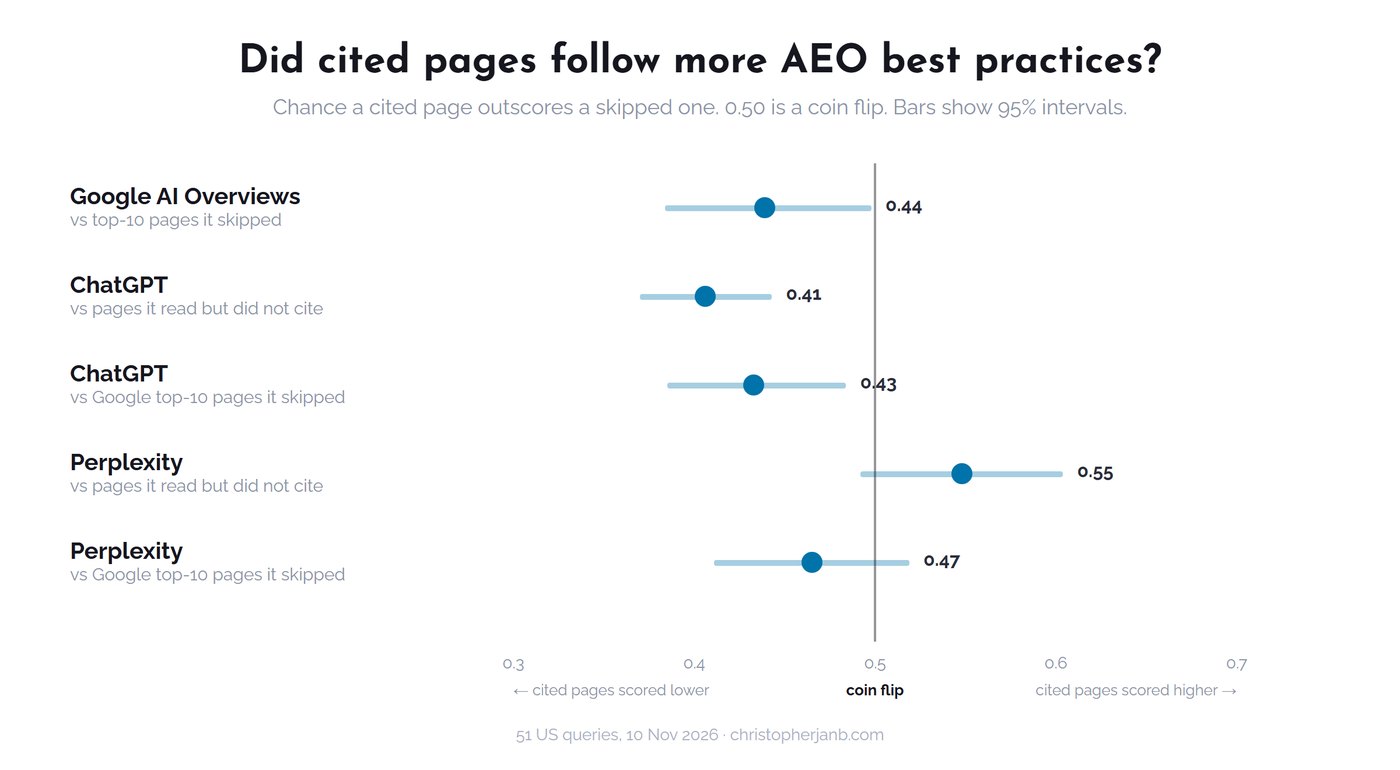
Engine by engine:
- Google’s AI Overviews showed no preference. Within the same search, cited pages scored higher than skipped top-10 pages in 24 of 47 searches. That’s a coin flip.
- ChatGPT preferred pages that scored lower. Most of that comes from homepages, which score badly on article checks and which ChatGPT cites often (more on that below). With homepages removed, the result moves to 0.46 (0.42 to 0.50): still no preference for best-practice pages.
- Perplexity leaned slightly toward higher-scoring pages, but its range includes 0.50, so the data can’t rule out chance.
Which AEO Best Practice Made the Biggest Difference?
No single best practice made a consistent difference. Four checks helped a little on one engine each, and none helped on more than one.
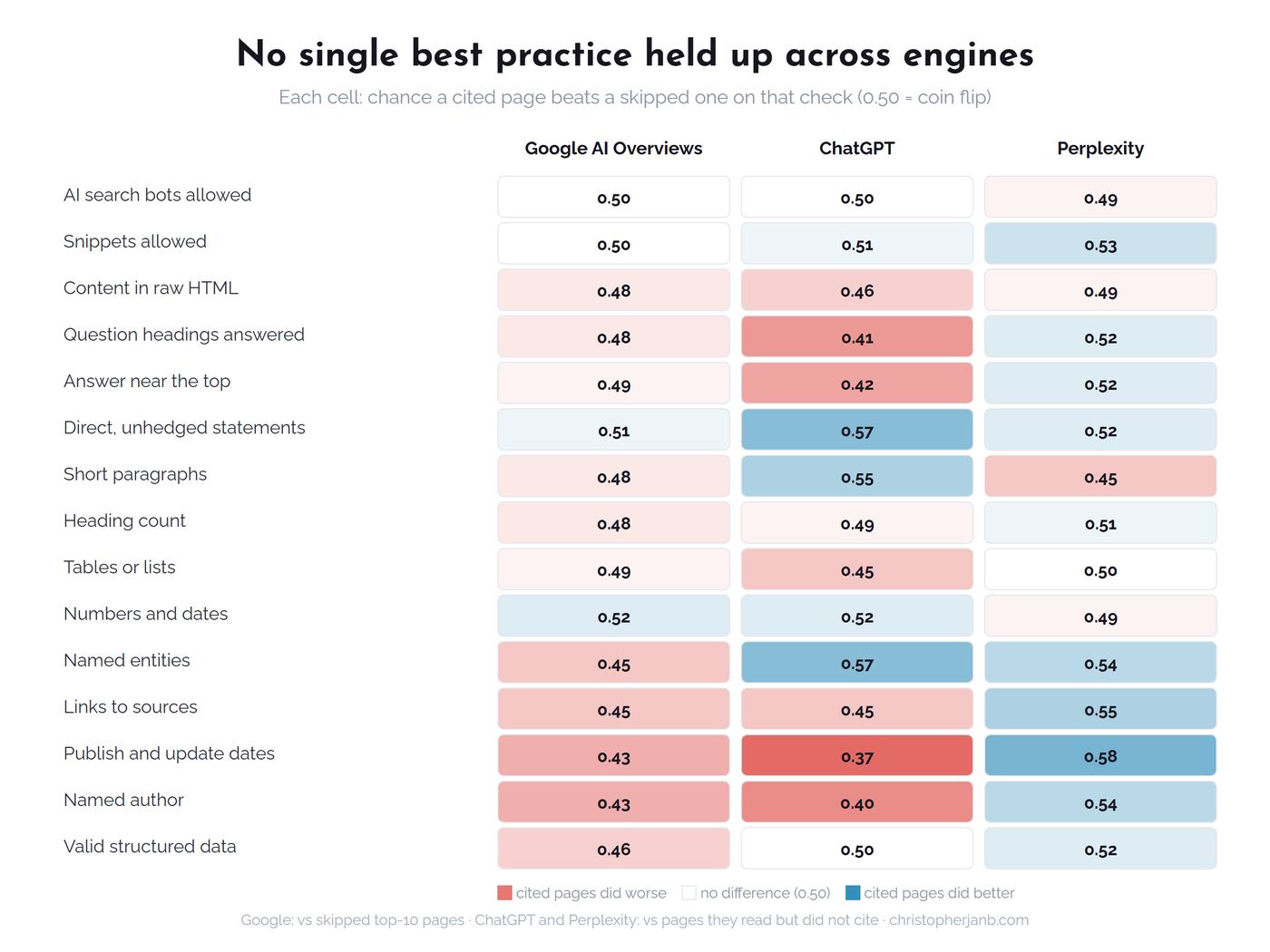
The ones that moved:
- Question headings answered in one sentence (often called answer capsules) scored 0.41 on ChatGPT. Pages ChatGPT cited had fewer of them than pages it read and skipped. On Google it was 0.48 and on Perplexity 0.52.
- Publish and update dates split the engines: 0.58 on Perplexity, 0.43 on Google and 0.37 on ChatGPT. The same check helped on one engine and hurt on the other two.
- Direct statements, short paragraphs and named entities each reached 0.55 to 0.57 on ChatGPT, and sat near 0.50 or below elsewhere.
That’s 45 tests (15 checks × 3 engines). At that count, two or three would land away from 0.50 by chance alone, so I’d treat any single-engine effect here as small and unconfirmed until a rerun shows it again.
What Did Each Engine Cite Instead?
Each engine leaned hard on one type of source. Those gaps (36% YouTube on Google against none on the other two, 27% homepages on ChatGPT against 1% of the pages it skipped) are far bigger than any difference the checklist picked up.
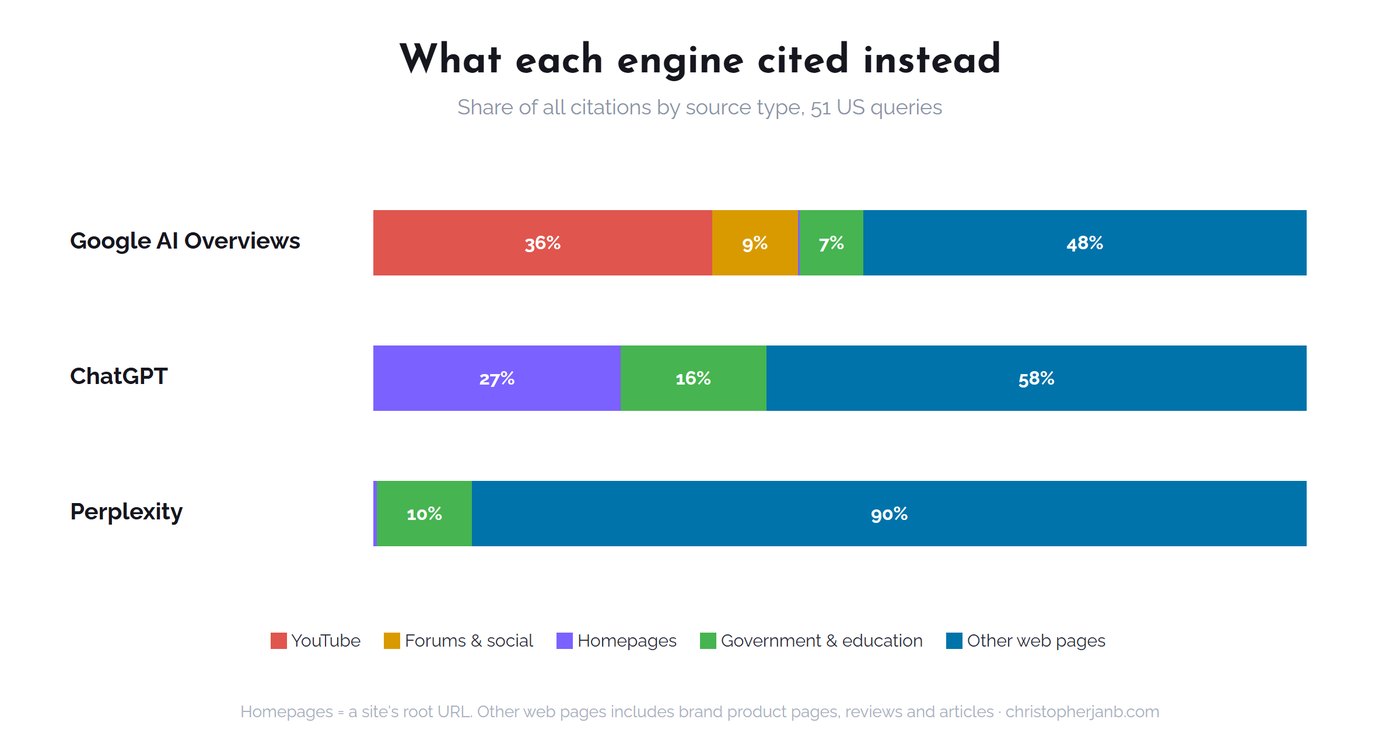
- Google AI Overviews cited YouTube for 36% of its sources (166 of 457), plus another 9% from forums and social sites like Reddit and Facebook. Only 6.3% of AI Overview sources were also in the top 10 organic results for the same search. Ranking in the top 10 and being an AI Overview source were almost separate lists.
- 27% of ChatGPT’s sources were brand homepages, against 1% of the pages it read and skipped. Most of these weren’t pages it quoted: 71% were links attached to the brands it recommended, titled “Visit ClickUp” or “Surfshark official website”. For “best project management software”, that meant links to ClickUp, Asana and Monday alongside the reviews it actually drew on. ChatGPT’s other cited pages were also shorter: a median of 1,069 words, against 1,840 for pages it read and skipped.
- Perplexity cited regular web pages 90% of the time and preferred long ones: a median of 2,582 words for cited pages, against 1,477 for pages it read and skipped.
- The engines rarely agreed. Across 1,050 page-and-query pairs that at least one engine cited, only 17 were cited by all three. Perplexity overlapped most with the others (29% of its cited pages were also cited by another engine for the same search). Google overlapped least (12%).
None of the 15 checks can see these patterns. A how-to page can’t become a YouTube video by adding a question heading, and no checklist item gets a brand onto ChatGPT’s shortlist.
Why Do Other Studies Find That Best Practices Work?
Most published AEO statistics describe pages that were cited without comparing them to pages that weren’t. A finding like “most cited pages answer the question in the first sentence” tells you what cited pages look like. It doesn’t tell you whether that’s why they were cited.
To know that, you need a comparison group: pages that were just as available to the engine and didn’t get cited. In this study the comparison group is pages the engine read or ranked for the same search. Once you add it, the skipped pages follow the same best practices at the same rates. These features are simply common on pages that compete for a search.
This isn’t a criticism of anyone who published those numbers. Most were never designed as tests. I made recommendations from the same kind of evidence until I ran this one.
Should You Stop Writing Answer-First Content?
No. Keep writing answer-first content because it helps readers. A page that answers the question in the first sentence is easier to use, and once an engine picks your page, a clean answer is easier for it to quote correctly.
What I’d change in my own advice:
- Stop selling structure as the lever. “Add answer capsules to get cited” isn’t supported by this data. “Add them because they help readers and make quoting easier” is.
- Fix access first. A page an engine can’t fetch can’t be cited. It’s the one part of the checklist that’s a hard requirement. In a quick probe of 120 sites from this study, 10 refused or challenged a request labelled as PerplexityBot even though their robots.txt allowed it, most likely because of a firewall or CDN rule.
- Match the source type the engine wants. If AI Overviews answer your topic with YouTube videos, a video may do more than another rewrite of the article. If ChatGPT answers your category by recommending brands and linking their homepages, the goal is to be one of the brands it names. That comes from appearing on the review and list pages it reads, not from rewriting your homepage.
- Look outside the page. This study didn’t measure brand authority, reviews or third-party mentions. My earlier studies on whether AI recommends the brand that ranks #1 and where AI gets its recommendations point to those as the bigger factors.
My AI search optimization guide already calls on-site work eligibility and off-site work the lever, and this data backs that. I’ll update the AI Overviews guide so its answer-first advice says the same.
Check Your Own Page
Given these results, I built the free AEO Checker around the one part that is a hard requirement: can AI engines reach the page? It answers Yes, Mostly or No by checking:
- robots.txt rules for the eight crawlers behind Google AI Overviews, ChatGPT, Claude and Perplexity search
- a live request as each of six AI search bots, to catch firewall or CDN blocks that robots.txt doesn’t show
- noindex, nosnippet and max-snippet rules
- whether the main text is in the HTML or only appears after JavaScript runs
The best practices from this study sit below that as an optional “easy for readers to use” checklist, labelled for what it is: a quality pass for people, not a visibility score. There’s no score out of 100, and it runs without sign-up.
The second tool acts on the bigger finding. The free AI Citation Map takes one search, asks Google’s AI Overview, ChatGPT and Perplexity live, and shows every page they cite, what type of source each one is, whether your site is cited or read and skipped, and which list pages, videos and threads to work on next.
What Are the Limits of This Study?
- One day, one market. Everything comes from November 10, 2026, US searches only. AI answers change daily, so I plan to rerun this.
- 51 searches across three topics (VPNs, mattresses, project management) plus 30 general how-to and what-is questions. Other topics, especially local, medical or news searches, may behave differently.
- Perplexity through its API. The consumer app may cite differently.
- Readable web pages only. Platform pages were excluded, and about 22% of web pages blocked my fetcher.
- Text-rule estimates. Some checks use text patterns, which miss nuance a human reader would catch.
- Correlation only. I didn’t change any pages and watch what happened. A controlled test would be stronger.
The raw data (2,486 rows: query, engine, page, whether it was cited, source type and every check result) is free to download: aeo-best-practices-study-data-2026-11.csv.
FAQ
What is an answer capsule?
An answer capsule is a short, direct answer, usually one sentence of 20 to 40 words, placed right under a heading phrased as a question. It’s a common AEO recommendation. In this study, ChatGPT’s cited pages had fewer of them than the pages it read and skipped, and Google and Perplexity showed no clear preference either way.
Does llms.txt help you get cited by AI?
This study didn’t test llms.txt, and no major AI engine has confirmed it reads the file. The AEO Checker reports whether a site has one but doesn’t count it.
Do these results apply outside the US?
Not necessarily. All searches ran from the US in English. My earlier study of who AI recommends as the best SEO expert in the Philippines showed that answers for Philippine searches draw on different sources, so a separate test would be needed for other markets.
Will you rerun this study?
Yes. AI engines change often, so I plan to run the same 51 searches again and publish whether the results hold.