

Author: Camille Concepcion

  • How to Use AI SEO for Your Website Optimization

    How to Use AI SEO for Your Website Optimization

    SEO is why your website is visible in the sea of countless online content. But doing it alone can feel like navigating through a complex maze. There’s just a lot to do and learn.

    On top of that, you have to be aware of new SEO trends. This is not the best way to spend your time as a business owner.

    The good news is that there’s a smarter method to do things faster and more efficiently. And that’s through the help of AI SEO software.ana

    In this article, we’ll discuss the process and the best tools to use in each step. I’ll also share the origin of artificial intelligence and the future of SEO with it. By the end, you’ll know how to up your SEO game, save valuable time, and enhance your site’s visibility and ranking.

    Understanding AI

    how to use AI SEO

    At its simplest, AI or Artificial Intelligence is the science of making machines and software think logically. This is a definition I got from one of the founding fathers, Professor John McCarthy

    It’s all about creating programs that perform tasks that would typically require human intervention. AI generally allows us to optimize processes and unleash a new efficiency level. 

    But when do you think was the idea of AI first conceived? Is it in the 21st century? Well, it was actually earlier than that. 

    AI was conceptualized mid-20th century. But because of how expensive computing resources were then, it wasn’t until 1955 that the birth of the first AI program emerged

    Since then, AI has grown and evolved, becoming a critical tool in numerous industries. It’s revolutionized healthcare, finance, entertainment, and digital marketing.

    The Transformation of SEO by AI

    AI has become a game-changer in the world of SEO. It’s transforming content creation and improving areas like SEO page optimization, keyword research, and backlinking.

    You can unlock many cool perks that help your online presence by blending AI with SEO. Despite some companies opposing it, a BrightEdge study revealed that over 58% of marketers plan to adopt AI SEO strategies this year (2023.) 

    This surge in interest shows the increasing importance of AI in making your website visible and searchable to your audience. 

    Why Invest in AI SEO

    Embracing these search engine optimization tools is a smart move for digital entrepreneurs. Here are some benefits that highlight its worth:

    • It Provides More Accurate Data. AI SEO tools are designed to comb through vast amounts of data, identify patterns, and provide insights that can help improve your website’s SEO.
    • It Gives You Competitive Advantage. You can identify content, keywords, or other gaps your competitors are missing out on and strategically fill them in. 
    • It Increases Efficiency and Speed. AI lets you streamline redundant and time-consuming tasks. For example, AI can automate keyword research, content optimization, and data analysis. And that allows you to operate at optimum efficiency.
    • It Provides a Forecast Based on Solid Data. With AI SEO, you’re not just guessing; you’re using data-driven insights to predict your SEO strategy results. 
    • It Allows Some Customization. AI-powered SEO tools can learn from your website’s data and understand what works best for your audience. It can then tailor SEO tactics to suit your website’s unique needs. 

    How to Use AI SEO to Optimize Your Website

    Step 1 – Do Keyword Research with AI SEO 

    AI-powered software can help you find keywords for website much more effectively than if you were to do it manually.

    You see, they take into account a whole lot of data and details. We’re talking about search keyword ranking and volume, current trends, difficulty, and other information you might miss.

    And instead of looking at every page on Google, all you have to do is type in your main keyword. The AI SEO software will provide you with relevant terms along with the crucial metrics. 

    Some of the best free keyword tools are Answer the Public, Keyword Surfer, and Google Keyword Planner. They provide the right mix of simplicity and power to get you started on your SEO journey.
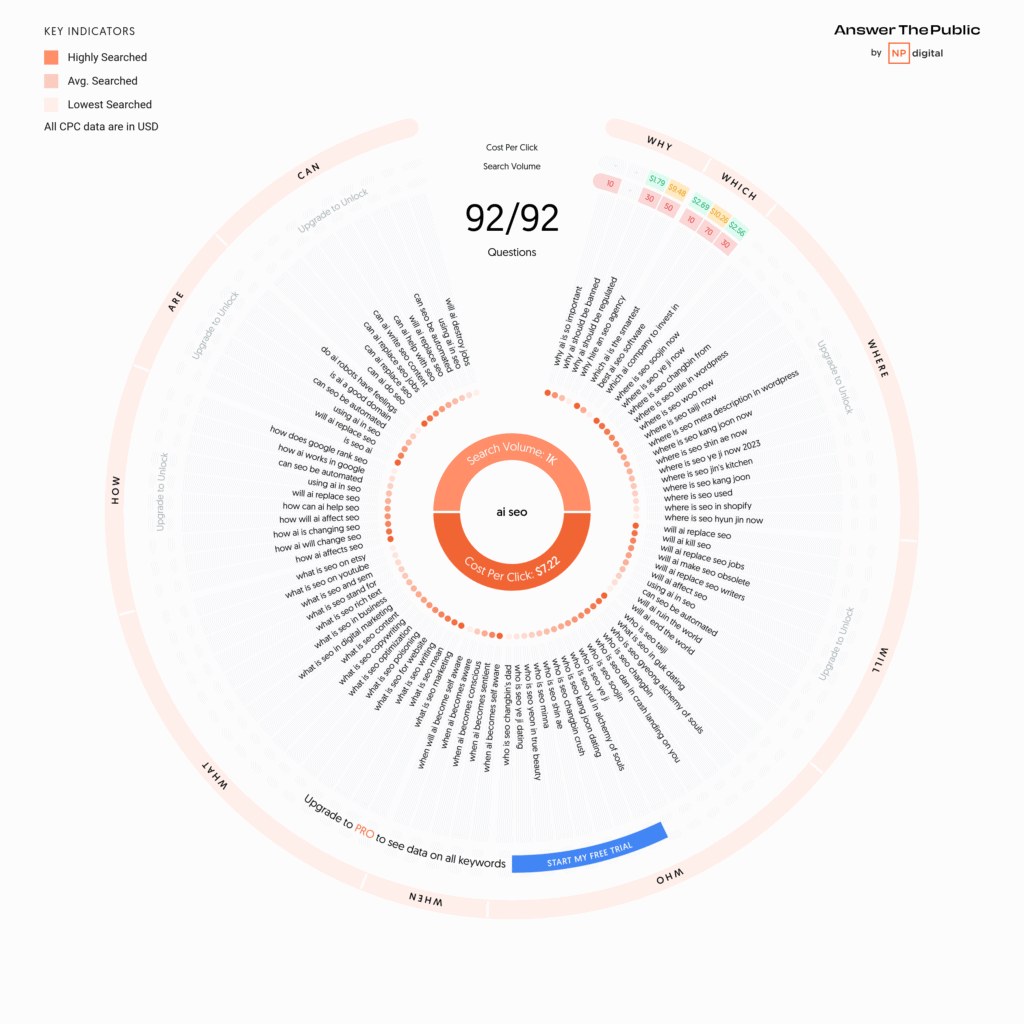
    But if you want to target your competitor’s keywords and have the budget to invest in paid tools, I recommend getting tools with a website analyzer like KWFinder, SEMrush, or SE Ranking

    Step 2 – Write High-Quality Content Using AI SEO

    Creating high-quality content can sometimes feel like solving a puzzle, but AI content writing tools can help turn this complex task into a simple one. 

    These tools that I’ll provide can help you create outlines, provide titles, produce meta descriptions,  and even remove writer’s block by generating the paragraphs and sentences you need. 

    AI content writing tools such as ChatGPT and Jasper.ai are by far my favorites. You can provide them with questions or prompts, and they churn out useful AI content in no time.

    However, you need to tread with caution. Relying solely on AI to do your writing can sometimes lead to inaccuracies.

    It can also be too generic and robotic. So while it’s an excellent tool for outlining and drafting, you should still be actively involved in the writing process. Think of it as a co-writer rather than your replacement.

    Step 3 – Optimize Content With AI SEO

    As an SEO writer, one of the most challenging parts for me is content optimization. I have to ensure that my content is not only engaging and relevant. But it should also be optimized for search engine algorithms. 

    Thankfully, there are tools like SurferSEO, Rankmath, and Yoast SEO. Let me show you how they can help with your SEO tactics. 

    SurferSEO can help you evaluate your new or existing content and see what parts you can improve. It scores your article based on its quality and SEO-friendliness.

    In addition, you’ll also see which are the best terms to target based on your chosen competitor articles. It uses the power of Natural Language Processing or NLP, which allows you to enhance the comprehension, relevancy, and overall quality of your content. 

    I use SurferSEO for most of my clients, and it’s one of the best. It’s super easy to use and very effective. 

    Here’s an example of an article I wrote with this optimization platform. 
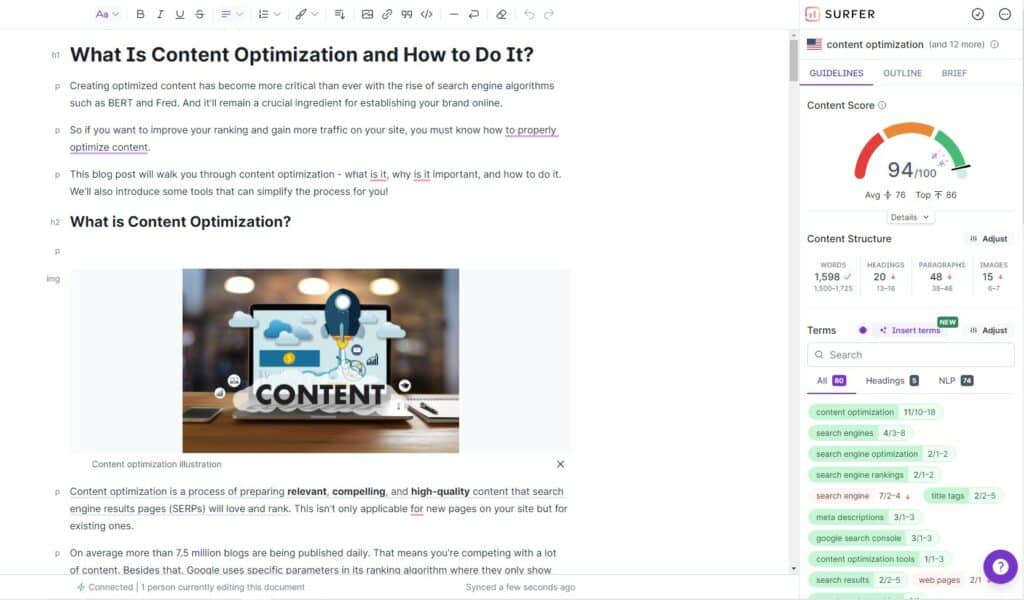
    RankMath is another brilliant tool that you can use as a WordPress plugin. It provides a detailed checklist to ensure your content is SEO-ready before you hit the ‘publish’ button.

    Artificial Intelligence isn’t just enhancing your on-page SEO efforts; it’s also shaking up off-page strategies, including backlink analysis.

    Navigating the backlink landscape can take time and effort. But it’s a crucial part if you want to do search engine ranking optimization.

    Why? Because a healthy backlink profile is akin to a good reputation in the digital world. It convinces search engines your website is credible and trusted by others, pushing you higher in the search. 

    AI SEO tools such as Ahrefs and SEMrush help demystify the complexity of backlink analysis. Ahrefs, for example, offers an in-depth view of your or any website’s backlink profile.

    You can use this to identify your strongest and weakest links. Or study your competitor’s profile. 
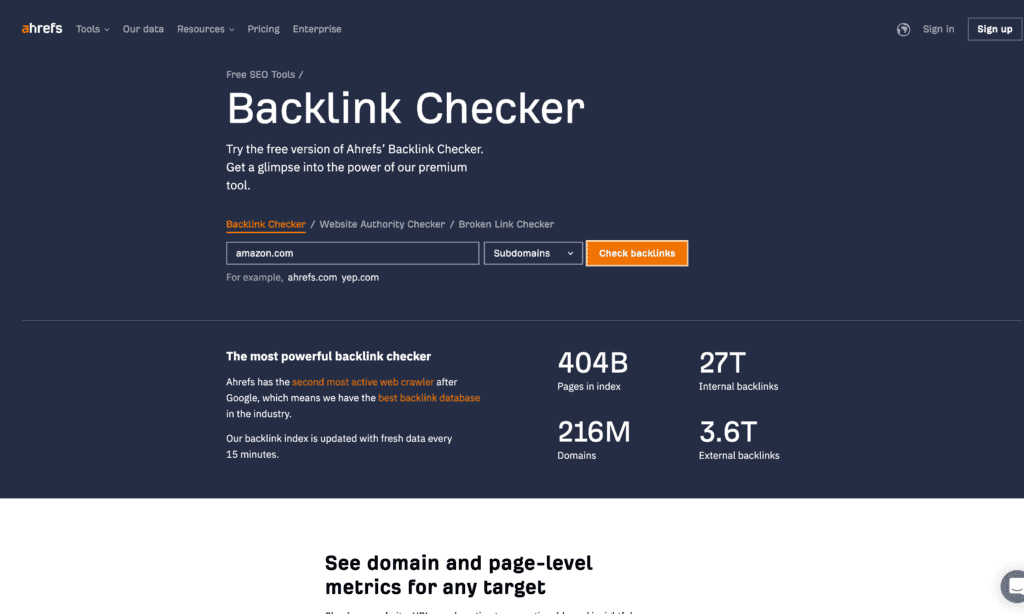
    Similarly, SEMrush delivers comprehensive backlink analytics, making it easy to monitor your link-building progress and provide insights into your competitors’ backlink strategies.

    The Future of AI in SEO

    Experts like Neil Patel and Rand Fishkin have provided their opinion on AI. And they are positive that it will only get better in the years to come.

    To provide you with proof, let me quote what Rand says about it. 

    “I think we’re going to see a continued move towards more personalized search results, and that will be driven by both better use of data as well as machine learning models.  I also believe we’ll start to see Google put more emphasis on entities, rather than just keywords, as they continue to try and better understand the searcher’s intent,”

    Rand Fishkin, co-founder of Moz

    The message is clear – AI is here to stay. 

    Conclusion

    So, there you have it!

    From boosting your keyword research to creating and optimizing your content and analyzing your backlinks, AI SEO tools can be your powerful allies. 

    I want to end this post with a quote from Ginni Rometty: “Some people call this artificial intelligence, but the reality is this technology will enhance us.” 

    If you want to move forward, you should never avoid technological advancements. Instead, you need to learn how to augment them in our processes so they can be more efficient and effective.

    After all, it’s about working smarter, not harder. 

    So, check the apps I mentioned above and use them for search engine optimization. 

  • How to Build an Effective Content Hub: Key Steps and Benefits

    How to Build an Effective Content Hub: Key Steps and Benefits

    Have you ever heard the term “content hub” and wondered what it is and how it could benefit your online business? 

    Today, I’ll answer those questions and teach you how to build an effective content hub. 

    I’ll keep it as simple as possible. So you can grasp the idea quickly and use it to improve your website’s authority.

    Sounds good? Let’s get started.

    What is a Content Hub?

    A content or marketing hub is a centralized space where your digital content – blogs, videos, e-books, podcasts, and more – lives and interconnects. 

    It acts like a one-stop shop for your audience to explore and engage with your content. 

    The best example I found is Hubspot’s content marketing hub. It’s a space where you can see the platform’s various content categorized into different types and niches. 

    effective content hub example - Hubspot's marketing hub

    Another content hub example you should check is Investopedia‘s home page. Once you open it, it will welcome you with the latest articles, podcast episodes, its market simulator, and so much more. 

    Benefits of an Effective Marketing Hub 

    A content hub brings a wealth of advantages in SEO and content marketing. Here are some of them: 

    • Improved Engagement: It makes it easy for readers to explore your media content in one spot. So they can easily find what they want to consume. 
    • Better SEO: It’s like giving Google a map of your site. That allows the search engines to understand your site, crawl it better, and boost your SEO efforts.
    • Streamlined Content Management: A content hub will enable you to sort everything and reduce duplication. 
    • Expert Status: Your content hub is also a great place to showcase your knowledge, experience, and skills. 
    • Stronger Branding: A content hub lets you consistently display your brand’s voice and style across content. And that reinforces your image and helps build audience loyalty.

    Key Steps for Building an Effective Content Marketing Hub

    Although content hub offers numerous benefits, it can only be valuable when executed correctly. 

    The following comprehensive guide outlines the steps to create a solid content hub.

    Step 1: Determine Your Objectives and Target Audience

    Before anything else, establishing your objectives and defining your target audience are crucial first steps. 

    Neglecting this step can lead to lacking direction and clarity, resulting in scattered, irrelevant, or ineffective content.

    Here’s a step-by-step guide to help you. 

    • Conduct thorough research: Review your audience’s demographics, behavior, and interests. Check relevant groups and forums, utilize keyword research tools like ‘Answer the Public,’ and study your competitors.
    • Map out your audience’s interests: Identify the topics and types of content your audience finds most engaging. 
    • Use targeted questions: Questions like those listed in Indeed’s guide to targeting can provide insights into your audience’s needs, goals, and challenges.
    • Build customer personas: Based on your research, create representative profiles of your target audience. This can guide your content creation and ensure it aligns with your audience’s preferences. You can use Hubspot’s Make My Persona for this. 
    hubspot's personal builder for effective content hub creation

    Remember, this process requires careful thought and planning, but the time invested will pave the way for a thriving content marketing hub.

    Step 2: Plan and Organize Your Content 

    Once you understand your goal and target audience, it’s time to plan your content. Here’s what you can do. 

    Choose Your Central and Sub-Topics

    Picking a core topic for your content hub is like setting your North Star – it guides all your content creation efforts. 

    This topic should be broad enough to branch out into related sub-topics. So you can provide a diverse yet interconnected content pool. 

    Let’s say you run a fitness blog; your core topic might be ‘Healthy Living,’ and sub-topics could include “Nutrition,” “Exercise Routine,” and “Mental Health.”  

    Tools like WriterZenAnswer the Public, or Buzzsumo can help you identify trending and related topics.

    Select the Type of Content Hub

    Content hubs come in many shapes and sizes. 

    • Hub Spoke Model: This is where you have one main piece of content (the hub), with related content (the spokes) branching off it.
    • Content Database: This is a vast collection of content. Your visitors can search through it to find exactly what they’re looking for.
    • Content Library: It’s like a bookshelf of various content types, neatly organized by category so users can find relevant material easily. The Hubspot content hub above fits this. 
    • Topic Gateway: This is a blend of resources focused on a specific topic. It’s perfect for comprehensive exploration and catering to long-tail keywords.
    • Topic Matrix: A layout that neatly organizes lots of content under topics, perfect for sites with heaps of information to share.

    You may check Portent’s blog on how to choose a content hub for a more detailed explanation. 

    Choose Your Media Content 

    Variety is the spice of life, and it’s no different with content. 

    Mixing up your content types – blog posts, infographics, videos, podcasts, or interactive quizzes – caters to different audience preferences and learning styles. 

    Use your audience research to inform your content mix, and be bold and experiment and track engagement levels.

    Create an Editorial Calendar

    An editorial calendar is your content’s roadmap. 

    It helps you plan, coordinate, and visualize your content creation and distribution schedule, keeping your hub fresh and dynamic. 

    Tools like TrelloAsana, or even Google Sheets can help you track your content’s progress from idea generation to publication.

    Step 3: Design and Develop Your Content Hub 

    When it comes to your content hub, remember this golden rule: stellar content deserves an equally stellar home. So let’s talk about design!

    First, pick a design and layout that’s attractive and matches your brand’s aesthetics. Consistency is key in reinforcing your brand image. 

    Secondly, make it navigable! Create a structure that guides your audience smoothly from one piece of content to the next, allowing them to explore easily.

    Next, make your content pop with graphics and images that draw the eye. But don’t stop there; help your audience find what they’re looking for with a robust search function. 

    Lastly, ensure a seamless experience across all devices. Whether on a desktop or mobile, your hub should shine!

    To sum up, a well-designed hub gives your content the spotlight it deserves, improving user engagement. 

    Step 4: Create and Publish Compelling Content 

    Once you’ve established your main topics and subtopics, it’s time to roll up your sleeves and create engaging content. 

    Remember, the lifeblood of your content hub is high-quality, valuable, and relevant content. It will draw your audience in and keep them coming back for more.

    Reoptimizing your existing content can also be highly beneficial at this stage. Look for opportunities to update, repurpose, or enhance your old content to align with your new content hub strategy.

    Here are some best tips to remember when you create content:

    • Use Storytelling: A well-told story can captivate your audience, engage their emotions, and make your content memorable. Try weaving a story into your content, whether a case study or a blog post.
    • Add Multimedia Elements: Different types of multimedia – videos, images, infographics, podcasts – can make your content more dynamic and engaging. 
    • Provide Value: Ensure that your content delivers real value to your audience. It should solve a problem, answer a question, or provide new and valuable information.

    If you want more tips, here’s a detailed article on how to write a good blog post.

    Step 5: Promote and Distribute Your Content 

    In content marketing, the 80/20 principle states that you should spend about 20% of your time creating and the remaining 80% promoting content.

    This idea was introduced by Derek Halpern in 2013

    Let’s put that into the perspective of a 40-hour workweek. If you follow this rule, you will spend about 8 hours (20%) of your week crafting premium content. 

    That leaves approximately 32 hours (80%) of your week to strategically distribute and promote this content, ensuring it gets in front of the right eyes.

    Promoting your content hub on the following channels can maximize its visibility and reach. 

    • Social Media Marketing: Sharing your content on social media platforms can help reach a wider audience. These platforms can also provide valuable feedback and engagement metrics.
    • Email Marketing: Sending out regular newsletters or updates about new content on your hub can keep your audience engaged and coming back for more.
    • Collaboration and Guest Posting: Collaborating with influencers or posting on other platforms can expose your content to new audiences and increase your authority and reach.

    Wrapping It Up 

    Building a well-designed content hub can take time, but its benefits make it a worthy investment.

    Let’s quickly review the content hub’s best practices and the steps you must take. So you can start constructing your compelling content hub today:

    • Identify your goals and understand your target audience.
    • Organize your existing content and plan the new ones.
    • Design a user-friendly hub.
    • Create compelling content.
    • Efficiently promote and distribute them.

    Now it’s your turn to harness the power of a content hub. Use it as a platform to establish your authority, boost your SEO, and enhance user engagement. 

/* ============================================================================= WebMCP tool registration for christopherjanb.com ----------------------------------------------------------------------------- Deploy: WPCode -> + Add Snippet -> Add Your Custom Code (HTML Snippet) Insert Location: Site Wide Footer Conditional Logic: NONE (this script self-gates on the URL path) Prereq: upload webmcp.js to the site root first, so it loads at https://christopherjanb.com/webmcp.js (download from https://github.com/jasonjmcghee/WebMCP) The blue widget only appears on https://christopherjanb.com/mcp/ ============================================================================= */