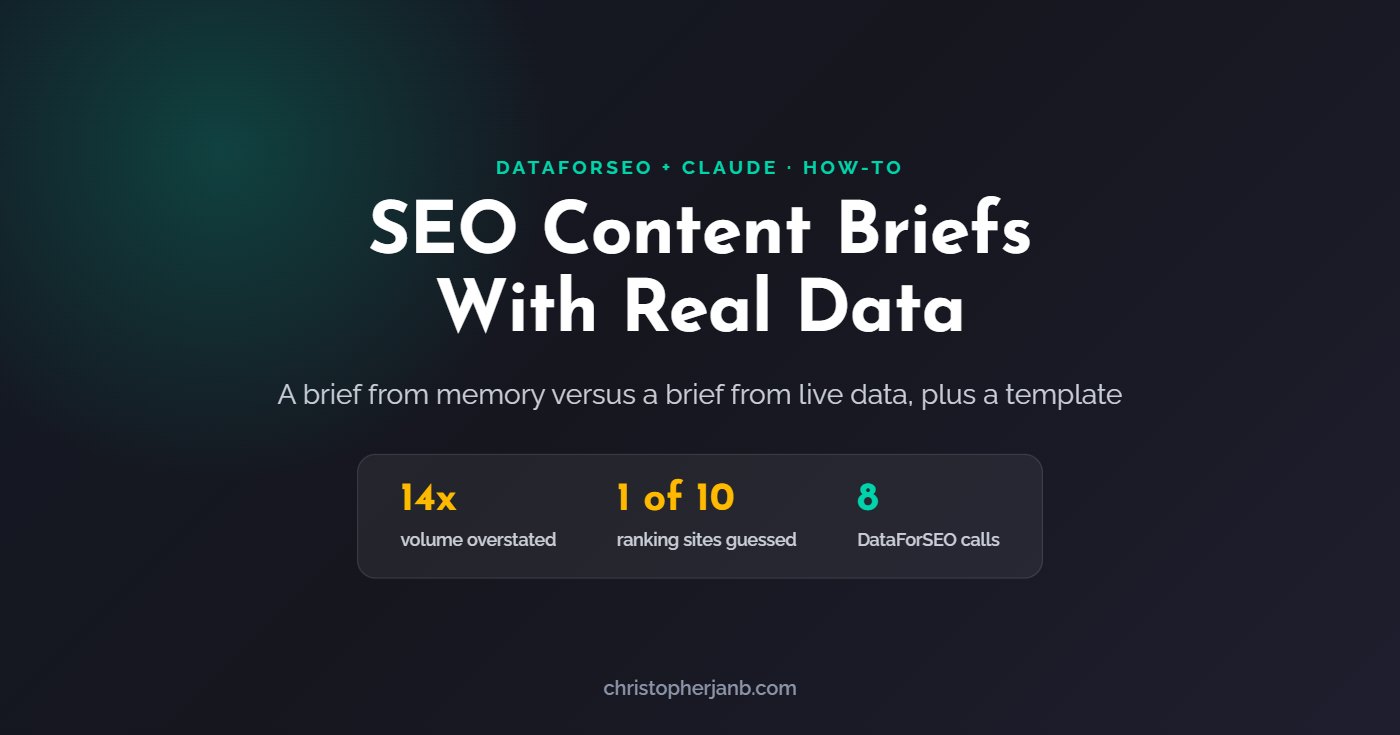
A content brief is a one or two page plan that tells a writer the goal, reader, keywords, structure and length of a piece before drafting starts. On 18 November 2026 I built two briefs for the keyword “content brief”. Claude wrote one from memory, and I built the other from 8 DataForSEO calls. The memory version overstated search volume by up to 14 times and named only 1 of the sites that actually rank. This guide shows the data-backed method, the traps in the data, and a template you can copy.
Disclosure: links to DataForSEO in this post are affiliate links. If you sign up through them, I may earn a commission on every successful sale, at no extra cost to you.
What is a content brief?
A content brief is a short planning document for one piece of content. It sets the goal, reader, keywords, outline, length and sources, so the writer and editor agree before drafting.
It sits between keyword research and writing. An SEO content brief adds what the search results show: which pages rank, what they cover, what Google puts above them, and which questions nobody answers well yet. That last part is where a brief earns its keep. A writer can find the obvious subtopics alone, but the gaps take research.
People often mix it up with a creative brief, and Google’s AI Overview for “content brief” includes a table comparing the two. The difference is scope.
| Content brief | Creative brief | |
|---|---|---|
| Covers | One article, page or video | A whole campaign |
| Written for | A writer and an editor | A creative team: designers, copywriters, producers |
| Main inputs | Keywords, search results, competitor pages | Brand goals, audience insight, budget |
| Output | An outline with a word count and sources | A concept, a message and deliverables |
What should an SEO content brief include?
An SEO content brief should include the goal, reader, keywords with intent, what the search results show, an outline with word counts, a target length, links and metadata.
- Goal and reader. What the page should make someone do, and who that someone is.
- Keywords and intent. One primary keyword, merged variants, secondary terms, volume, difficulty and whether people want to learn or buy.
- The search results. The SERP features in order, the ranking pages, the AI Overview and its sources, and the People Also Ask questions.
- Competitor coverage. The headings of the top five pages, what all of them cover, and what none of them cover.
- Outline and length. H2s and H3s with a word budget each, plus a total taken from the ranking pages.
- Links and metadata. Internal links to add, the call to action, a title, a meta description and any schema.
What happens when Claude writes a brief without data?
It writes a confident brief built on guesses. In my test the volumes ran 10 to 14 times high, and only 1 of its 10 predicted ranking sites was actually ranking.
I asked Claude, with no tools connected, for a brief on “content brief”. Then I built the same brief from live DataForSEO data for Google US the same day.
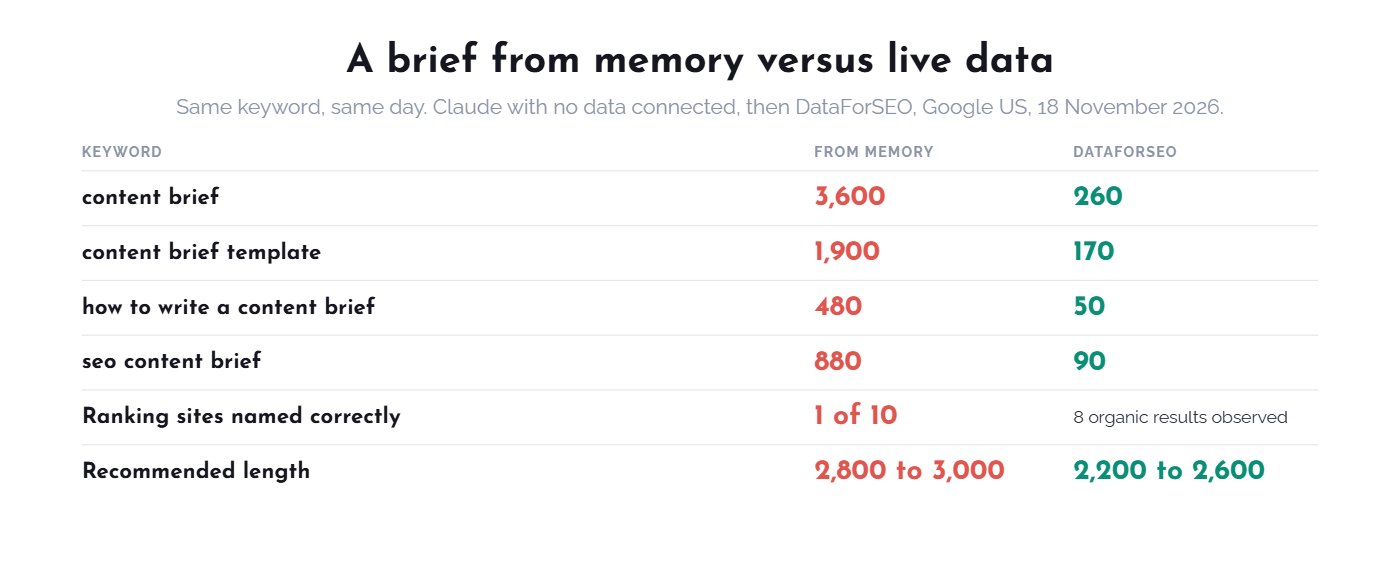
| Item | From memory | DataForSEO, 18 Nov 2026 |
|---|---|---|
| “content brief” volume and difficulty | 3,600 a month, KD 52 | 260 a month, KD 2 |
| “content brief template” | 1,900, KD 41 | 170, KD 2 |
| “seo content brief” | 880 | 90 |
| “how to write a content brief” | 480 | 50 |
| Ranking sites | 10 big names, including Semrush, Ahrefs, HubSpot, Backlinko, Surfer and Clearscope | Clearscope is the only match in 8 organic results |
| AI Overview sources | HubSpot, Semrush, Ahrefs | HubSpot, MarketMuse and State of Digital Publishing, plus links to Content Harmony and monday.com |
| Recommended length | 2,800 to 3,000 words | 2,200 to 2,600 words |
The guesses were not random. HubSpot, Backlinko, Semrush and Ahrefs are on the results page, but only in the Images pack at the top. The organic positions go to smaller agencies and vendors: textuar.com, knowadays.com, searchatlas.com, sessioninteractive.com, gravitywrite.com, clearscope.io, holabrief.com and outrank.so. A writer briefed from memory would study the wrong competitors and treat a KD 2 keyword as if it were hard to rank for.
Which DataForSEO endpoints build a content brief?
Four endpoints cover it: the live SERP with People Also Ask, content parsing for the top pages, Keyword Suggestions and Related Keywords. The priced calls in my run came to about $0.03.
| Endpoint | What it adds to the brief | Calls | Cost in my run |
|---|---|---|---|
| SERP, Google Organic Live Advanced | SERP features in order, AI Overview, People Also Ask, ranking pages | 1 | About $0.002 |
| On-Page Content Parsing | Headings, text and templates of the top five pages | 5 | Not shown in the response |
| Labs Keyword Suggestions | Variants containing the keyword, with volume, difficulty and intent | 1 (50 rows) | About $0.018 |
| Labs Related Keywords | Terms from Google’s related searches | 1 (8 rows) | About $0.013 |
The Labs rows already included search intent, so I skipped the separate intent call. Content parsing responses carried no cost field, so check your dashboard’s usage page for the real charge. DataForSEO (affiliate link) has no subscription, and you pay per call. My pricing post breaks down 30 days of real spend, and the keyword research guide covers the Labs endpoints in more depth.
What does a data-backed content brief look like?
Here is the brief for “content brief” itself, shortened. Every number comes from the 18 November 2026 run on Google US, English, desktop.
- Primary keyword: content brief, 260 a month, KD 2, informational. Its 12-month range was 110 to 480.
- Secondary keywords: content brief template (170), what is a content brief (110), seo content brief (90, commercial), seo content brief template (90), content brief examples (50), how to write a content brief (50), content brief generator (50, commercial).
- SERP layout: Images pack, AI Overview, People Also Ask, 8 organic results, then related searches for template, examples and PDF.
- What every top page covers: a definition, why briefs matter, the core elements, and SEO basics such as keywords, meta tags and internal links.
- Gaps: no ranking page shows a brief filled in with real data, and none offers a template you can copy. They say little about briefing for AI Overviews or AI writers, setting word count from the SERP, or checking a draft against the brief.
- Length: 2,200 to 2,600 words, with the effort going into a real example and a usable template.
This post follows that brief, which is why it shows a real comparison and ends with a template.
How do you set word count from the search results?
Parse the top five pages, strip navigation and sidebars, and take the median of the pages that match your format. Leave out listicles and outliers.
The top five pages for “content brief” came to about 1,600, 650, 3,300, 2,300 and 2,300 words. The 3,300-word page is a software listicle, so it is the wrong format to copy. The page in second place has about 650 words, which shows that length is not what wins on this keyword. The three how-to guides averaged about 2,070 words, so 2,200 to 2,600 leaves room for an example and a template without padding. The memory brief’s 2,800 to 3,000 would have meant about 600 extra words with nothing to fill them.
A copy-ready content brief template
Copy this template into a doc or a Claude project. Each field names its data source, so you can fill it in by hand or from DataForSEO.
| Field | What to put | Source |
|---|---|---|
| Goal | The one action the page should drive | You |
| Reader | Who searches this, and what they already know | You, checked against the ranking pages |
| Primary keyword | Keyword, volume, KD, intent, 12-month range | Labs Keyword Suggestions |
| Secondary keywords | Variants merged, each volume counted once | Labs Suggestions and Related Keywords |
| SERP layout | Features in order, number of organic results | Live SERP |
| AI Overview | Whether it shows, its structure, and the sources it cites | Live SERP |
| Questions | People Also Ask questions that fit the topic | Live SERP |
| Top 5 pages | URL, page type, word count, H2s, whether it has a template | Content Parsing |
| Shared topics | What every top page covers | Content Parsing |
| Gaps | What no top page covers well | Content Parsing, plus your judgement |
| Outline | H2s and H3s with a word budget each | You, from the gaps and shared topics |
| Length | Median of same-format pages | Content Parsing |
| Links and CTA | Internal links, the call to action, outbound sources | You |
| Metadata | Title, meta description, schema type | You |
| Facts not to invent | Numbers and claims the writer must source or leave out | You |
Here is the same template as plain text, ready to paste:
CONTENT BRIEF
Keyword:            | Market:            | Date pulled:
Goal:
Reader:
Primary keyword:    volume / KD / intent / 12-month range
Secondary keywords: (merge variants, count each volume once)
SERP layout:        (features in order, number of organic results)
AI Overview:        (shown? structure? sources cited?)
Questions to answer:
Top 5 pages:        URL / type / words / main H2s / template?
Every page covers:
Gaps to fill:
Outline:            H2 / H3 / word budget
Target length:      (median of same-format pages)
Internal links:
CTA:
Title:              | Meta description:   | Schema:
Facts not to invent:
What traps should you watch for in the data?
This one brief hit six: off-topic questions, redirect URLs, a wrong language label, a duplicate keyword, a short results page and a one-month volume spike.
- People Also Ask was off-topic. The six questions included “How to write a brief description?” and “What are the 7 types of content writing?”. Only one, about creative briefs, was close, and all six answers came back empty. Read the questions before you put them in an outline.
- Every organic URL was a Google redirect. The domain field said google.com for each result. I read the real sites from the breadcrumbs, and the parsing endpoint followed the redirects to the real pages.
- “content brief template” was labelled as Kannada. Labs flagged an English keyword as another language. A filter on language would have dropped the biggest secondary term.
- “brief content” duplicated the head term. It showed 260 searches with the same monthly pattern as “content brief”. Counting both would have doubled the head volume to 520.
- Only 8 organic results came back. I asked for 10. The Images pack, AI Overview and People Also Ask sat above them.
- The template keyword spiked once. It hit 480 in August 2026 against 70 to 260 in other months. Plan around the usual level, not the peak.
How do you brief for AI Overviews and AI writers?
Add answer-first rules to the brief: question headings, a short direct answer under each, named sources, and a list of facts the writer must not invent.
Record what the AI Overview already does. For “content brief” it opened with a one-sentence definition, then listed what goes in a brief, why briefs matter, the content brief versus creative brief table, and how to start. That structure tells you what an answer engine expects to find. The Overview had no reference list in the API response, so I read its sources from the image cards and inline links. That is worth noting in the brief, because the cited sources were not the sites ranking organically.
If an AI model will write the draft, the brief matters even more. Give it the numbers it may use and tell it to leave anything else out. The no-data test above shows what happens otherwise: the model fills gaps with plausible figures. Searches for “ai content brief generator” are small, about 50 a month, but they rose through 2026, so this part of the topic is growing.
How do you build a content brief in Claude?
Connect the DataForSEO MCP server, give Claude the keyword and market, cap the number of calls, and ask for the brief in the template’s fields.
- Connect DataForSEO to Claude. My MCP setup guide covers Claude Desktop, Claude Code and Codex.
- Paste the template into the chat or a Claude project.
- Give it the keyword, country, language and a call limit.
- Check the traps above in what comes back: redirects, merged variants, off-topic questions and spikes.
- Write the goal, reader, outline and CTA yourself. Those depend on your business, not the data.
A prompt that works:
Build a content brief for "[keyword]" for Google [country], [language], desktop.
Use DataForSEO: one live SERP call with People Also Ask, content parsing for the
top 5 organic pages, Keyword Suggestions and Related Keywords. No more than 12 calls.
Fill every field in the template above. Merge close variants and count each volume
once. Read real hosts from breadcrumbs if URLs are Google redirects. Flag any
People Also Ask question that is off-topic. Set length from the median of pages in
the same format. List the cost of each call. Do not estimate anything the data does
not show.
Frequently asked questions
How long should a content brief be?
One or two pages is enough for most articles. The brief needs the decisions and the evidence behind them, not a draft. If it runs longer, the outline is probably doing the writer’s job.
Who writes the content brief?
Usually the SEO lead or the editor who will approve the draft. With Claude and DataForSEO, Claude can pull the data and fill the fields, and the editor checks them and writes the goal, reader and outline.
Can AI write a content brief?
Yes, if it has live data. Without data, Claude overstated volume by up to 14 times and named the wrong competitors. With 8 DataForSEO calls it produced a brief I could use.
What is the difference between a content brief and a creative brief?
A content brief plans one piece of content from keywords and search results. A creative brief plans a whole campaign from brand goals, audience insight and budget.
How do you make this repeatable?
Save the process as a Claude skill, so every brief uses the same fields, checks the same traps and quotes its cost. The seo-execution skill in my free pack includes a brief stage that can use DataForSEO data, as one step of a full client month.
Get the free Claude SEO skill pack. If you still need the data, open a DataForSEO account (affiliate link) and run one brief on the trial credit. For the other guides in this series, see the DataForSEO and Claude hub.