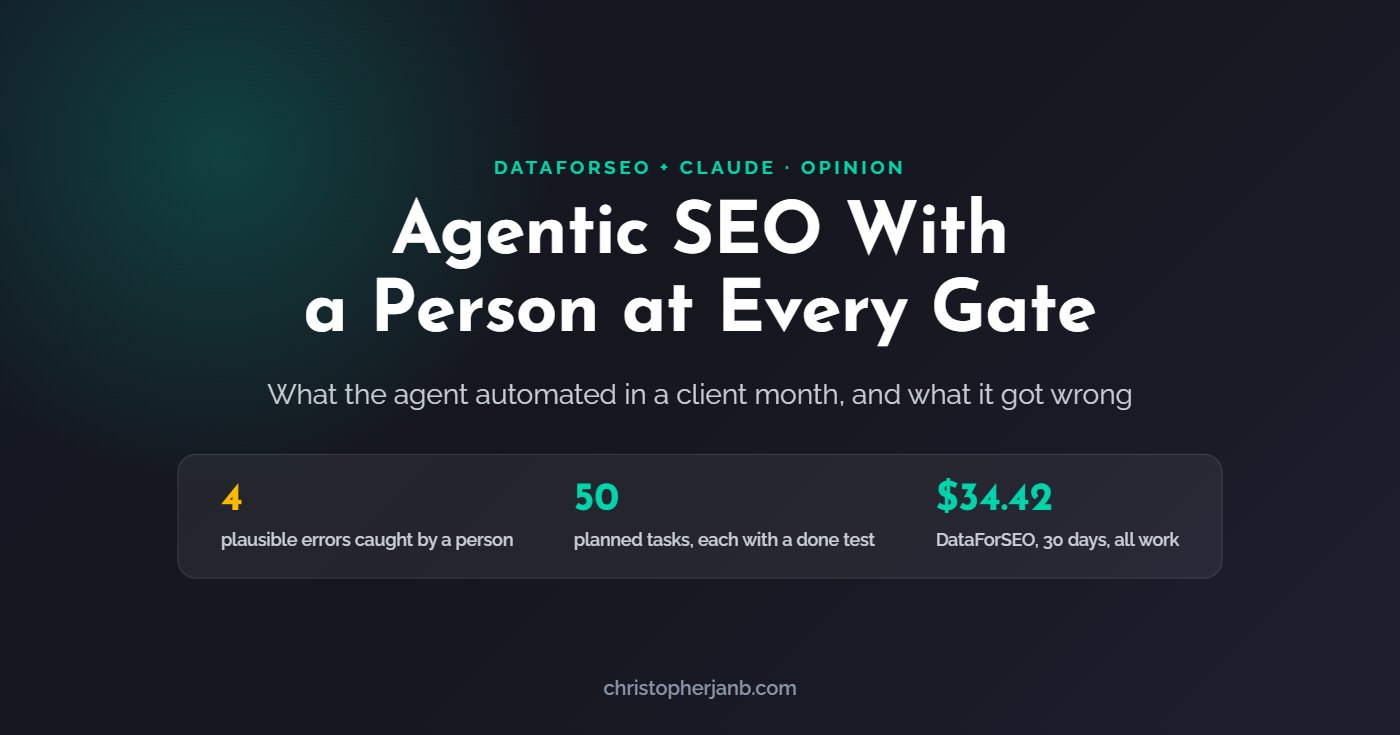
Agentic SEO means handing multi-step SEO work to an AI model that can use tools: crawlers, data APIs, your CMS. I run it every month with Claude and DataForSEO on client work, and I keep a person between every step. In one October client month, the agent’s work produced four errors that read as plausible. A person caught all four, and two had already reached the client by then. This post covers what agentic SEO is, what it automated for me, and why I would not let it run unattended.
Disclosure: links to DataForSEO in this post are affiliate links. If you sign up through them, I may earn a commission on every successful sale, at no extra cost to you.
What is agentic SEO?
Agentic SEO is SEO work done by an AI agent that plans steps, calls tools and acts on the results, instead of answering one prompt at a time. A person sets the goal.
Google’s AI Overview for “agentic seo” goes further and calls it autonomous agents running SEO “in real time”. That is the vendor pitch. In practice an agent is a model like Claude with access to tools: a data API such as DataForSEO, Search Console, a crawler, files and sometimes your CMS. It can pull data, compare sources, write a plan and draft the changes. Whether it should also publish them is the real question.
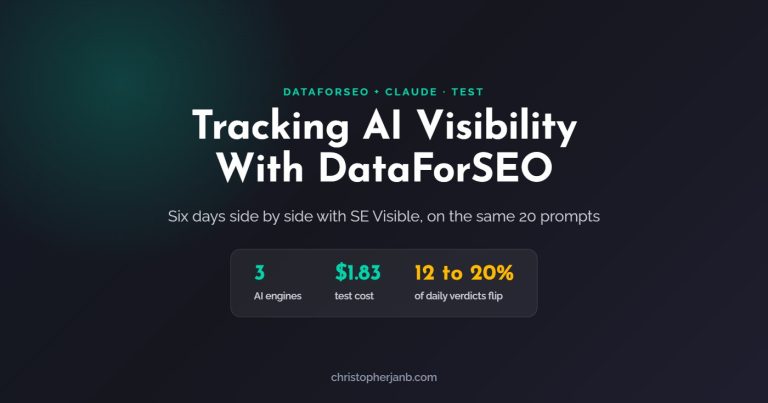
The term also has a second meaning: getting AI agents to pick your brand when they search and buy for someone. That is closer to AI visibility, which my AI visibility tracking post covers. This post is about agents doing the SEO work.
How is agentic SEO different from SEO automation?
SEO automation runs fixed rules on a schedule. An agent decides its next step from what it finds. That makes agents more useful on messy data, and harder to trust.
| Classic SEO automation | Autonomous agent, as pitched | Gated agent, as I run it | |
|---|---|---|---|
| How it works | Fixed rules: a scheduled crawl, a rank report, a Make or n8n flow | The agent finds problems, decides and ships fixes | The agent researches, plans and drafts, and a person approves each stage |
| Handles odd data | No, it passes through | Sometimes, with no one checking | Yes, because a person checks it against another source |
| Who publishes | Usually nobody, it only reports | The agent | A person |
| Where it fails | Rules miss new problems | Confident errors go live | Slower, and gates still miss things |
Searches for “seo automation” fell from about 3,600 a month to 880 over the year to September 2026, while “agentic seo” rose from 70 to 260 a month between November 2025 and October 2026 (DataForSEO, US). The interest is moving to agents. The trust problem moves with it.
Why do gated steps beat autonomous agents for client work?
Because agent errors look plausible. In one client month, four of them did, and each was caught by a person checking against a second source, not by the agent itself.
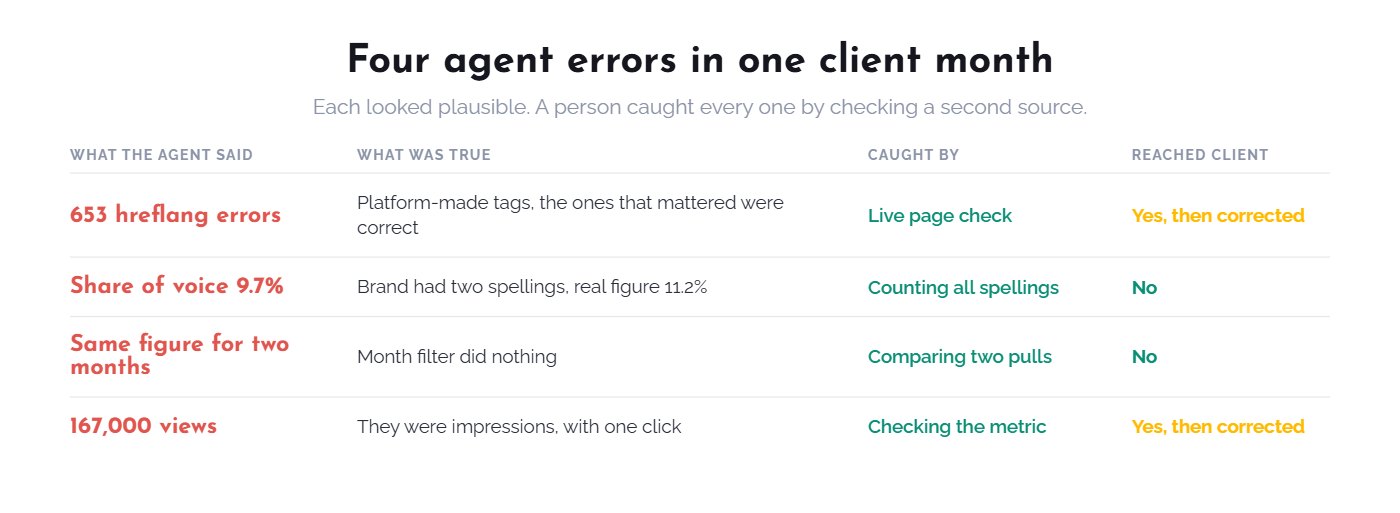
- 653 hreflang errors that were not errors. The audit flagged them, and the plan and client report treated them as a theme fix. A live check showed the platform generated those tags and the ones that mattered were correct. I sent the client a correction.
- A share of voice that was too low. The tracker matched one spelling of the brand, and ChatGPT often wrote another. Counting all spellings moved share of voice from 9.7% to 11.2% before it went into the report.
- A month filter that did nothing. An LLM Mentions pull returned the same figure for September and October. I quoted no month-over-month change from it.
- Impressions called views. A sale page had about 167,000 impressions and one click. My first message to the client called those views. I corrected it and told the client the opportunity was smaller than I had first made it sound.
Two of the four reached the client before they were fixed, so gates do not catch everything. But an autonomous agent would have shipped all four, and the hreflang one would have become development work on a theme that was fine. The full month is in my client month write-up.
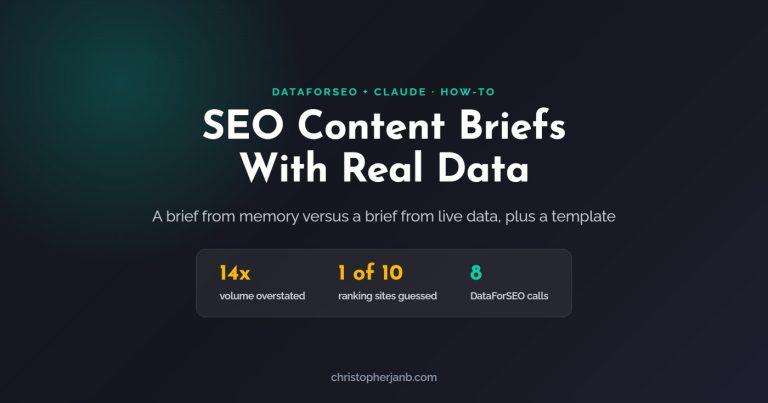
The same pattern showed up in this hub’s tests. An audit flagged 221 broken backlinks, and a closer look found almost all came from one scraper site, leaving one page worth redirecting. A content brief written by Claude with no data overstated search volume by up to 14 times. Each looked right until something outside the first tool contradicted it.
What does a gated agentic SEO loop look like?
Four stages in one project folder: audit, plan, execute and report. Each stage writes a file the next one reads, and a person approves the file before the next stage starts.
| Stage | The agent does | The person checks |
|---|---|---|
| Audit | Pulls Search Console, crawl and DataForSEO data, finds causes | Does each finding hold up against a second source? |
| Plan | Turns findings into tasks with an owner, a week and a definition of done | Is this worth doing for this business, and in this order? |
| Execute | Drafts content, metadata, redirects and fixes, then verifies they shipped | Is it accurate, on brand and safe to publish? |
| Report | Writes the client summary from the files | Is every number labelled correctly, and would I defend it? |
The definition of done matters most. A task that ends with “one URL remains, the old one redirects in one hop, and no links point to it” lets the agent check its own work with a rescan. A task that ends with “improve the page” does not.
What did the agent actually automate in a client month?
Most of the volume: research, drafting and checking. In October that meant 61 posts optimized, 28 product descriptions, 563 internal links fixed and hundreds of metadata fixes.
- 61 blog posts fact-checked and optimized for AI search
- 28 product descriptions rewritten
- 563 internal links to redirected URLs fixed
- 123 long titles, 275 long descriptions and 104 duplicate titles cleaned up
- A 50-task plan across five owners, each with a definition of done
I did not time the work against a manual month, so I am not claiming an hours-saved figure. What I can say is that this volume, for one person, only happens with an agent doing the drafting. It also created new problems: November’s audit found errors from October’s own work, such as duplicate H1s rising from 74 to 90. Those went straight into the next plan, which is the loop working as intended.
Where does DataForSEO fit in an agentic SEO setup?
It is the agent’s view of the market. Search Console shows your own site, and DataForSEO shows live results, competitors, backlinks and AI answers, so the agent works from data instead of memory.
An agent without a data source fills gaps from its training data. That is how the no-data content brief guessed 3,600 searches for a keyword with 260. With DataForSEO (affiliate link) connected through its MCP server, Claude can check the live results page, competitor keyword counts and LLM mentions mid-task. In the client month, that is what showed a leading competitor had lost about the same share of keywords as the client, so part of the drop was the market.
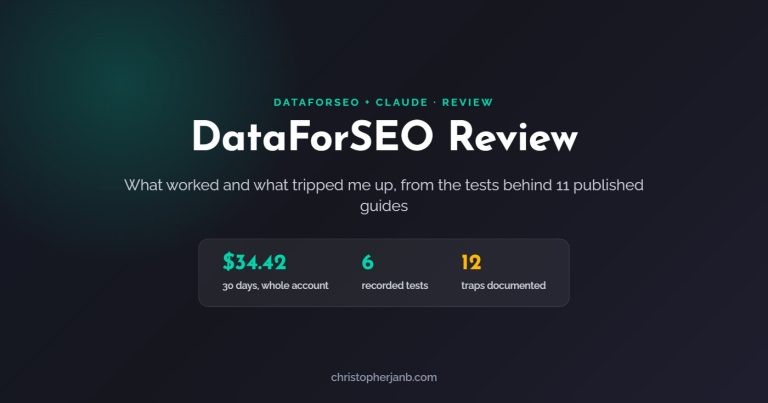
It is also cheap enough to call often. My whole account came to $34.42 for the 30 days to 26 October, across every client and study. The pricing post has the breakdown, and the MCP setup guide covers connecting it to Claude.
Which SEO tasks should an agent never run alone?
Anything a client sees or a search engine indexes: publishing, redirects, deletions, client messages and any number that goes into a report. Drafting and checking can run freely.
| Let the agent run it | Keep a person on it |
|---|---|
| Pulling and joining data | Deciding what a finding means for the business |
| Drafting content, titles and descriptions | Publishing them |
| Proposing redirects and merges | Applying them |
| Rescanning to verify a fix shipped | Deleting pages or content |
| Writing a report draft | Sending anything to a client |
Two of my four October errors would not trip any automated check: impressions called views, and a filter that silently did nothing. A person reading the number with the source open catches them.
How do you start with agentic SEO?
Start with one site and one loop. Give the agent data access, save each stage as a reusable skill, and write every correction back into the skill so it does not repeat.
- Install Claude Code or Claude Desktop and connect Search Console data and DataForSEO.
- Add skills for the four stages, so each run follows the same steps.
- Run the audit on one site and check every finding against a second source before planning.
- Give every task a definition of done the agent can verify.
- When you correct something, add the correction to the skill.
The how-to guides in this series cover each stage with real data: audits, keyword research, content briefs and reporting.
Frequently asked questions
Can an AI agent do SEO on its own?
It can do most of the research and drafting. It should not publish, redirect or report numbers to a client without a person checking, because its errors look plausible.
Is agentic SEO the same as SEO automation?
No. Automation runs fixed rules. An agent chooses its next step from what it finds, which handles messy data better and needs more checking.
What does an agentic SEO setup cost?
Mine is a Claude subscription plus DataForSEO usage. DataForSEO came to $34.42 for 30 days across all my client work and studies, with a $50 minimum top-up.
Which AI is best for agentic SEO?
I use Claude, mainly through Claude Code, because skills and MCP servers make the steps repeatable. The data source and the gates matter more than the model.
Where do you get the skills?
My free pack has the four loop skills (audit, task plan, execution and report), a setup skill that tailors them to a client, and a DataForSEO keyword research skill.
Get the free Claude SEO skill pack. To give the agent market data, open a DataForSEO account (affiliate link). For the rest of the series, see the DataForSEO and Claude hub.