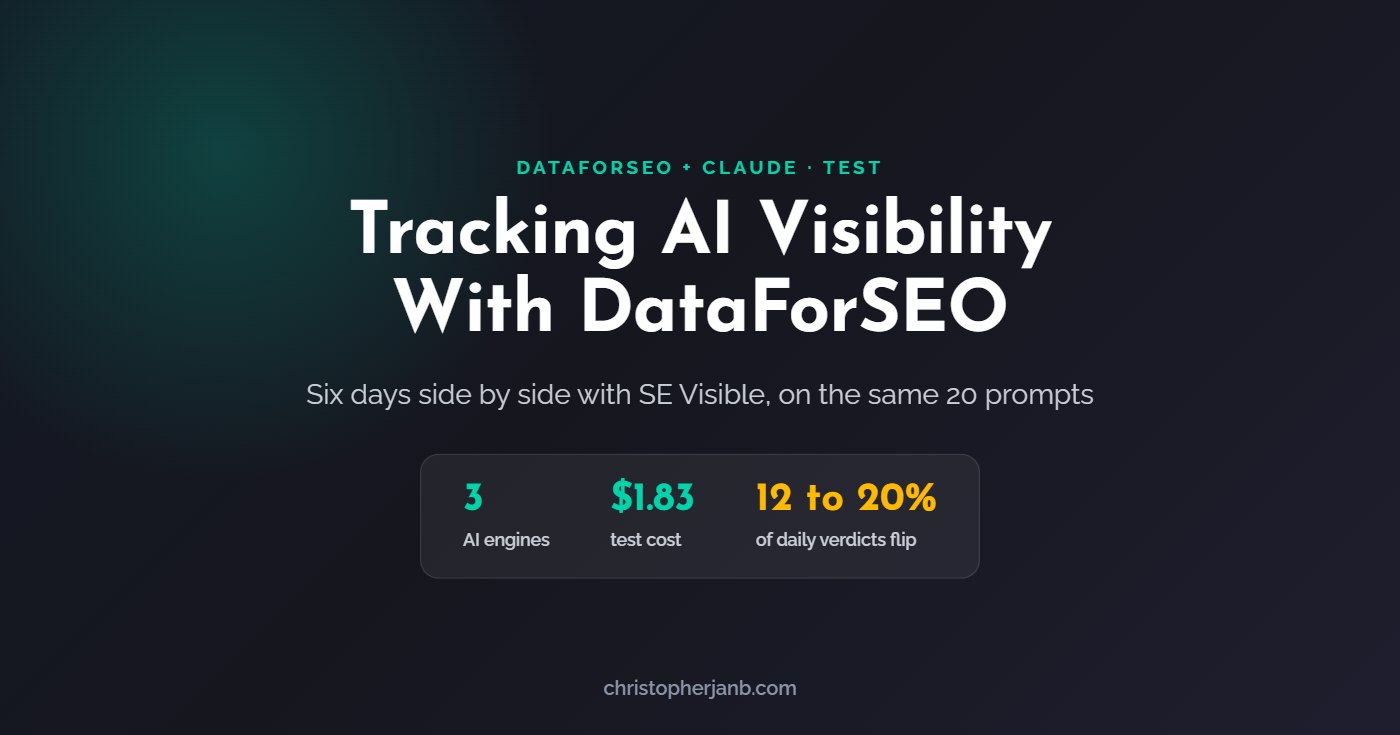
You can track AI visibility with DataForSEO by sending a fixed set of prompts to ChatGPT, Google AI Mode and AI Overviews each day, then counting how often your brand appears. I ran that tracker side by side with SE Visible on the same 20 prompts for a client in November 2026. The two tools agreed about as often as each agreed with itself, where both were set up the same way. Where they differed, the cause was the setup. The test cost $1.83 in DataForSEO calls.
Disclosure: links marked “affiliate link” in this post go to DataForSEO and SE Ranking, which makes SE Visible. If you sign up through them, I may earn a commission on every successful sale, at no extra cost to you. The client is an anonymized ecommerce brand, so prompts, brands and markets are left out.
What does AI visibility tracking measure?
AI visibility tracking measures how often AI answers mention your brand, and which sites they cite, for a fixed set of prompts over time. The prompts stay the same, so changes in the results mean something.
- Mention rate. The share of answers that name the brand in the text.
- Citations. Whether the brand’s own site is linked as a source, and which other sites are.
- Answer rate. How often the engine returned an answer at all. This matters most for AI Overviews, which do not appear for every search.
How did the side-by-side test work?
Both tools tracked the same 20 prompts on ChatGPT, Google AI Mode and AI Overviews. I compared them on six days with data from both, 4 to 11 November 2026, using one answer per prompt per engine per day.
The DataForSEO tracker was a short script run daily on GitHub Actions. It called the DataForSEO (affiliate link) ChatGPT scraper and its Google SERP API for AI Mode and AI Overviews. SE Ranking (affiliate link) ran the same prompts in SE Visible, its AI visibility platform, on a trial. I counted agreement only where both tools returned an answer. Mentions are rare, so raw agreement flatters both tools, and the full comparison also uses a statistic that corrects for that.
Did DataForSEO and SE Visible agree?
On Google AI Mode the two tools agreed as often as each tool agreed with itself, so the differences were noise. On ChatGPT and AI Overviews they agreed slightly less, and both gaps had a cause.
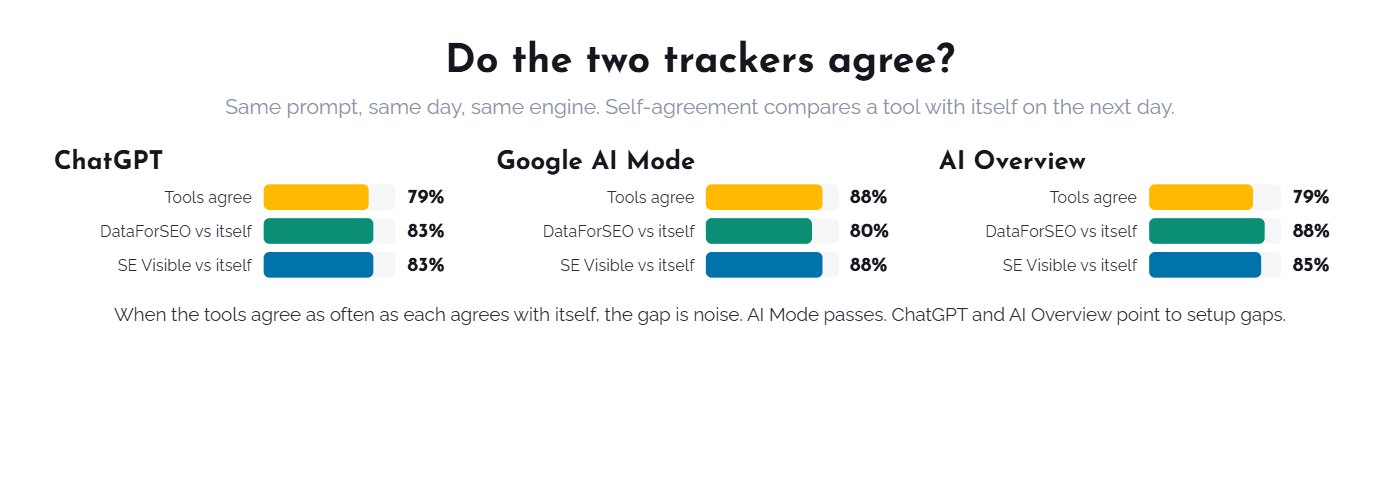
| ChatGPT | Google AI Mode | AI Overview | |
|---|---|---|---|
| Tools agree, same day | 79% | 88% | 79% |
| DataForSEO agrees with itself, next day | 83% | 80% | 88% |
| SE Visible agrees with itself, next day | 83% | 88% | 85% |
| Brand mention rate, DataForSEO | 26% | 23% | 18% |
| Brand mention rate, SE Visible | 38% | 20% | 19% |
| Answer rate, DataForSEO | 100% | 100% | 73% |
| Answer rate, SE Visible | 100% | 100% | 96% |
The cited sources overlapped too. The sites that mattered for this client appeared near the top of both tools’ lists, though only 9 to 12 of each top 20 matched. The ChatGPT list overlapped least, which fits the location difference below.
Why did the two trackers disagree?
The trackers disagreed because they were set up differently, not because one measured better. Two gaps explain most of it.
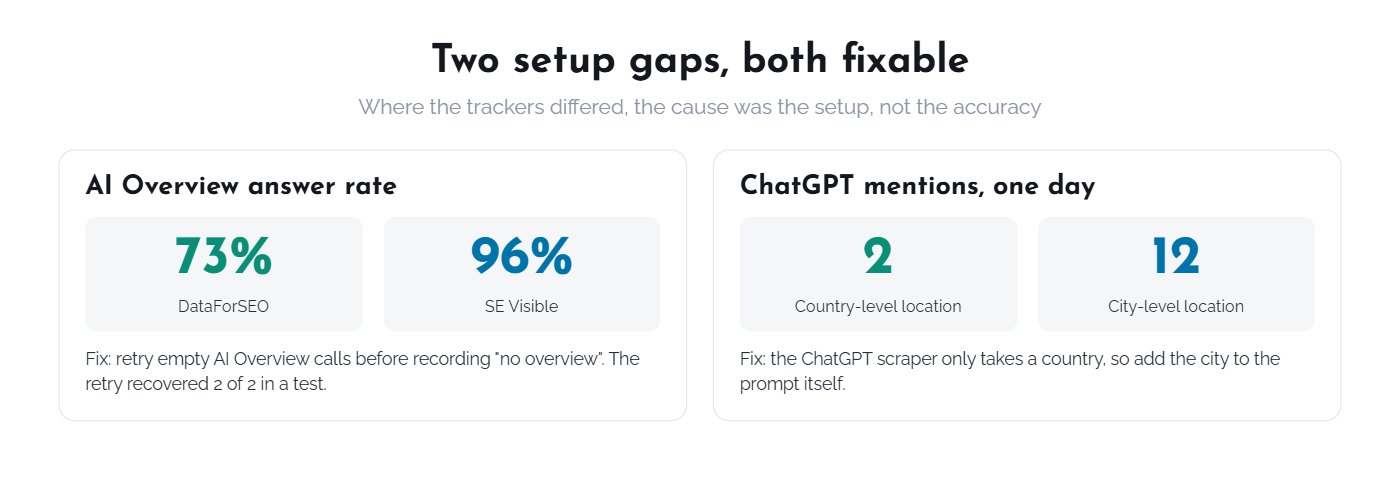
- AI Overview coverage. DataForSEO returned an AI Overview for 73% of prompt-days, and SE Visible for 96%. An empty result was often a missed overview, not a missing one. Retrying empty calls fixed this: in a test, the retry recovered 2 of 2 empty overviews.
- ChatGPT location. SE Visible asked ChatGPT as a user in a specific city, and its answers opened by naming that city. DataForSEO’s ChatGPT scraper only accepts a country. On one day that split was 12 brand mentions in SE Visible against 2 in DataForSEO. Adding the city to the prompt text made DataForSEO’s answers open the same way.
I checked the raw DataForSEO answers behind three of the disagreements, and the brand was not in them at all. The answers really differed, so this was not a parsing error. The two tools also count mentions differently. SE Visible includes shopping cards and link labels, and it splits product names into separate brands, which can hide a product-only mention.
How stable is a single day’s AI visibility result?
A single day’s result is not stable. In both tools, the verdict for one prompt flipped between 12% and 20% of the time from one day to the next.
A same-day repeat in DataForSEO, about eight hours apart, matched 85% of the time on ChatGPT and 69% on AI Overviews. So the tracker now takes up to three answers for a prompt when the result flips or the prompt is new, and reports mention rates, not single yes or no verdicts. The same caution applies to rank checks, as my rank tracking test showed.
How much does AI visibility tracking cost with DataForSEO?
Each ChatGPT, AI Mode or AI Overview call cost about $0.004 in this test. Twenty prompts on three engines came to about $0.23 a day, and the full test cost $1.83.
| Setup | Estimated monthly cost |
|---|---|
| 20 prompts, 3 engines, one answer a day | About $7 |
| Same, with extra answers only when results flip | About $14 |
| Same, with three answers every day | About $21 |
| 200 prompts, three answers every day | About $215 |
Those costs come from the cost field in each DataForSEO response, so they are actual charges, not list-rate estimates. The bigger cost is your time. The script, the brand list and the weekly review are yours to build and maintain.
Should you build a tracker or use SE Visible?
Build with DataForSEO if you want the raw answers and control over the setup. Use SE Visible if you need Copilot coverage, a client-facing dashboard or ready-made sentiment labels.
| DataForSEO tracker | SE Visible | |
|---|---|---|
| Engines in this test | ChatGPT, Google AI Mode, AI Overviews | The same three, plus Copilot |
| AI Overview coverage | 73%, before adding retries | 96% |
| Location | Country only, city added in the prompt | City level |
| Raw answers | Every answer stored and searchable | Text previews in the interface |
| Dashboard and sentiment | Build your own | Included |
| Cost | Pay per call, about $7 to $21 a month here | Subscription |
For this client I moved to the DataForSEO tracker after fixing the two setup gaps, because owning the raw answers mattered more than the dashboard. Nothing in the test showed SE Visible measuring the brand less accurately. It measured with a different setup, and it handled AI Overviews better out of the box.
What can you do with the raw answers?
Raw answers let you find the sources AI engines cite for competitors but not for you. Those sources become an outreach list.
The tracker compares the domains cited alongside competitors with the ones cited alongside the client. It then checks which of those sites already link to the client, using the Backlinks API. The first run surfaced three review sites cited with competitors, and none of them linked to the client. ChatGPT’s own search queries also showed two questions where it found no page from the client at all, which pointed to content gaps.
How do you set up AI visibility tracking with DataForSEO?
Fix your prompts, run them daily, repeat the ones that flip, and review the brands and sources weekly. Claude Code can write and run the script for you.
- Write 20 fixed prompts. Use the questions a buyer would ask before choosing a product like yours. Do not change them later, or the trend breaks.
- Connect the data. Follow my DataForSEO MCP setup guide to test prompts by hand first. For daily runs, have Claude Code write a script that calls the API directly and stores every answer.
- Match the setup you care about. Add the city to ChatGPT prompts if your buyers are local, and retry empty AI Overview calls before recording “no overview”.
- Report rates, not verdicts. Take extra answers when a result flips, and report the share of answers that mention you.
- Review weekly, report monthly. Weekly swings are mostly noise, so I review internally each week and send the client a monthly report.
DataForSEO also sells a pre-built database of AI answers through its LLM Mentions endpoints. It is faster to start with, but on one client account its month filter returned the same figure for two different months, so I check it against a tracker like this one. My SEO reporting post shows how AI visibility fits into a monthly report, and my free Claude SEO skill pack includes the reporting stage. More guides are in the DataForSEO + Claude hub.