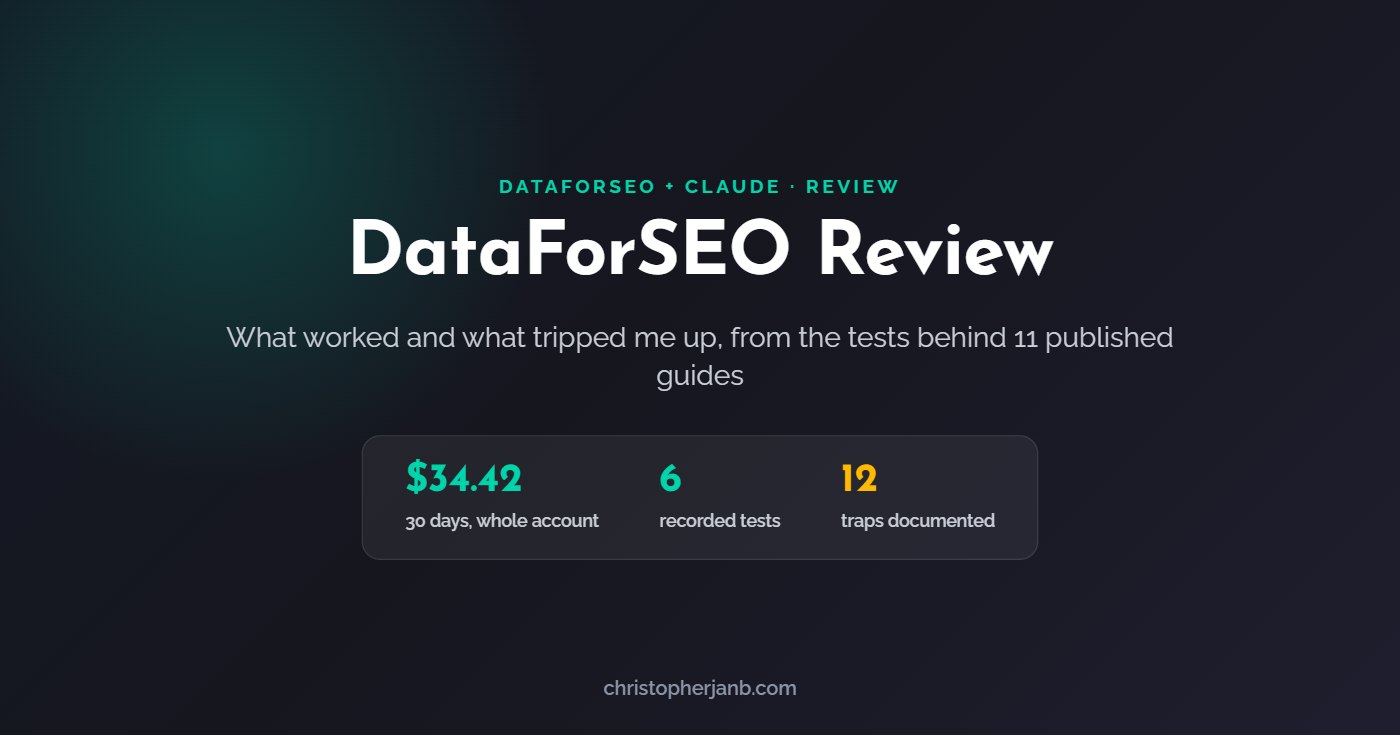
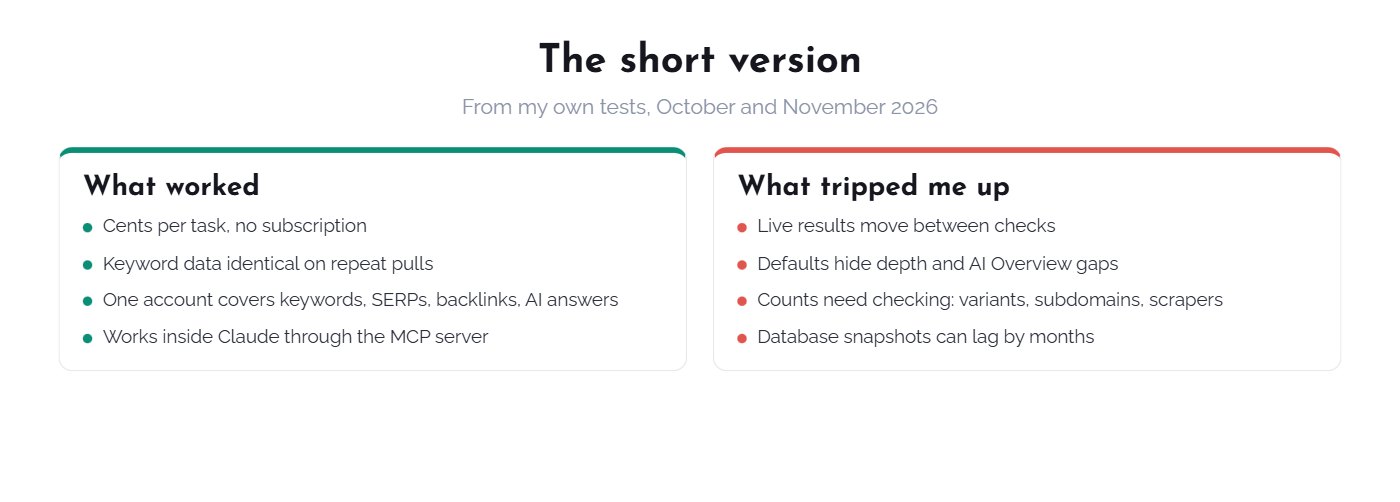
DataForSEO is worth it if you want raw SEO data at cents per task and are willing to check what comes back. I used it for the tests behind 11 guides in this hub during October and November 2026, on client accounts and my own research. My whole account came to $34.42 for 30 days, and no single recorded test cost more than $2. The data was useful and cheap. It also needed checking more often than a finished SEO tool would, and this review lists every place it caught me out.
Disclosure: links marked “affiliate link” in this post go to DataForSEO and SE Ranking. If you sign up through them, I may earn a commission on every successful sale, at no extra cost to you. That is a reason to read the problems section closely, because I included everything I found.
What is DataForSEO?
DataForSEO is a pay-as-you-go API that sells SEO data: keyword metrics, Google results, backlinks, site crawls and AI answers. It has no dashboard of its own, so you reach the data through code, automation tools or an AI assistant such as Claude.
You top up a balance, with a $50 minimum, and the balance does not expire. New accounts get $1 of trial credit. I connect it to Claude through its MCP server, which my setup guide covers, so I can ask for data in plain English.
What does DataForSEO cost in real use?
Real use cost me $34.42 for 30 days across every client, my own sites and the studies I publish. Ordinary SEO work, without the studies, came to $17.37. Each recorded test in this hub cost between $0.07 and $1.83.
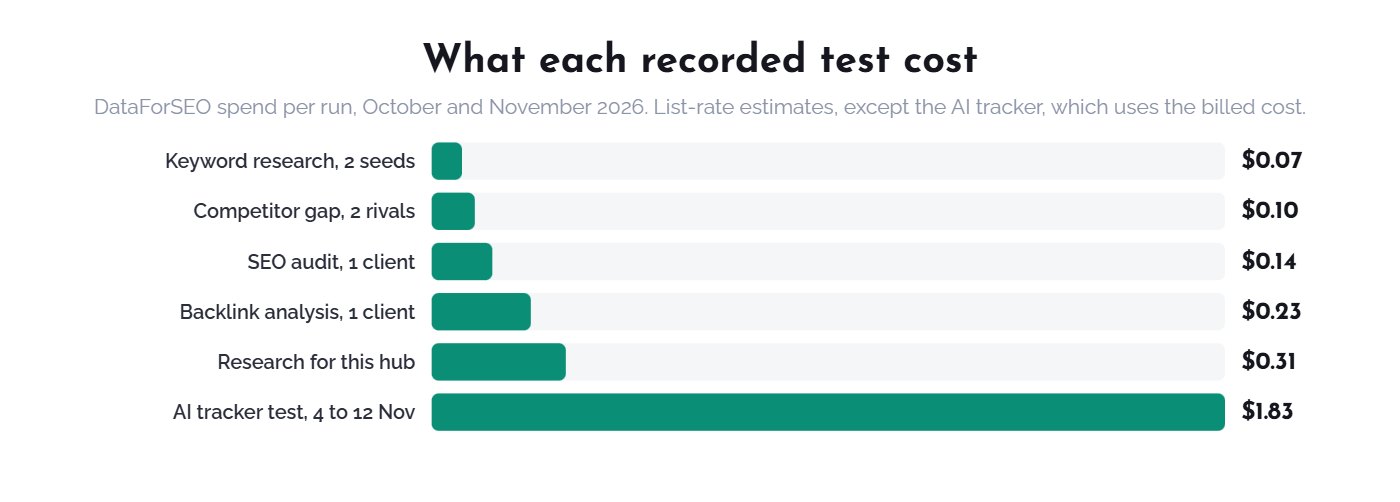
| Test | Calls | Cost | Guide |
|---|---|---|---|
| Keyword research, 2 seeds | 9 | About $0.07 | Keyword research |
| Competitor gap, 2 competitors | 7 | About $0.10 | Competitor analysis |
| SEO audit, 1 client | 9 | About $0.14 | SEO audit |
| Backlink analysis, 1 client | 9 | About $0.23 | Backlink analysis |
| Keyword research for this hub | 19 | About $0.31 | This hub |
| AI visibility tracker, 4 to 12 November | Daily runs | $1.83 | AI visibility tracking |
Most figures are estimates at the 27 October 2026 list rates, because most responses do not report their own cost. The AI tracker figure is the billed cost from the response data. The pricing post breaks down the 30 days by API and endpoint.
What does DataForSEO do well?
DataForSEO does four things well: low cost per task, stable keyword data, broad coverage in one account, and easy use inside Claude.
- Cost per task. A full backlink analysis cost about $0.23, and a thousand backlinks cost six cents at list rates. For occasional research, nothing with a monthly fee comes close.
- Stable keyword data. I ran the same keyword suggestions call twice, and all 30 rows came back identical, in the same order.
- One account, many data types. Keyword data, live results, backlinks, AI Overviews, ChatGPT answers and site checks all bill to one balance.
- Works inside Claude. With the MCP server, I can pull data mid-conversation and have Claude clean it in the same session. That is how every test in this hub ran.
Other users report a similar picture. On 18 November 2026, DataForSEO showed a 4.6 rating from 76 reviews on Trustpilot’s UK site.
What problems did I run into?
I documented 12 traps across the tests. None was a data error on DataForSEO’s side that I could prove. Each one would have produced a wrong conclusion if I had trusted the output without checking it.
| # | Trap | What I saw |
|---|---|---|
| 1 | Live results move | Two checks 2 minutes apart changed 3 of 5 positions. One keyword shared 0 of 9 pages with itself on a repeat pull. |
| 2 | Depth is not pages | Asking for 100 results returned one page of 6 to 9 results, unless the number of pages was also set. |
| 3 | Redirects in the domain field | Live results listed google.com as the domain, so sites had to be matched on the breadcrumb. |
| 4 | Missing AI Overviews | AI Overviews came back for 73% of prompt-days, against 96% in SE Visible, until empty calls were retried. |
| 5 | Country-only ChatGPT location | The ChatGPT scraper accepts a country, not a city, so local answers needed the city in the prompt. |
| 6 | A month filter that did nothing | An AI mentions pull returned the same figure for two different months. |
| 7 | Variants share one volume | The top 30 suggestions for one seed added up to 9,400 searches, or 6,820 with shared volumes counted once. |
| 8 | Spikes hide in averages | “free rank tracking software” reported 1,600 searches, mostly from two months at 8,100. |
| 9 | Language labels misfire | “dataforseo” was tagged as Spanish and “seo checker” as German in US English pulls. |
| 10 | Missing is not zero | Keyword Overview returned 5 of 9 terms, and 26 of 115 gap keywords had no difficulty score. |
| 11 | Backlink counts need definitions | 568 referring domains in one endpoint, 437 in another. 221 broken backlinks came down to one real fix. |
| 12 | Database snapshots lag | Labs data for one site dated from July to September, so a hub launched in October did not appear yet. |
Most of these are normal for raw data, and a dashboard tool would hide several of them behind its own choices. With an API, those choices are yours. The guides linked above show how I handled each one.
Is DataForSEO cheaper than Ahrefs or Semrush?
For research and occasional analysis, DataForSEO is much cheaper. For deep daily tracking at scale, a subscription can cost less per check.
Ahrefs Lite starts at $129 a month, and Semrush’s SEO plan at $139, on their pricing pages as of 13 November 2026. My whole DataForSEO account averaged $34.42 a month across several clients. But tracking 2,000 keywords daily to the top 100 would cost about $360 a month on DataForSEO’s standard queue, against $129 for SE Ranking (affiliate link)’s Core plan. My rank tracking post has that comparison. The subscriptions also include interfaces, history and support for people who do not want to handle raw data.
Who should use DataForSEO?
Use DataForSEO if you work with AI assistants or automation and want to own the raw data. Skip it if you need a ready-made dashboard or do not have time to check what comes back.
| Good fit | Poor fit |
|---|---|
| Practitioners running research and reports through Claude or scripts | Teams that want a dashboard to log into |
| A handful of clients with occasional deep pulls | Hundreds of keywords tracked daily to the top 100 |
| People who check sources and document their method | Anyone who will paste raw numbers into a client report unchecked |
| Custom AI visibility tracking with stored answers | Needing Copilot coverage, which the API does not offer |
What is my verdict on DataForSEO?
DataForSEO is now the data layer for my client work and this hub, and I would choose it again. It earns that place on cost and breadth. It keeps it only because I check the output, and the 12 traps above are why.
If you want to try it, the $1 trial covers several runs of the tests in this hub. Open a DataForSEO account (affiliate link), connect it with the MCP setup guide, and start with the keyword research guide. My free Claude SEO skill pack builds several of these checks in. More guides are in the DataForSEO + Claude hub.