
You just published an amazing blog post.
It’s well-researched. Optimized for search. Full of actionable insights.
And then… crickets.
Sound familiar?
Here’s the uncomfortable truth I learned after years of content marketing: great content without promotion is invisible.
The “publish and pray” approach doesn’t work. It never has.
I’ve seen too many content creators spend 10 hours writing a piece and 10 minutes promoting it. Then they wonder why nobody’s reading their stuff.
The best content marketers I know flip that ratio. They spend just as much time promoting content as creating it.
In this guide, I’ll share exactly how to get your content in front of the right people. These are the same strategies I use to promote content for my clients and my own blog.
Let’s get into it.
Why Promotion Matters More Than Ever
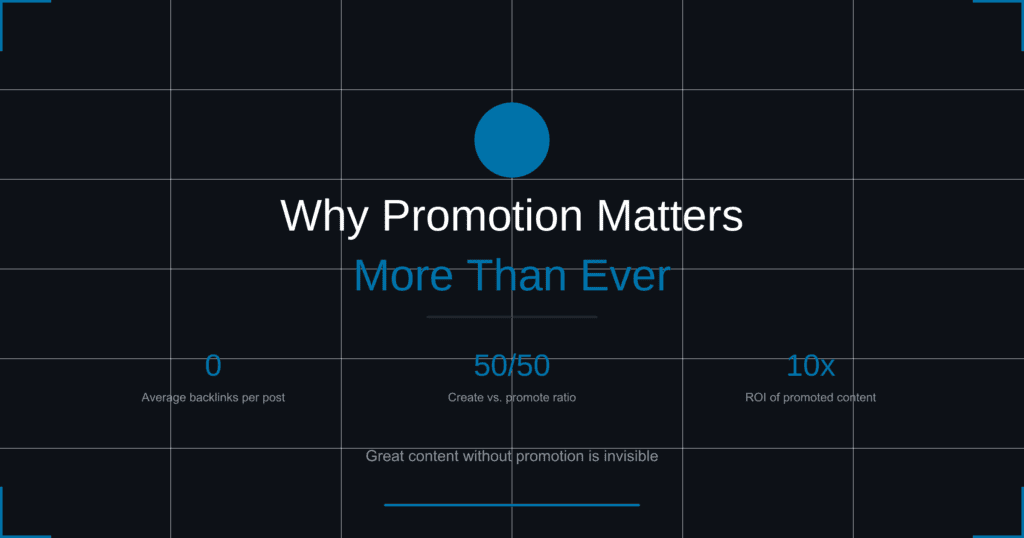
The average blog post receives zero backlinks.
Zero.
And minimal organic traffic to boot.
That’s not because the content is bad. It’s because nobody knows it exists.
Meanwhile, top performers treat promotion as half the job. Not an afterthought. Not something they’ll get to eventually. A core part of the content lifecycle.
Think about it this way. Every hour you invest in creating content gets amplified by promotion. One well-promoted piece will outperform ten posts that just sit there collecting digital dust.
The Promotion Mindset Shift
Most content creators operate like this:
- 80% of time on creation
- 20% of time on promotion
High performers do the opposite:
- 50% creation, 50% promotion
- Some even go 40/60
I’ll admit, this was hard for me to accept at first. I loved the writing part. The promotion felt like a chore.
But once I started treating promotion as part of my workflow from day one, everything changed. Traffic went up. Backlinks increased. And that content I worked so hard on actually got seen.
The Owned, Earned, Paid Framework
Before we dive into tactics, let me break down the three types of promotion channels.
Owned media is everything you control:
- Your website and blog
- Email list and newsletter
- Social media profiles
- Podcast or YouTube channel
Earned media is when others amplify your content:
- Backlinks from other sites
- Social shares and mentions
- Press coverage and features
- Guest post opportunities
Paid media is exactly what it sounds like:
- Social media ads
- Sponsored content
- Influencer partnerships
- Content discovery platforms
The most effective promotion strategies use all three over time. Don’t put all your eggs in one basket.
Owned Media Promotion
Let’s start with the channels you already control.
Email Newsletter Promotion
Your email list is the only audience you truly own.
Social platforms can change their algorithms overnight. Google can tank your rankings with an update. But your email list? That’s yours.
And it’s still the highest ROI channel for content distribution. Over 75% of marketers say email is their most effective tool for promoting content.
Here’s how to do it right.
Don’t just drop a link. Explain why this piece matters. Lead with the benefit. What will they learn? What problem does it solve?
Give them a compelling preview, not the full post. You want them clicking through.
Use a clear, single call-to-action. Don’t confuse people with multiple links.
For your best content, send dedicated emails. Save the roundup format for regular updates, not flagship pieces.
Building your list for promotion:
- Create lead magnets related to your content topics
- Add content upgrades within popular posts
- Use exit-intent popups on high-traffic pages
- Consider newsletter cross-promotions with complementary creators
The bigger your list, the more built-in distribution you have for every piece of content.
Website and Blog Promotion
Your own site is prime real estate for promoting content.
Internal linking from related posts drives traffic to new content. Every time you publish something new, go back and link to it from older relevant posts.
Feature new content prominently on your homepage or sidebar. Add “related posts” sections to keep readers engaged.
Create resource pages that link to your best content. These become hubs that distribute traffic across your site.
For flagship content launches, use announcement bars at the top of your site. Make it impossible to miss.
Social Media Promotion on Your Channels
Here’s where most people mess up: they share once and move on.
One post isn’t enough. You need multiple touchpoints over weeks.
My promotion schedule looks like this:
- Day 1: Initial announcement
- Day 3: Share a key insight or quote
- Week 2: Ask a question related to the topic
- Week 4: Share again with a fresh angle
- Ongoing: Reference in relevant conversations
Each post should hit a different angle. Share a statistic. Ask a question. Pull out a quote. Give a quick tip.
Pin important content to the top of your profiles. Engage with every comment to boost algorithmic reach.
And for the love of all that is good, don’t just copy-paste the same message across platforms. Tailor it for each audience.
Earned Media Promotion
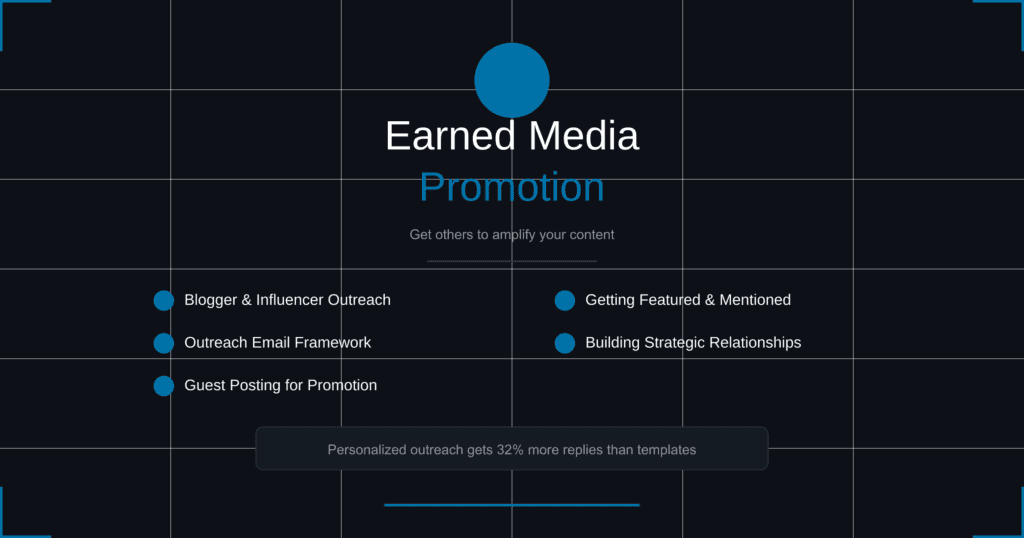
This is where things get interesting. Earned media is when other people promote your content for you.
It takes more effort upfront. But the payoff is massive.
Blogger and Influencer Outreach
Outreach gets your content in front of audiences that don’t know you yet. And when it comes from a trusted voice, people pay attention.
Personalized outreach gets 32% more replies than templates. I’ve tested this myself. Generic emails get ignored. Personal ones get responses.
Who should you reach out to?
- Bloggers who write about similar topics
- Industry experts with engaged social followings
- Journalists covering your niche
- Podcast hosts in your space
- Newsletter curators who share relevant content
How to find them:
- Google search: “[topic] + blog” or “[topic] + write for us”
- BuzzSumo to see who shares similar content
- Ahrefs or Semrush to find who links to competitors
- Twitter/X to search topic hashtags for active voices
- LinkedIn for industry thought leaders
The golden rules of outreach:
Build relationships before asking for anything. Engage with their content first. Leave thoughtful comments. Share their work. Mention them positively.
When you do reach out, personalize every message. Reference specific work of theirs. Show you actually know who they are.
Lead with value. What’s in it for them? Not what you want.
Keep it short. Under 150 words for the first email.
Follow up once, then move on. Nobody likes a pest.
The Outreach Email That Works
Subject line: Short, specific, no clickbait.
- “Quick question about [their post topic]”
- “Resource for your [topic] readers”
- “[Mutual connection] suggested I reach out”
Email structure:
- Personal connection (why them specifically)
- The value you’re offering (not asking)
- Clear, easy ask
- Brief sign-off
What can you offer?
- Content that complements something they wrote
- Original data or research they can cite
- Expert quote for an upcoming piece
- Exclusive first look at your content
- Cross-promotion to your audience
Notice how every offer gives them something. That’s the key.
Guest Posting for Promotion
Guest posting is still one of the best ways to build authority and drive referral traffic.
But here’s the reality check: the average guest post brings only about 50 visitors. That’s not nothing, but you need to make your guest posts work harder.
Focus on sites where your target audience actually reads. A highly relevant smaller site often beats a big generic one.
Maximizing guest post promotion:
- Include a “guest post bonus” (exclusive resource for that audience)
- Link to your best content naturally within the post
- Create a compelling author bio with a clear CTA
- Promote the guest post to your own audience
- Repurpose into social content mentioning the host site
Finding guest post opportunities:
- “[Your niche] + write for us”
- “[Your niche] + guest post guidelines”
- Check where competitors have guest posted
- Reach out to sites that have linked to you before
- Look for “contributor” or “become an author” pages
I’ve put together a comprehensive list of blogs that accept guest posts if you want a head start. And if you want paid writing opportunities, I have a list for that too.
For more on developing a guest posting strategy, check out my detailed guide.
Getting Featured and Mentioned
Want journalists and bloggers to quote you and link to your content?
You need to be quotable and linkable.
HARO alternatives for 2026:
- Qwoted: Journalists seeking expert sources
- Featured.com: Connects experts with media opportunities
- Help a B2B Writer: B2B-focused journalist requests
- Source of Sources: Curated journalist queries
- Twitter #journorequest: Real-time media requests
Being quotable and linkable:
- Publish original research and data (most linkable content type)
- Create definitive resources others want to reference
- Share unique frameworks or methodologies
- Include custom graphics others can embed
- Make statistics and findings easy to cite
The more original value you create, the more people will link to you naturally.
Building Strategic Relationships
One-time outreach is transactional. Relationships compound.
I’ve seen this with my own network. The bloggers and marketers I’ve built real relationships with have referred clients, shared my content, and opened doors I couldn’t have opened alone.
Relationship building tactics:
- Schedule recurring calls with 2-3 peers in your space
- Share each other’s content consistently
- Collaborate on joint content (co-authored posts, webinars)
- Introduce contacts who could help each other
- Celebrate their wins publicly
This isn’t about quid pro quo. It’s about genuinely supporting people whose work you respect. The promotion benefits follow naturally.
Community Promotion
Online communities offer direct access to engaged audiences. But they’re also the easiest place to get labeled a spammer.
Online Community Engagement
Reddit, Facebook Groups, Slack channels, Discord servers. These are goldmines if you approach them right.
Most communities ban self-promotion. Or at least frown on it heavily.
The solution? Provide value first. Build a reputation as a helpful contributor. Then, when you do share your content, people actually want to see it.
Effective community promotion:
- Answer questions thoroughly, then mention your content if relevant
- Create genuinely helpful posts that happen to include your link
- Share insights from your content without requiring clicks
- Add your site to your profile for passive discovery
Platform notes:
- Reddit: Answer questions in relevant subreddits. Link only when truly helpful and allowed.
- Facebook Groups: Engage consistently before sharing. Follow group rules exactly.
- Slack/Discord: Participate in discussions. Share content in appropriate channels only.
- LinkedIn Groups: Less active but still valuable for B2B. Focus on starting discussions.
Your reputation in the community determines your promotion success. There are no shortcuts here.
Building Your Own Community
Want built-in distribution for everything you create?
Build a community around your content.
Members share content organically. They provide feedback. They become advocates. And a strong community is a competitive moat that’s hard to replicate.
Community options:
- Facebook Group around your niche
- Discord or Slack for more engaged audiences
- Newsletter with strong reply and discussion culture
- Comment section cultivated for real conversation
Growing your community:
- Invite engaged readers and subscribers
- Provide exclusive content or early access
- Facilitate connections between members
- Share new content to community first
This takes time. But once it’s running, promotion becomes almost automatic.
Paid Promotion
Should you pay to promote your content?
Sometimes. But not how most people do it.
When to Use Paid Promotion
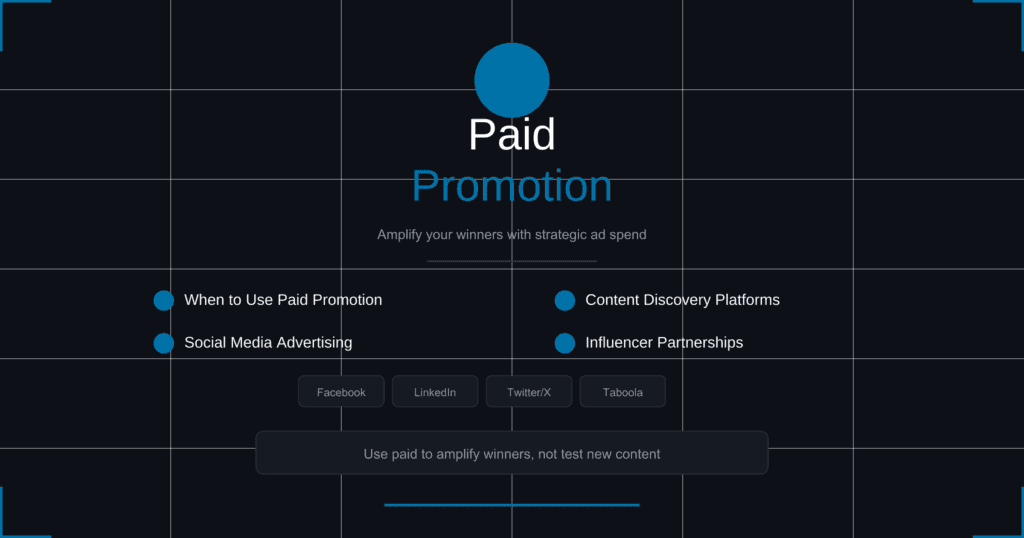
Here’s my rule: use paid to amplify winners, not test new content.
If something performs well organically, paid extends its reach. If something’s flopping, throwing money at it won’t fix the underlying problem.
Paid works best for content tied to conversion goals. Lead magnets. Flagship guides. Content that drives measurable business results.
Good candidates for paid promotion:
- Lead magnet content with proven conversion
- High-performing blog posts you want to scale
- Flagship content pieces (reports, guides, research)
- Time-sensitive content (launches, events, announcements)
Social Media Advertising
Facebook/Instagram Ads:
Boosting high-performing posts is the easiest starting point. You already know the content resonates. Now you’re just showing it to more people.
For more control, create dedicated campaigns for flagship content. Target lookalike audiences based on current readers. Use retargeting to reach people who’ve visited your site.
Start small. $5-10 per day. Scale what works.
LinkedIn Ads:
Higher cost but precise B2B targeting. Best for gated content and lead generation. Sponsored content appears in feeds natively.
Target by job title, company size, industry. You can get incredibly specific.
Twitter/X Ads:
Good for promoting to specific interest communities. Lower cost than LinkedIn for B2B. Promoted tweets work well for content distribution.
Content Discovery Platforms
Platforms like Taboola, Outbrain, and Quuu Promote place your content as “recommended” on major publisher sites.
They work best for broad-appeal content. Quality varies, so monitor traffic quality closely. The traffic tends to be lower intent than search or social.
Proceed with caution and test carefully before scaling.
Influencer and Sponsor Partnerships
Paying influencers to share or create content featuring your brand can work well. So can newsletter sponsorships that put you in front of engaged audiences.
Evaluating partnerships:
- Engagement rate matters more than follower count
- Request case studies or past performance data
- Start with smaller partnerships to test fit
- Track results with unique links or codes
Choose partners whose audience actually matches your target. A smaller, perfectly aligned audience beats a large mismatched one.
Promotion Timing and Scheduling
When you promote matters almost as much as how.
Launch Day Promotion
Before publishing:
- Alert your email list that something’s coming (for flagship content)
- Set up social posts in your scheduler
- Prepare your outreach list with personalized messages ready
- Line up any collaborators who agreed to share
On publish day:
- Send to your email list first (your most engaged audience)
- Post to all owned social channels
- Send outreach emails while content is fresh
- Share in relevant communities where appropriate
- Engage with every comment and share
This is your moment. Don’t waste it.
Ongoing Promotion
Promotion doesn’t end on day one.
Content has a long shelf life. Especially evergreen content. Keep promoting it.
Promotion calendar approach:
- Week 1: Heavy promotion across all channels
- Weeks 2-4: Scheduled social posts with varied angles
- Monthly: Include in newsletter roundups
- Quarterly: Review for update and re-promotion opportunities
- Ongoing: Link from new related content
Reference older content in new posts and conversations. Update and re-promote evergreen pieces periodically. Add to email sequences and automated workflows.
Timing Best Practices
There’s no universal “best time” but some patterns hold:
- Email: Tuesday through Thursday mornings tend to perform best. Test with your specific list.
- Social: Platform-specific optimal times vary. Test and track.
- Outreach: Early week for bloggers. Avoid Mondays and Fridays.
- Launches: Avoid major holidays and industry events.
Promotion for Different Content Types
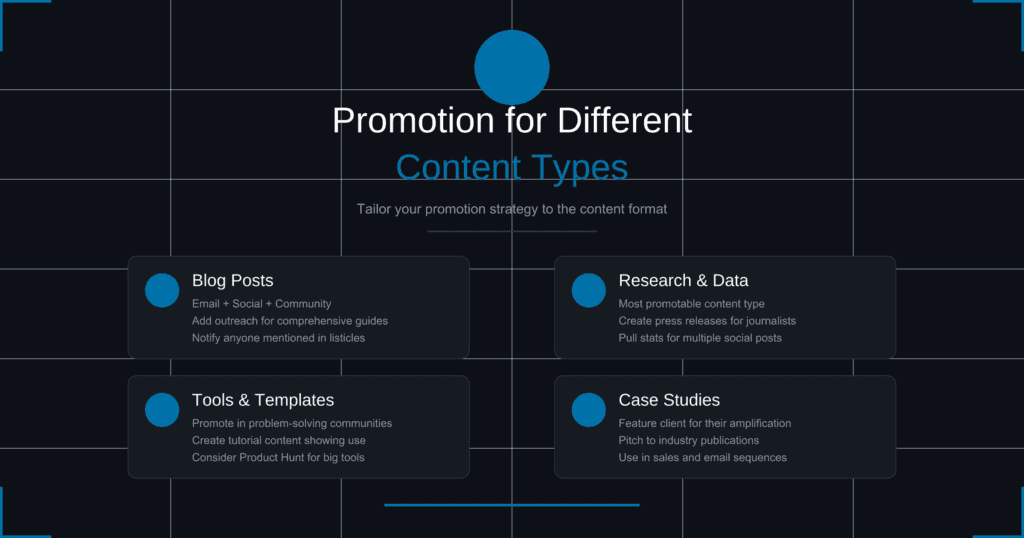
Not all content promotes the same way.
Blog Posts
Standard promotion: email plus social plus community.
For comprehensive guides, add outreach for backlinks.
For listicles featuring others, notify everyone mentioned. They’ll often share.
For opinion pieces, engage in the discussions they spark.
Research and Data
This is the most promotable content type. Everyone wants to cite original data.
Create a press release or summary for journalists. Offer exclusive first looks to key influencers. Pull individual findings for multiple social posts. Build a landing page optimized for backlinks.
If you’re going to invest in creating original research, invest equally in promoting it.
Tools and Templates
Promote in communities where people need the solution.
Create tutorial content showing the tool in action. Reach out to bloggers who write about related topics. Consider Product Hunt launch for substantial tools.
Case Studies
Feature your client prominently. They’ll share to their audience.
Pitch to industry publications as contributed content. Pull results and metrics for social proof posts. Use in sales conversations and email sequences.
Measuring Promotion Success
If you’re not tracking, you’re guessing.
Key Promotion Metrics
Traffic metrics:
- Referral traffic from promotion sources
- Social traffic by platform
- Email click-through rates
- Direct traffic increases after promotion pushes
Engagement metrics:
- Social shares and saves
- Comments and replies
- Time on page from promoted traffic
- Pages per session from referral sources
Growth metrics:
- New email subscribers attributed to content
- New social followers
- Backlinks earned
- Brand mentions
Tracking Promotion Sources
Use UTM parameters on all shared links. Create unique links for different channels. Track in Google Analytics by source and medium.
UTM structure:
- Source: where traffic comes from (twitter, newsletter, linkedin)
- Medium: type of link (social, email, referral)
- Campaign: specific content or promotion effort
Keep a log of your promotion activities so you can correlate with results.
Evaluating ROI
Compare time spent promoting versus traffic and engagement gained.
Track which channels consistently perform. Double down on what works. Cut what doesn’t.
Calculate cost per visitor for paid promotion. But don’t just look at clicks. Consider long-term value like subscribers and backlinks.
Common Promotion Mistakes
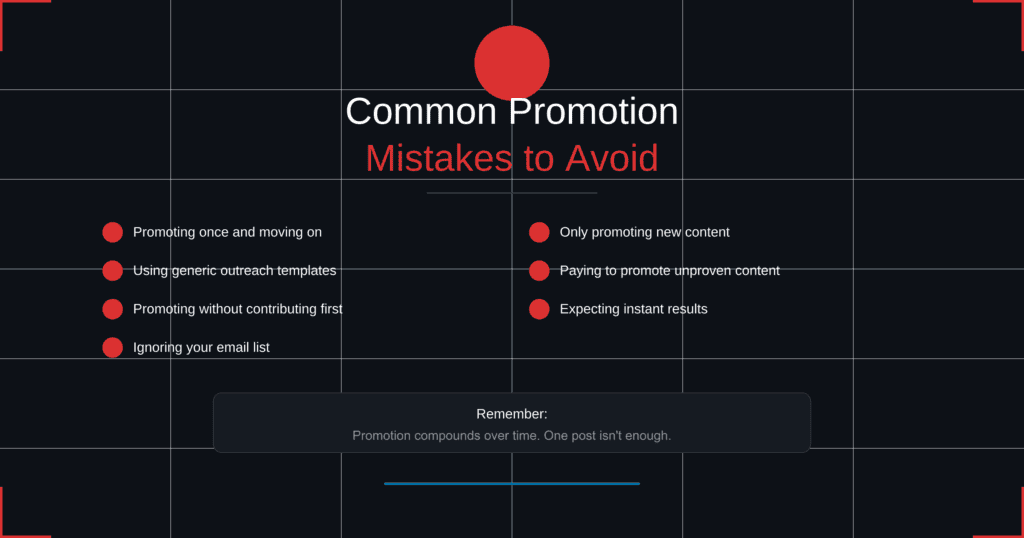
I’ve made most of these. Learn from my experience.
Mistakes to Avoid
Promoting once and moving on. Content needs ongoing promotion. One post isn’t enough.
Generic outreach. Templates get ignored. Personalize everything.
Promoting in communities without contributing. You’ll be marked as spam. Build reputation first.
Ignoring your email list. Your warmest audience. Often underutilized.
Only promoting new content. Old high-performers deserve re-promotion.
Paying to promote unproven content. Test organically first.
Expecting instant results. Promotion compounds over time.
Signs Your Promotion Isn’t Working
- High bounce rate from promoted traffic
- No engagement (shares, comments) despite views
- Email unsubscribes after promotion pushes
- Outreach response rate under 5%
- Paid traffic not converting
When promotion fails, ask yourself:
- Is the content actually valuable to this audience?
- Are you targeting the right people and communities?
- Is your messaging clear about the benefit?
- Are you promoting to cold audiences without warming first?
Sometimes the problem isn’t promotion. It’s the content itself.
Content Promotion Checklist
Use this to make sure you don’t miss anything.
Before Publishing
- [ ] Email list notification scheduled (for flagship content)
- [ ] Social media posts drafted and scheduled
- [ ] Outreach list prepared with personalized angles
- [ ] UTM links created for tracking
- [ ] Internal links added from related existing content
Launch Day
- [ ] Email sent to subscribers
- [ ] Posted to all owned social channels
- [ ] Outreach emails sent
- [ ] Shared in relevant communities (following rules)
- [ ] Responded to early comments and shares
Week 1
- [ ] Follow-up outreach sent if needed
- [ ] Additional social posts scheduled
- [ ] Engaged in conversations the content sparked
- [ ] Notified anyone mentioned or featured
- [ ] Tracked initial performance data
Ongoing
- [ ] Added to email welcome sequence (if evergreen)
- [ ] Referenced from new related content
- [ ] Included in relevant newsletter roundups
- [ ] Scheduled periodic re-shares
- [ ] Reviewed for update and re-promotion opportunities quarterly
Over to You
Content promotion isn’t optional. It’s not an afterthought. It’s half the job.
The strategies in this guide work. I’ve used them for my own content and for clients across industries.
Start with what you can control. Build your email list. Show up consistently on social. Engage in communities before you promote.
Then expand to earned media. Build relationships. Reach out to influencers. Guest post strategically.
Use paid to amplify what’s already working.
And track everything so you know what’s moving the needle.
Your content deserves to be seen. Now go make that happen.
Related Resources: