
I’ve been doing SEO for over a decade now.
And if there’s one thing I’ve learned, it’s this: great content means nothing if nobody’s searching for it.
That’s where keyword research comes in.
It’s the foundation of every successful SEO strategy I’ve ever implemented. Without it, you’re basically throwing content at the wall and hoping something sticks.
In this guide, I’ll walk you through everything you need to know about finding keywords that actually drive traffic. We’ll cover the tools, the process, and the strategies that work right now in 2026.
Let’s get into it.
What Is Keyword Research?
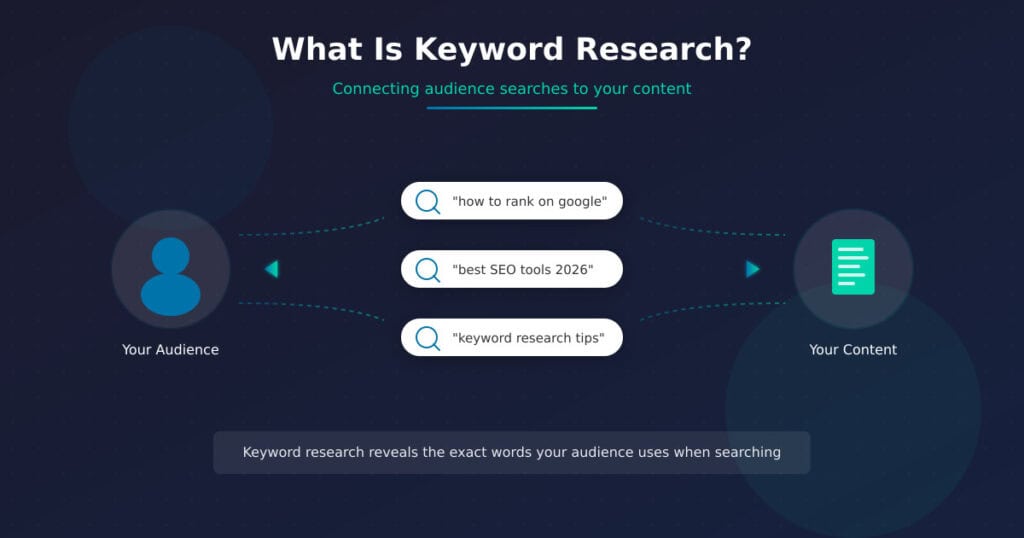
Keyword research is simply discovering the words and phrases your audience uses when they search online.
Think about it. Your potential readers are typing questions into Google every day. Keyword research helps you figure out exactly what they’re asking so you can create content that answers those questions.
Here’s the thing most people get wrong: keyword research should happen before you write, not after.
I’ve seen too many writers create a beautiful piece of content, then scramble to find keywords to optimize it for. That’s backwards.
When you research keywords first, you create content people are actually looking for.
Why Keyword Research Still Matters in 2026
I hear this question a lot. With AI search, voice assistants, and all these new technologies, does keyword research even matter anymore?
Short answer: absolutely.
Google still processes 8.5 billion queries daily. People are still typing (and speaking) searches. AI search systems still need to match queries to relevant content.
What has changed is how we approach it.
We’ve moved away from stuffing exact-match keywords into content. Now it’s about understanding topics, semantic relationships, and user intent.
Tools have gotten smarter too. Personal Keyword Difficulty metrics now account for your specific domain’s authority, not just general competition.
But the core principle remains the same. Find out what your audience wants, then give it to them.
Types of Keywords
Not all keywords are created equal.
Understanding the different types will help you build a more strategic approach to your content.
Short-Tail vs. Long-Tail Keywords
Short-tail keywords are those 1-2 word phrases that seem attractive because of their huge search volume.
Think “SEO” or “content writing.
The problem? Everyone’s targeting them. The competition is brutal, and the intent is usually vague. Someone searching “SEO” could want anything from a definition to an agency to a course.
Long-tail keywords are 3+ words and much more specific. Something like “how to do keyword research for blog posts.
Lower volume? Yes. But also lower competition and crystal clear intent.
Here’s what most people don’t realize: long-tail keywords make up 91.8% of all searches.
That’s not a typo. The vast majority of searches are specific, conversational queries.
And they convert better. Someone searching “best SEO tools for small business 2026” knows exactly what they want. They’re further along in their decision process.
Why Long-Tail Keywords Dominate in 2026
Voice search has made long-tail even more important.
People talk to their devices naturally. They don’t say “SEO tools.” They ask “what are the best free SEO tools for beginners?”
AI search tools encourage the same conversational approach.
For newer or smaller sites, long-tail keywords are your best friend. You can actually rank for them while building authority for those bigger terms.
The math works too. Many long-tail keywords combined often drive more traffic than a handful of high-volume head terms.
Semantic Keywords and Related Terms
Google has gotten incredibly smart about understanding context.
It knows that “dog training tips” and “puppy obedience training” are related. You don’t need to force exact-match keywords into every sentence.
Semantic keywords are terms conceptually related to your main topic. When you include them naturally, you’re signaling to Google that your content thoroughly covers the subject.
This is why comprehensive topic coverage beats keyword density every time.
Write naturally. Include related terms where they make sense. Don’t overthink it.
Branded vs. Non-Branded Keywords
Branded keywords include your company or product name. They’re easier to rank for because you’re the obvious result.
Non-branded keywords are generic industry terms. Higher competition, but they help new people discover you.
You need both.
Branded captures existing demand from people who already know you. Non-branded expands your reach to new audiences.
The Keyword Research Process
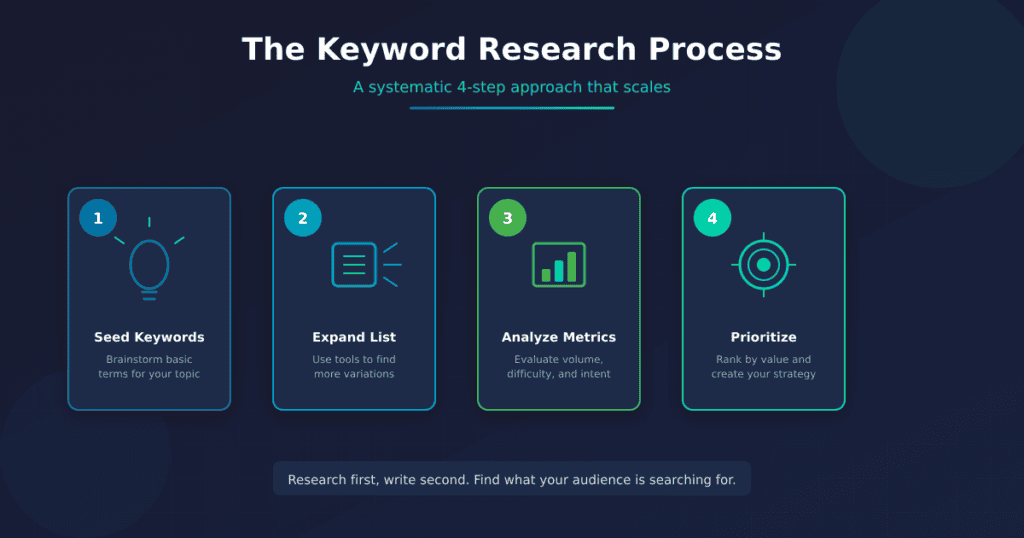
Let me walk you through the exact process I use with clients.
It’s a systematic 4-step approach that works whether you’re running a small blog or managing enterprise content.
Step 1: Seed Keywords and Brainstorming
Every research project starts with seed keywords.
These are the basic terms describing your business, products, or services. Don’t overthink this. Just write down the obvious stuff.
What problems do you solve? How do your customers describe those problems?
I always recommend checking existing content too. What topics are already performing well? There might be related keywords you’re missing.
Customer feedback is gold here. Review sales calls, support tickets, and emails. Real audience language beats your assumptions every time.
And yes, check your competitors. What topics are they covering? This isn’t about copying. It’s about identifying opportunities.
Step 2: Expanding Your Keyword List
Now take those seed keywords and expand them.
Enter them into keyword research tools for variations. You’ll be surprised how many related terms you’ll find.
Google Autocomplete is a free goldmine. Start typing your seed keyword and see what Google suggests. These are real searches people make.
Check the “People Also Ask” boxes in search results. These question-based keywords often have lower competition and clear intent.
Don’t ignore Reddit, Quora, and niche forums. This is where people discuss your topics in their own words. You’ll find keyword ideas no tool will show you.
Step 3: Analyzing Keyword Metrics
Not every keyword deserves your attention.
Here are the metrics that actually matter:
Search Volume tells you estimated monthly searches. But higher isn’t always better. A 10,000 volume keyword you can’t rank for is worthless.
Keyword Difficulty (KD) estimates how hard it is to rank. Always consider this against your domain’s authority. A 50 difficulty keyword might be easy for a big site but impossible for a new blog.
Cost Per Click (CPC) indicates commercial value. High CPC means advertisers are paying good money for those clicks. That usually means high buyer intent.
Traffic Potential is more accurate than raw volume. It estimates actual clicks you’d receive, accounting for featured snippets and other SERP features.
SERP Features show opportunities beyond traditional rankings. Can you get a featured snippet? Is there a video carousel you could target?
Step 4: Prioritizing Keywords
Here’s where strategy comes in.
You need to balance difficulty against potential reward. Don’t waste months chasing keywords you can’t rank for.
I use a simple KOB (Keyword Opposition to Benefit) analysis: traffic value divided by difficulty, multiplied by relevance.
New sites should target easier keywords first. Build authority with achievable wins, then go after tougher terms.
Always align keywords with business goals. Traffic is great, but traffic that converts is better.
Group your keywords by topic. This will inform your content strategy and help you avoid creating competing pages.
Keyword Clustering and Grouping
This is where a lot of people go wrong.
They find 50 great keywords and create 50 pieces of content. That’s a recipe for thin content and keyword cannibalization.
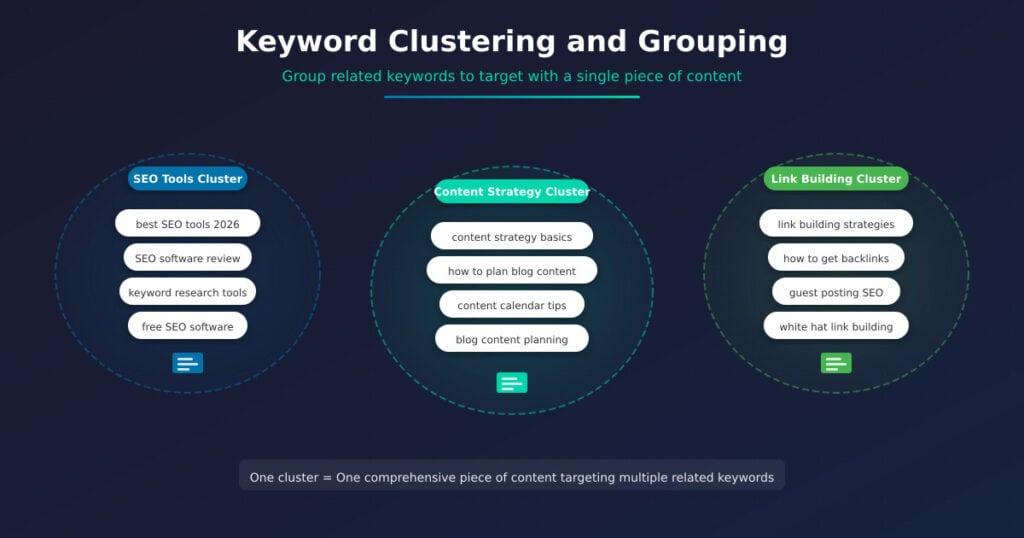
Keyword clustering means grouping related keywords that share the same search intent. Then you target multiple keywords with a single comprehensive piece of content.
77% of SEO professionals report better results after implementing clustering. That matches my experience exactly.
Why Keyword Clustering Works
Google doesn’t rank pages for just one keyword.
A single well-optimized page can rank for thousands of related terms. Creating multiple thin pages for similar keywords just dilutes your efforts.
Worse, you end up competing with yourself. Multiple pages targeting similar keywords confuse Google about which one to rank.
One comprehensive page outperforms multiple thin pages almost every time.
Clustering also builds topical authority. When you thoroughly cover a subject, Google recognizes your expertise.
And it’s just more efficient. Why write five mediocre posts when you can write one great one?
Methods for Clustering Keywords
There are three main approaches:
SERP-Based Clustering groups keywords that show similar search results. If two keywords have 30%+ overlap in the top 10 URLs, they probably belong together.
This is the most accurate method because it reflects what Google actually considers similar.
Intent-Based Clustering groups keywords with the same user goal. “Best keyword tools” and “top SEO software for research” both indicate someone looking to buy or compare tools.
Semantic Clustering uses natural language processing to group conceptually related keywords.
I recommend SERP-based clustering as your primary method. It’s grounded in real Google data.
Manual vs. Automated Clustering
For small lists under 100 keywords, manual clustering works fine. Use a spreadsheet and group keywords that obviously belong together.
For larger lists, you’ll want automated tools. Analyzing thousands of keywords by hand isn’t practical.
Tools like Keyword Insights, Semrush’s Keyword Manager, and SE Ranking’s Grouper can handle the heavy lifting.
But always validate automated clusters. Human judgment catches nuances that algorithms miss.
From Clusters to Content
Each cluster typically becomes one piece of content.
Identify your primary keyword (highest volume or most valuable) and secondary keywords within each cluster.
Map clusters to content types. Informational clusters become guides and tutorials. Commercial clusters become comparisons and reviews.
For more on structuring content around keywords, check out my SEO content writing services.
Free Keyword Research Tools
You don’t need expensive tools to get started.
In fact, some of the best data comes from free sources.
Google Keyword Planner
Google Keyword Planner is free with a Google Ads account. You don’t need to spend money on ads to use it.
Since it’s directly from Google, the data is as accurate as you’ll get anywhere.
The main limitations? Search volumes come in ranges rather than exact numbers. And it’s designed for ads, not organic SEO, so some features won’t be relevant.
But for a free tool, you can’t beat the accuracy.
Google Search Console
This is the most underrated SEO tool out there.
Search Console shows you the actual keywords your site already ranks for. Real data based on real performance.
I use it to find quick-win opportunities. Look for keywords where you rank positions 8-20. A little optimization could push those onto page one.
If you’re not using Search Console, you’re flying blind. It’s essential for monitoring and refining your strategy.
Google Trends
Google Trends compares keyword popularity over time and by region.
It’s perfect for identifying seasonal trends. If you’re writing about “tax tips,” you’ll want to publish before April, not after.
It also helps validate keyword relevance. Is interest growing or declining?
Just remember it shows relative popularity, not absolute search volume.
Other Free Tools Worth Using
Answer the Public visualizes questions people ask about any topic. Great for finding content ideas and long-tail keywords.
Ubersuggest’s free tier gives you basic keyword suggestions and volume estimates. Limited, but useful for getting started.
Keyword Surfer is a Chrome extension that shows search volume directly in Google results. Super convenient for quick research.
AlsoAsked maps “People Also Ask” questions hierarchically. Helpful for understanding how topics connect.
ChatGPT and other AI tools can generate keyword ideas. Just don’t trust their volume estimates. They’re often completely wrong.
Paid SEO Tools Comparison
Free tools have limits. At some point, you’ll want more data, larger databases, and advanced features.
The right tool depends on your needs, budget, and team size.
My main advice? Pick one and learn it deeply. Jumping between tools constantly just slows you down.
Semrush
Semrush is what I’d call an all-in-one digital marketing platform.
It’s not just for keywords. You get SEO, PPC, content marketing, and social media tools in one place.
The keyword database is massive: 27+ billion keywords globally, with 3.7 billion just for the USA.
What I like most is the Personal Keyword Difficulty feature. It calculates difficulty based on your specific domain’s authority, not just general competition.
The SEO Writing Assistant is also excellent for content optimization.
Pricing starts around $130/month with a 14-day free trial.
Semrush is ideal if you need a complete toolkit beyond just SEO.
Ahrefs
Ahrefs is the go-to for backlink analysis and competitive research.
They have the largest backlink index in the industry. If link building is a major part of your strategy, Ahrefs is hard to beat.
The keyword database is similar to Semrush at 28+ billion keywords across 217 countries.
I particularly like their Traffic Potential metric. It estimates actual clicks rather than just search volume.
The main drawback is the credit-based system. Heavy use can get expensive quickly. And there’s no free trial for the main plans.
Starter plan is $29/month (limited), with the full Lite plan at $129/month.
Best for SEO agencies and anyone focused heavily on link building.
Other Notable Tools
Moz Pro ($49/month) is user-friendly with excellent educational resources. Good for learning SEO.
SE Ranking ($52/month) offers solid features at a budget-friendly price.
Ubersuggest ($29/month) is an affordable entry point for small businesses.
Mangools (KWFinder) has a simple interface focused specifically on keyword research.
Surfer SEO combines content optimization with keyword research integration.
How to Choose
Here’s my recommendation:
Start with free tools if you’re new or have limited budget. You can do real keyword research without paying anything.
Choose Semrush if you need marketing tools beyond SEO. The all-in-one approach saves time and money compared to multiple tools.
Choose Ahrefs if backlink analysis and competitor research are your priorities.
Always try free trials before committing.
And seriously, don’t switch constantly. Master one tool for better results.
Competitor Keyword Analysis
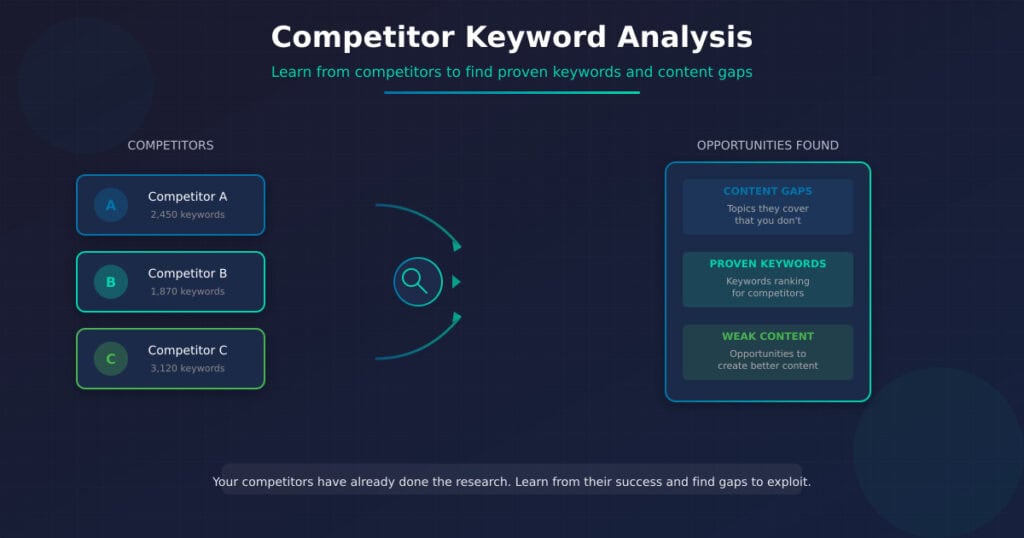
Your competitors have already done a lot of research for you.
They’ve tested topics, created content, and figured out what ranks. You can learn from their success.
But competitor analysis should inform your strategy, not dictate it. Don’t just copy what others do.
Finding Competitor Keywords
First, identify your true SEO competitors.
These might be different from your business competitors. In SEO, you’re competing against whoever ranks for your target keywords.
Use Site Explorer tools (in Semrush, Ahrefs, or similar) to see all keywords competitors rank for.
Focus on keywords where competitors rank positions 1-10. These are proven to be valuable and achievable.
Look for high traffic potential keywords you don’t currently target.
Content Gap Analysis
Content gaps are topics competitors cover that you don’t.
Use gap analysis tools to compare your keyword profile against competitors.
Prioritize gaps where multiple competitors rank. That’s validated demand across the industry.
Also look for gaps where competitor content is weak. If their page is thin or outdated, you have an opportunity to create something better.
For help identifying these opportunities, consider a content audit.
Learning From Competitor Strategy
Analyze top-performing competitor pages.
Look at structure, length, format, and which keywords they target.
Note which content types perform best in your niche. Are listicles dominating? In-depth guides? Comparison posts?
Study their internal linking and topic clustering approach.
Don’t copy. Use these insights to create better, more comprehensive content.
Keyword Research Checklist
Let me give you a practical checklist you can follow for any keyword research project.
Research Phase
Define seed keywords based on business goals.
Expand your list using keyword tools (free and/or paid).
Check Google Autocomplete and “People Also Ask.”
Analyze competitor keywords and content gaps.
Review forums and communities for audience language.
Analysis Phase
Record search volume, difficulty, and intent for each keyword.
Filter out keywords that don’t match your business.
Identify quick wins (keywords you almost rank for in Search Console).
Calculate priority scores using KOB or similar methods.
Group keywords into clusters by intent.
Planning Phase
Map clusters to content types (guides, comparisons, tools).
Assign primary and secondary keywords per piece.
Plan internal linking structure.
Set realistic ranking timelines based on difficulty.
Ongoing Maintenance
Monitor rankings weekly or monthly in Google Search Console.
Track keyword performance and adjust strategy accordingly.
Update content for keywords losing position.
Add new keywords as trends emerge.
Audit your keyword strategy quarterly.
Final Thoughts
Keyword research isn’t glamorous work.
It’s easy to skip and jump straight into writing. But that’s a mistake I see people make constantly.
The time you invest in research pays off exponentially in the content you create.
Start with the free tools. Follow the process I’ve outlined. Be patient with long-tail keywords while you build authority.
And remember: this isn’t a one-time task. The best SEO strategies involve continuous research and refinement.
If you need help building a keyword strategy or optimizing existing content, get in touch. I’ve been doing this for over a decade and I’m happy to help.
Now go find some keywords.