

Last Updated on 2 years ago by Christopher Jan Benitez
Let’s talk about a game-changer in search engine optimization: LSI keywords. If you’re looking to give your website’s search rankings a serious boost, you’ll want to pay attention.
In this article, we’ll explore the world of these keywords and how they can enhance your SEO. We’ll explain what they are, why they’re so important, and how you can start using them in your content like a pro.
By the end of this guide, you’ll have a solid grasp of how search engines make sense of your content’s context and relevance. Plus, you’ll be armed with the knowledge to optimize your pages and make them irresistible to search engines.
Understanding LSI Keywords
LSI (Latent Semantic Indexing) Keywords are words or phrases conceptually related to the main keyword you are targeting in Google search. These keywords help search engines understand the context and relevance of your content.
LSI is a technology that was originally patented in 1989. It is a methodology for retrieving textual data objects.
LSI keywords are not synonyms, but they are the related words and phrases that help search engines understand the relationships between words in your content.
These keywords are closely tied to the main keyword the page is targeting and are, in some way, often semantically related terms to it.
Importance of LSI Keywords
The keywords help search engines understand the context and relevance of your content.
By including LSI keywords in the title tag of your content, you can help search engines understand the relationships between words in your content. This can help improve the ranking of relevant results for your content in search engine results pages.
They can also help you find related searches, primary keywords, and topics that are relevant to your content.
Role of LSI Keywords in SEO
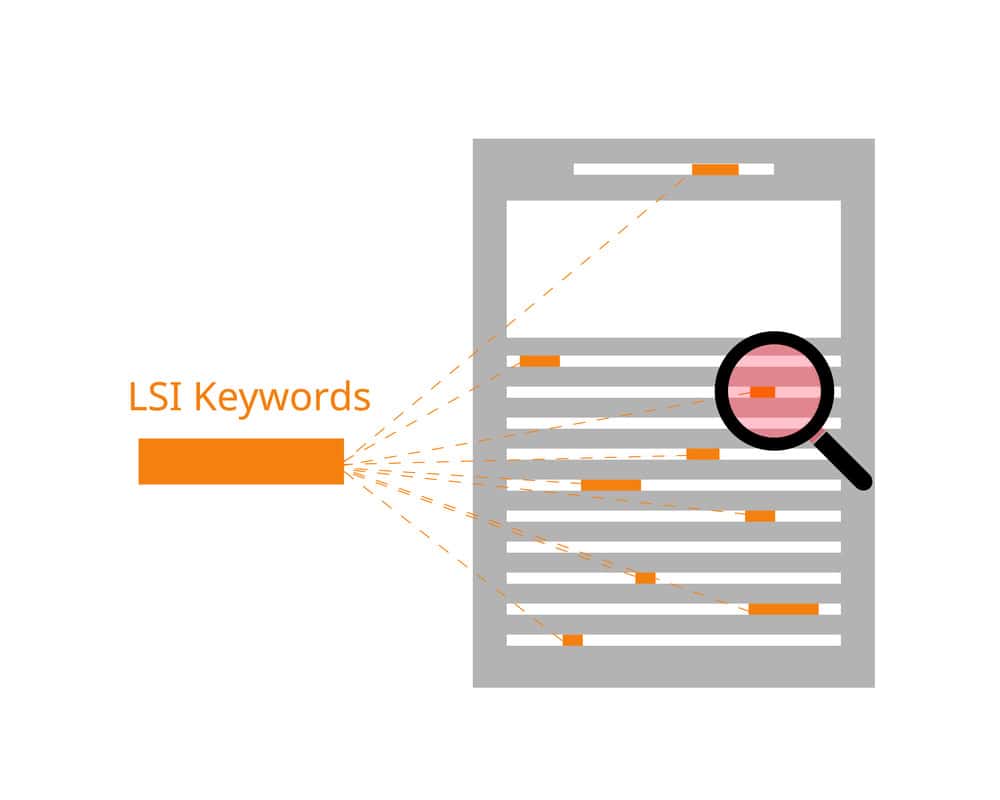
These keywords are an important factor in determining your website’s ranking on search engines. They are also important in understanding the search intent of users.
Google’s algorithm is constantly evolving and becoming more sophisticated, and LSI keywords play a crucial role in helping other search engines understand the context and relevance of your content.
By including them in your content, you can help Google to better understand what your web page is about and improve your chances of ranking higher in google’s search algorithm results.
Researching LSI Keywords
When it comes to researching and finding the keywords here, there are a few things you can do to make the process easier and your search suggestions more effective.
Using SEO Tools for LSI Keyword Research
One of the best ways to find LSI keywords is by using SEO tools. Tools like Google Autocomplete, Google Keyword Planner, and Keyword Tool can help you with keyword ideas and generate a list of related keywords that you can use in your content.

Another tool that can be helpful is LSIGraph. This tool allows you to enter a keyword and generate a list of related keywords, as well as their search volume and opportunity score. This can help you identify which keywords are worth targeting.
Understanding Search Volume and Keyword Difficulty
When researching LSI keywords, it’s important to consider both search volume and target keyword and difficulty.
Search volume refers to the number of searches a keyword receives each month, while keyword difficulty refers to how hard it is to rank for that specific keyword now.
The aforementioned tools above can help you determine search volume and keyword difficulty. By targeting keywords with high search volume and low keyword density and difficulty, you can increase your chances of ranking well in search engine results pages (SERPs).
Competitor Analysis for LSI Keywords
Another way to find the keywords is by analyzing your competitors’ content. Look at the keywords they’re targeting and try to identify any related LSI keywords related to that you can use in your own content.
Tools like GA (Google Analytics) can help you identify which keywords your competitors are top ranking pages for for. This can give you insight into what’s working for them and help you identify opportunities to improve your own content.
Implementing LSI Keywords

When it comes to implementing LSI keywords, there are a few key areas to focus on. By using them in the right places, you can improve the relevance and context of your content, helping to boost its visibility and ranking in search results.
In Content
One of the most important places to use the keywords is within your content itself. By including related search terms and phrases throughout your text, you can provide more context and help search engines better understand what your content is about.
To do this effectively, start by identifying a handful of semantic keywords that are relevant to your blog post main topic. Then, weave them naturally into your content, making sure to use them in a way that makes sense and adds value for your readers.
In Meta Tags and Headers
In addition to using LSI keywords within your content, it’s also a good idea to include them in your meta tags and headers. This can help to reinforce the relevance of relevant keywords within your content and provide additional context for search engines.
When adding keywords to your meta tags and headers, make sure to use them in a natural and meaningful way. Avoid stuffing them in simply for the sake of including more keywords, as this can actually hurt your search ranking in the long run.
Avoiding Keyword Stuffing
While using these keywords can be a great way to improve the relevance and context of your content, it’s important to avoid keyword stuffing at all costs. This means using your keywords in a way that feels natural and adds value, rather than cramming them in wherever possible.
To avoid keyword stuffing, focus on creating high-quality content that provides value for your readers. Use LSI keywords to supplement your content and provide additional context, but don’t rely on them as a crutch.
Advanced Topics in Latent Semantic Indexing Keywords
This section will provide an in-depth analysis of advanced LSI keyword topics to give you a better understanding of how search engines use this technology to effectively rank web pages.
LSI Keywords and Natural Language Processing
These keywords are an essential part of natural language processing (NLP), which is the branch of computer science that deals with how computers can understand and interpret human language.
NLP is a complex field that involves a wide range of techniques, including machine learning, semantic analysis, and text mining.
By analyzing the relationships between words and phrases, search engines can create a knowledge graph that allows them to provide more relevant search results.
Latent Semantic Analysis vs Latent Semantic Indexing
Latent Semantic Analysis (LSA) and LSI are two related techniques that are often used interchangeably. However, there are some key differences between the two.
LSA is a mathematical technique that uses a matrix to represent the relationships between words and phrases. LSI, on the other hand, is a more advanced version of LSA that uses a technique called Singular Value Decomposition (SVD) to reduce the dimensionality of the matrix.
While LSA is a useful technique for analyzing text, LSI is more powerful because it can handle larger datasets and provide more accurate results.
The Future of LSI Keywords in SEO

As search engines continue to evolve, we can expect to see more advanced techniques, such as search algorithms such as word vectors and deep learning, being used to analyze text.
One exciting development in this field is the use of contextual-based SEO, which involves using LSI keywords to in search engine optimization create content that is more closely related to the user’s search query. This approach can help improve the relevance of search results and provide a better user experience for search queries.
Frequently Asked Questions
Using LSI keywords is simple. Once you have identified your primary keyword, you can use the keywords to support it. You can include them in your content naturally, ensuring that they fit the context of your content. It is important to avoid stuffing keywords into your content, as this can negatively impact your SEO.
Latent Semantic Indexing (LSI) is a technique used by search engines to identify patterns between words and semantically related phrases or keywords and phrases to understand the context of a piece of content. They are words and phrases semantically related to your primary keyword. Using these keywords in your content can help search engines understand the context of your content, which can improve your search engine rankings.
There are many free LSI keyword tools available online. Some popular options include LSIGraph, Google’s Keyword Planner, and Ubersuggest. These tools can help you identify the keywords that are relevant to your content, which can improve your SEO.
Using LSI to find keywords used in your content can have several benefits. It can help search engines understand your content’s context, improving your search engine rankings. It can also help you create more comprehensive and relevant content, improving user engagement and leading to more conversions.
The best LSI keywords to use are relevant to your content and your target audience. You can use keyword research tools to identify your LSI keyword suggestions or keywords that are semantically related to your primary keyword. It is important to include these keywords that fit the context of your content and avoid stuffing them in unnaturally.
The full form of LSI is Latent Semantic Indexing. It is a technique used by search engines to identify patterns between words and phrases to understand the context of a piece of content.
