
SEO content writing has evolved far beyond stuffing keywords into paragraphs. Today, creating content that ranks requires understanding search intent, satisfying user needs, and demonstrating genuine expertise. This guide covers everything you need to know about writing content that both search engines and readers love.
Whether you are an SEO professional looking to sharpen your content skills or a content writer wanting to add SEO expertise to your toolkit, this guide provides actionable strategies based on over a decade of experience in the field.
- What Is SEO Content Writing?
- Understanding Search Intent
- Keyword Research for SEO Writers
- On-Page SEO Essentials for Writers
- Writing Content That Ranks and Converts
- Technical SEO Basics Every Writer Should Know
- Generative Engine Optimization: The New SEO Frontier
- Building Authority Through Link Building
- Content Maintenance and Optimization
- Common SEO Writing Mistakes to Avoid
- SEO Tools Every Content Writer Needs
- Your SEO Content Writing Action Plan
What Is SEO Content Writing?
SEO content writing is the practice of creating content optimized for both search engines and human readers. The goal is to produce material that ranks well in search results while genuinely helping your audience. This balance between technical optimization and user value is what separates effective SEO content from keyword-stuffed articles that fail to perform.
The discipline has changed dramatically over the years. Early SEO focused heavily on keyword density and link manipulation. Modern SEO content writing prioritizes user intent, comprehensive topic coverage, and demonstrable expertise. Google’s algorithms have become sophisticated enough to understand context, evaluate quality, and reward content that truly serves searchers.
In 2025, SEO content faces new challenges. AI Overviews appear in roughly 13 to 20 percent of searches, and zero-click searches continue to rise. Content must now satisfy traditional ranking factors while also being structured in ways that AI systems can cite and reference. This adds complexity but also creates opportunities for writers who understand both human readers and algorithmic requirements.
SEO Content Writing vs. Traditional Copywriting
The key difference between SEO content writing and traditional copywriting lies in their primary objectives. SEO writing aims to attract organic search traffic by matching what people are actively searching for. Traditional copywriting focuses primarily on persuasion and conversion, often for paid advertising or direct marketing contexts.
SEO content targets organic discovery through search engines. You are writing for people who have expressed a need by typing a query. Your content must answer that query comprehensively while also meeting technical requirements that help search engines understand and rank your page.
Modern SEO content must now satisfy both traditional rankings and AI citation eligibility. This means writing with clarity and structure that allows AI systems to extract and reference your information accurately. The best content accomplishes all three goals: ranking well, serving readers, and being AI-friendly.
The Role of E-E-A-T in SEO Content
E-E-A-T stands for Experience, Expertise, Authoritativeness, and Trustworthiness. These factors guide how Google’s quality raters evaluate content and inform the signals that algorithms use to rank pages. While E-E-A-T is not a direct ranking factor, it reflects the qualities that correlate strongly with high-performing content.
Trust is the most important element in this framework. Google prioritizes content from sources that demonstrate credibility through accurate information, transparent authorship, and a history of reliability. Experience and expertise support trust by showing that the content creator has genuine knowledge of the topic.
E-E-A-T matters more than ever in 2025. The flood of AI-generated content has made human expertise a key differentiator. Search engines are looking for signals that real experts with genuine experience created the content. Author bios, verifiable credentials, original research, and first-hand insights all contribute to E-E-A-T signals.
Understanding Search Intent
Matching search intent is now more important than keyword density or any other optimization factor. Search intent refers to the underlying goal a user has when typing a query. Google’s algorithms prioritize content that delivers exactly what users are looking for, and content misaligned with intent simply will not rank regardless of how well it is optimized.
Understanding intent requires analyzing what users actually want when they search specific terms. A query like “best running shoes” indicates someone researching options before a purchase, while “buy Nike Air Max” shows readiness to complete a transaction. Your content must match these different needs to succeed.
The Four Types of Search Intent
Informational intent covers searches where users want to learn something. Queries like “how to start SEO” or “what does a content writer do” indicate informational intent. These searches call for educational content such as guides, tutorials, explainers, and how-to articles. The content should thoroughly answer the question and anticipate follow-up questions the reader might have.
Navigational intent involves users seeking a specific website or page. Someone searching “Ahrefs login” or “Semrush blog” already knows what they want to find. For your own brand, optimize navigation pages and ensure users can easily reach the destinations they seek.
Commercial intent describes users researching before making a purchase decision. Queries like “best SEO tools 2025” or “Grammarly premium review” show commercial intent. Create comparison posts, reviews, listicles, and buyer’s guides that help users evaluate their options.
Transactional intent indicates readiness to buy or take action. Searches like “buy Semrush subscription” or “hire a freelance writer” signal transactional intent. These require clear calls to action, streamlined purchase paths, and trust signals that reduce friction in the conversion process.
How to Identify Search Intent for Any Keyword
The most reliable method for identifying search intent is analyzing the current top ten Google results for your target keyword. Note what type of content dominates. If the first page shows mostly how-to guides, that keyword has informational intent. If you see product pages and shopping results, transactional intent dominates.
SERP features provide additional intent signals. Featured snippets often indicate informational queries. People Also Ask boxes suggest questions you should answer. Shopping results and local packs indicate commercial or transactional intent. Let the search results guide your content approach.
Use the 3 C’s framework to analyze results systematically. Content Type refers to whether results are blog posts, product pages, landing pages, or something else. Content Format covers the specific format such as listicles, guides, tutorials, or reviews. Content Angle identifies the unique perspective or hook that top results use. Match all three to align with intent.
Keyword Research for SEO Writers
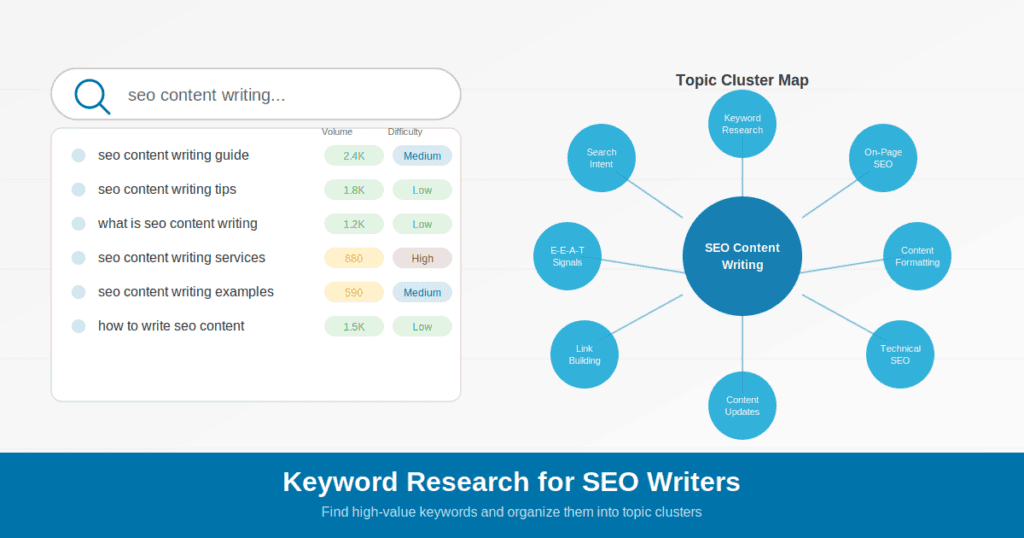
Keyword research remains foundational to SEO content writing, but the approach has evolved beyond simple volume chasing. Modern keyword research focuses on understanding topic ecosystems rather than individual terms. The goal is finding clusters of related keywords that you can target with comprehensive content.
Effective keyword research balances three factors: search volume, keyword difficulty, and intent alignment. High volume means nothing if the difficulty is beyond your site’s authority. Low difficulty keywords only matter if they match what your audience needs. Intent alignment ensures your content can actually satisfy searchers.
Finding High-Value Keywords
Tools like Semrush, Ahrefs, and Google Keyword Planner help you discover keyword opportunities efficiently. Start with seed terms related to your topic and explore variations, questions, and related searches that tools surface. Look for patterns in what your target audience is searching for.
Prioritize long-tail keywords for lower competition and clearer intent signals. A query like “how to optimize blog posts for featured snippets” is more specific and easier to rank for than “SEO tips.” Long-tail keywords also tend to convert better because they reflect more specific needs.
Evaluate keyword difficulty scores realistically. If major publications and high-authority sites dominate the first page, you may need to build authority before targeting that term. Look for keywords where you can genuinely compete with your current resources.
Organizing Keywords Into Topic Clusters
The hub-and-spoke model organizes content into pillar pages supported by related cluster content. A pillar page covers a broad topic comprehensively, while cluster pages dive deep into specific subtopics. Internal links connect everything, creating a structure that search engines recognize as topically authoritative. This approach is central to topical mapping and content strategy.
Group keywords by topic rather than treating each as an isolated target. If you are writing about SEO content writing, related keywords might include content optimization, keyword research for writers, on-page SEO, and E-E-A-T. Each becomes a cluster page linking back to your main pillar content.
Create a content map showing how pillar and cluster pages interlink. This visualization helps you plan content strategically and identify gaps in your topic coverage. The goal is building an effective content hub that Google rewards with higher rankings across related searches.
On-Page SEO Essentials for Writers
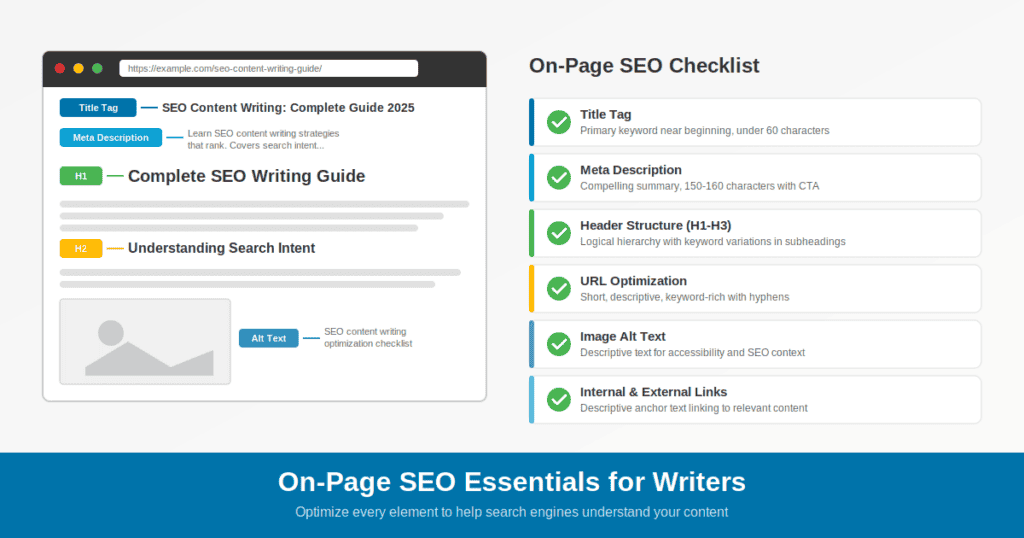
On-page SEO ensures search engines understand and properly index your content. These elements work together as a system. Optimizing your title tag without considering meta descriptions and headers limits your results. The goal is creating a cohesive page that communicates its topic and value clearly to both algorithms and readers.
On-page optimization should enhance readability, not compromise it. Every technical element serves the reader first. Your title tag is your first impression in search results. Your headers help readers scan and find information. Your meta description convinces searchers to click. Technical and user-focused goals align when done properly.
Crafting SEO-Optimized Title Tags
Include your primary keyword naturally in the title, ideally near the beginning. Front-loading the keyword helps both search engines and users quickly understand what the page covers. Avoid awkward phrasing that sacrifices readability for keyword placement.
Keep titles under 60 characters to avoid truncation in search results. Truncated titles look unprofessional and may cut off important information. Check how your title displays in search results and adjust if needed.
Make titles compelling and click-worthy. They are your first impression in SERPs. Include numbers, power words, or clear value propositions when appropriate. “Complete SEO Writing Guide” tells users exactly what they will get.
Writing Effective Meta Descriptions
Summarize page content in 150 to 160 characters with a clear value proposition. The meta description serves as ad copy for your search listing. Tell potential visitors what they will learn or gain by clicking through to your content.
Include target keywords naturally within the description. Google bolds matching terms in search results, making your listing more visually prominent. This increases the likelihood of clicks from searchers scanning results.
Add a subtle call to action to encourage clicks. Phrases like “Learn how” or “Discover the strategies” create forward momentum. Keep the tone aligned with your content and avoid clickbait promises you cannot deliver.
Header Structure and Keyword Placement
Use H1 for the main title, limiting to one per page. The H1 should contain your primary keyword and clearly communicate the page topic. This is typically the same as or very similar to your title tag.
Structure H2s and H3s logically to create a scannable hierarchy. Headers should outline your content in a way that allows readers to quickly find specific sections. This also helps search engines understand the relationship between different content sections.
Include keyword variations and related terms in subheadings naturally. If your primary keyword is “SEO content writing,” subheadings might include “writing for search intent” or “optimizing content for rankings.” This reinforces topical relevance without keyword stuffing.
URL Optimization
Keep URLs short, descriptive, and keyword-rich. A URL like /seo-content-writing-guide/ tells both users and search engines what to expect. Long URLs with unnecessary parameters or random strings look less trustworthy and are harder to share.
Avoid unnecessary parameters, numbers, or special characters in URLs. Clean URL structures are easier to read, remember, and share. They also avoid potential issues with URL encoding and display across different platforms.
Use hyphens to separate words for readability. Underscores and other separators can cause issues with how search engines parse URLs. Hyphens are the standard convention and ensure proper word separation.
Image Optimization and Alt Text
Write descriptive alt text that helps visually impaired users and search engines understand your images. Alt text should describe what the image shows in the context of your content. This improves accessibility and provides another opportunity to reinforce topical relevance.
Include keywords in alt text when naturally relevant. If your image shows a content optimization dashboard, mentioning “content optimization” in the alt text makes sense. Avoid forcing keywords into descriptions where they do not fit.
Compress images and use modern formats like WebP for faster loading. Page speed affects both rankings and user experience. Large, unoptimized images are one of the most common causes of slow-loading pages.
Writing Content That Ranks and Converts
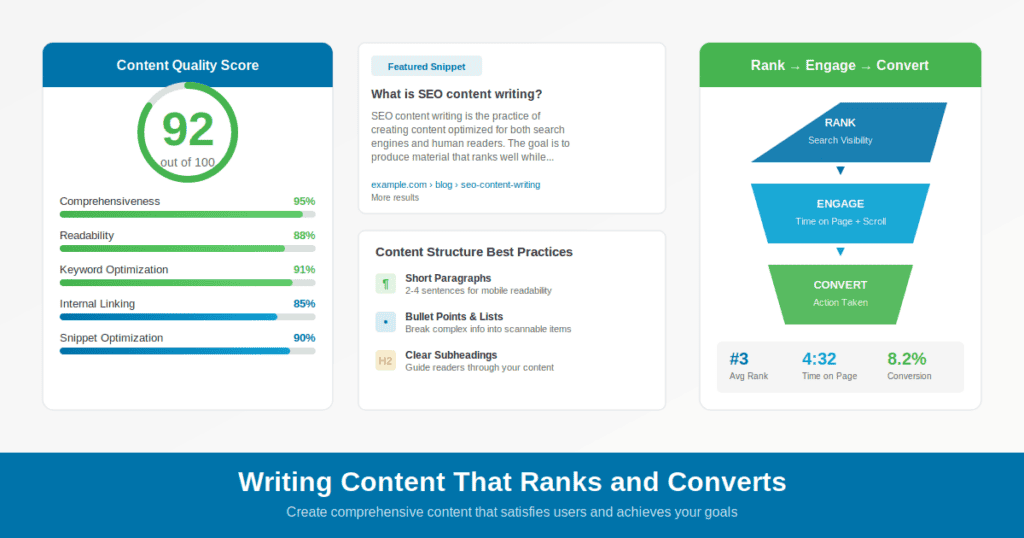
Ranking requires quality content that satisfies user intent completely. Search engines evaluate whether users find what they need on your page. If visitors quickly return to search results, that signals your content did not meet their needs. Comprehensive coverage of topics signals expertise to algorithms.
Engagement metrics influence rankings more than many realize. Time on page, scroll depth, and bounce rate all provide signals about content quality. Creating content that holds attention and encourages further exploration helps both rankings and conversions.
Creating Comprehensive, In-Depth Content
Cover topics thoroughly by answering all related questions a user might have. Anticipate follow-up questions and address them within your content. This keeps readers on your page rather than returning to search for additional information.
Use the skyscraper approach: analyze what currently ranks and make your content better. Look at the top results for your target keyword and identify gaps, outdated information, or areas where you can provide more value. Then create content that surpasses what exists.
Include unique insights, original data, or expert perspectives that competitors lack. Information that only you can provide gives readers a reason to choose your content over alternatives. First-hand experience and proprietary research are particularly valuable.
Content Formatting for Readability and SEO
Break content into scannable sections with clear headings. Most readers scan content before deciding whether to read it fully. Headers, subheaders, and visual breaks help them quickly assess whether your content answers their questions.
Use bullet points, numbered lists, and tables for complex information. These formats make information easier to digest and reference. They also create opportunities for featured snippet placement, as Google often pulls formatted lists into search results.
Keep paragraphs short, generally two to four sentences, for easier reading on mobile devices. Long blocks of text discourage reading. White space makes content feel more approachable and easier to consume.
Adding Internal and External Links
Link to relevant internal pages to distribute authority and help users navigate your content ecosystem. Internal links help search engines discover and understand the relationship between your pages. They also keep visitors engaged with your site longer.
Cite authoritative external sources to support claims and build credibility. Linking to research, statistics, and expert sources shows you have done your homework. This supports E-E-A-T signals and provides additional value to readers.
Use descriptive anchor text that tells users and search engines what to expect from the linked page. Generic phrases like “click here” waste an opportunity to provide context. Anchor text like “keyword research best practices” clearly communicates the destination.
Optimizing for Featured Snippets
Structure content to directly answer common questions in 40 to 60 words. Featured snippets pull concise answers from pages that clearly address search queries. Position direct answers immediately after relevant headers.
Use definition-style paragraphs, numbered steps, or tables that Google can extract. Format matters for snippet eligibility. If the query asks for steps, use a numbered list. If it asks for a definition, provide a clear, concise paragraph.
Target People Also Ask questions with clear, concise answers in your content. These FAQ-style queries often appear in search results and provide opportunities for additional visibility. Address common questions explicitly throughout your content.
Technical SEO Basics Every Writer Should Know
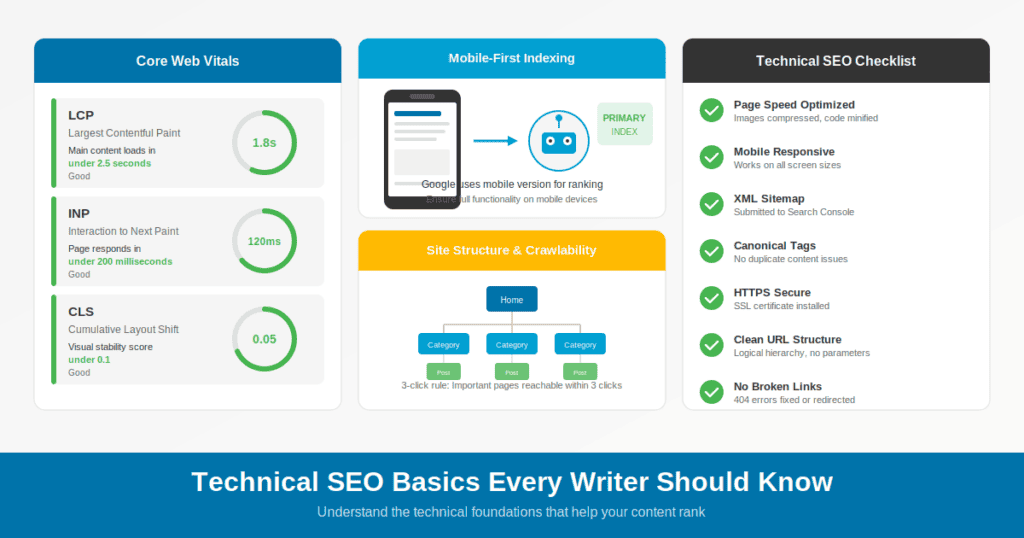
Technical issues can prevent great content from ranking even when everything else is done right. Writers do not need to become developers, but understanding basic technical concepts helps you collaborate effectively with technical teams and avoid creating content that runs into avoidable problems.
Site speed and mobile experience directly impact rankings. Google uses page experience signals including Core Web Vitals to evaluate pages. Content that loads slowly or displays poorly on mobile devices faces ranking disadvantages regardless of quality.
Core Web Vitals Explained
Largest Contentful Paint (LCP) measures how quickly the main content loads. The largest element in the viewport, often an image or heading, should appear within 2.5 seconds. Slow LCP often results from unoptimized images or slow server response times.
Interaction to Next Paint (INP) replaced First Input Delay in 2024 and measures responsiveness throughout the page visit. Pages should respond to interactions within 200 milliseconds. Heavy JavaScript and unoptimized code cause INP issues.
Cumulative Layout Shift (CLS) measures visual stability. Elements should not shift unexpectedly as the page loads. Ads, images without dimensions, and dynamically loaded content often cause layout shifts. Keep CLS scores under 0.1 for a good user experience.
For more details on improving these metrics, see this guide on WordPress speed optimization.
Mobile-First Indexing
Google primarily uses the mobile version of content for ranking and indexing. This means the mobile experience determines your search visibility, not the desktop version. Content must be fully accessible and readable on mobile devices to rank well.
Ensure all content, images, videos, and interactive elements work properly on mobile. Content hidden behind tabs, accordions, or other interactive elements may be weighted less if it is not immediately visible on mobile. Test your pages on actual mobile devices to verify functionality.
Responsive design is essential for modern SEO. Pages should adapt seamlessly to different screen sizes without requiring horizontal scrolling or pinch-to-zoom. Mobile users expect content that is easy to read and navigate with their thumbs.
Site Structure and Crawlability
Create a logical site hierarchy that search engines can easily navigate. Important pages should be reachable within three clicks from the homepage. Clear navigation and internal linking help search engines discover and understand your content.
XML sitemaps help search engines discover all important pages on your site. While Google can crawl and find pages through links, sitemaps ensure nothing important is missed. Especially valuable for large sites or newly published content.
Implement proper canonical tags to avoid duplicate content issues. When similar content exists on multiple URLs, canonical tags tell search engines which version to index and rank. This prevents diluting your rankings across duplicate pages. A thorough website analysis can help identify these technical issues.
Generative Engine Optimization: The New SEO Frontier
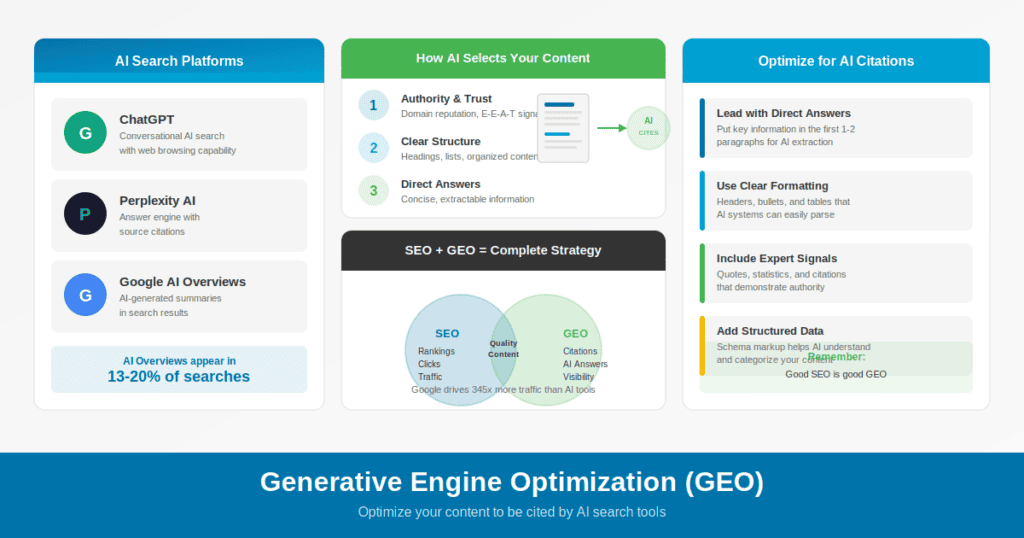
AI search tools like ChatGPT, Perplexity, and Google AI Overviews are changing how people discover information. GEO, or Generative Engine Optimization, focuses on optimizing content to be cited in AI-generated answers rather than just ranked in traditional search results.
GEO builds on SEO fundamentals. Good SEO practices generally translate to good GEO performance. Clear structure, authoritative content, and proper formatting help AI systems understand and cite your content. Think of GEO as an extension of SEO rather than a replacement.
How AI Search Engines Select Sources
AI platforms prioritize authoritative, well-structured content from trusted domains. Brand recognition and domain authority influence whether AI systems select your content for citations. Building a reputation in your niche matters for AI visibility just as it does for traditional search.
Content with clear answers, proper formatting, and cited sources gets referenced more frequently by AI systems. Well-organized content with explicit headings and structured data is easier for AI to parse and extract. Ambiguous or poorly organized content is less likely to be selected.
Schema markup and structured data help AI understand and extract your content accurately. While not a direct ranking factor, structured data provides context that helps AI systems categorize and cite your information appropriately.
Optimizing Content for AI Citations
Lead with direct answers in the first one to two paragraphs. AI systems often extract opening content for answers and citations. Put your key information upfront rather than burying it deep in the content. This follows journalistic inverted pyramid principles.
Use clear headings, bullet points, and tables that AI can easily parse. Structured content formats translate well to AI citations. When information is clearly organized, AI systems can more accurately extract and attribute it.
Include expert quotes, statistics, and citations that demonstrate authority. AI systems look for signals of expertise and credibility when selecting sources. Content that references authoritative sources and includes verifiable data is more likely to be cited.
Tracking Your AI Visibility
Manually test queries in ChatGPT, Perplexity, and Google AI Overviews to see if your content is being cited. There are no comprehensive tools yet for tracking AI citations automatically. Regular manual testing gives you insight into your AI visibility.
Monitor referral traffic from AI platforms in Google Analytics 4. While still a small percentage of overall traffic, tracking AI referrals helps you understand the impact of GEO efforts. Watch for trends as AI search adoption grows.
Keep perspective on the importance of AI versus traditional search. Google still drives roughly 345 times more traffic than AI tools combined. Do not abandon traditional SEO for GEO. Instead, treat GEO optimization as an enhancement to solid SEO fundamentals.
Building Authority Through Link Building
Backlinks remain one of the strongest ranking signals in 2025. Links from other websites signal to search engines that your content is valuable and trustworthy. Quality matters far more than quantity. One link from an authoritative site in your niche is worth more than dozens of low-quality links.
The best link building strategy is creating content worth linking to. When your content provides genuine value, other sites naturally want to reference it. This approach is more sustainable and effective than aggressive outreach for low-value links.
Creating Link-Worthy Content
Produce original research, data, or insights that others will want to cite. Information that only you can provide is inherently link-worthy. Surveys, case studies, industry benchmarks, and original analysis give other content creators reasons to link to you.
Create comprehensive resources that become go-to references in your niche. Ultimate guides, glossaries, and definitive how-to content earn links from people who want to provide their readers with thorough resources. Aim to create the best coverage of a topic available.
Develop unique frameworks, tools, or templates that provide genuine value. Practical resources that solve problems get shared and linked to repeatedly. A useful spreadsheet template or calculator can generate links for years.
Outreach and Relationship Building
Build genuine relationships in your industry before asking for links. Networking, engaging on social media, and providing value to others creates a foundation for natural link building. Cold outreach to strangers is far less effective than warm requests to professional connections.
Guest posting on relevant, authoritative sites remains one of the most effective ways to earn contextual backlinks. Writing for established publications builds your personal brand while generating quality links. Focus on sites where your expertise adds genuine value to their audience.
If you are new to this approach, start by learning what guest posting is and whether guest posting still works in the current landscape. Then develop a guest posting strategy and learn how to find guest post websites. This list of blogs that accept guest posts can help you get started.
Respond to journalist queries through services like HARO and Connectively to earn media mentions. Reporters regularly seek expert sources for stories. Providing helpful quotes and insights can result in links from major publications. Blogger outreach follows similar principles.
Internal Linking Strategy
Link new content to relevant existing pages to distribute authority throughout your site. Internal links help search engines discover new content and understand how your pages relate to each other. They also keep visitors engaged with your site.
Update older high-authority pages with links to newer content. This passes link equity from established pages to new ones. Regularly auditing and updating internal links keeps your site structure optimized as you add new content.
Use descriptive anchor text that tells users and search engines what they will find. Internal anchor text provides context about the destination page. Vary your anchor text naturally while keeping it relevant to the linked content.
Content Maintenance and Optimization
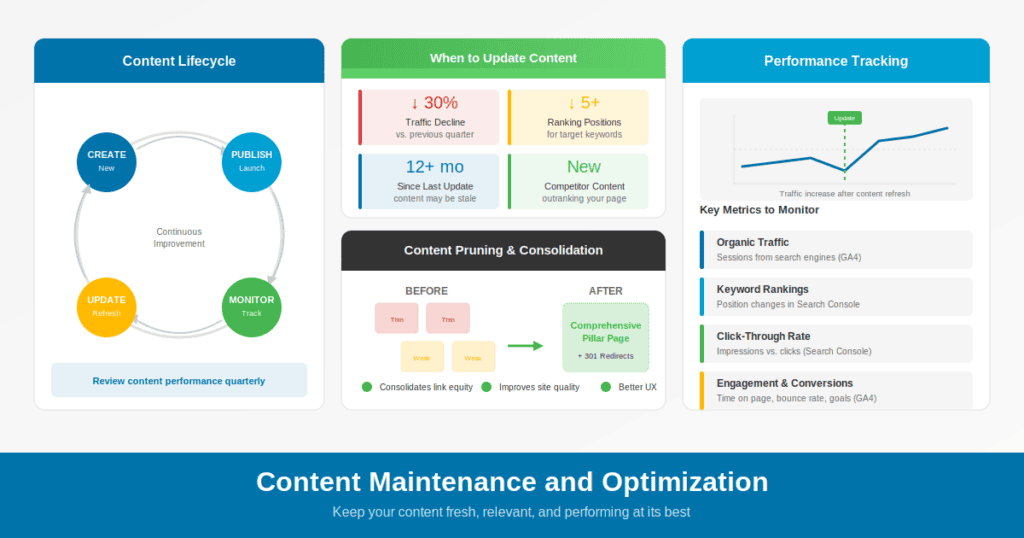
SEO is an ongoing process. Content needs regular updates to maintain rankings, especially for time-sensitive topics. Google rewards fresh, accurate content that reflects current information. Stale content gradually loses rankings as competitors publish more current alternatives.
Updating existing content often delivers better ROI than creating new pieces. A page with existing authority and backlinks can be refreshed and improved more quickly than building a new page from scratch. Smart content investment means maintaining your best performers.
When and How to Update Content
Review performance quarterly and prioritize pages with declining traffic or rankings. Google Search Console shows which pages are losing positions. Focus your update efforts on content that is underperforming relative to its potential.
Update statistics, examples, and screenshots to reflect current information. Outdated data signals to both users and search engines that your content may not be trustworthy. Current information improves user experience and supports E-E-A-T signals.
Add new sections to address questions competitors have started covering. If competitors are ranking for related topics you do not address, your content has gaps. Expanding content to cover new angles helps you compete for broader query sets.
Content Pruning and Consolidation
Identify thin or underperforming pages that dilute your site’s authority. Pages with little traffic, few backlinks, and thin content may be hurting your overall site quality. Removing or improving weak content can lift rankings across your entire site.
Merge related weak pages into comprehensive pillar content. Instead of multiple thin articles on related topics, combine them into one authoritative resource. This consolidates link equity and creates more valuable content for users.
Set up 301 redirects from old URLs to consolidated pages. Redirects ensure users and search engines find your new content and that link equity transfers properly. Never simply delete pages without redirecting to relevant alternatives.
A professional content audit can identify which pages need updating, consolidation, or removal. For pages that have lost rankings, content reoptimization services can help recover lost traffic.
Measuring SEO Content Performance
Track rankings, organic traffic, and click-through rates in Google Search Console. Search Console provides free, accurate data directly from Google. Monitor position changes, impressions, and clicks to understand how your content performs in search.
Monitor engagement metrics including time on page, bounce rate, and conversions in Analytics. These metrics indicate whether your content satisfies users after they click. High engagement signals quality content that meets user expectations.
Set up regular reporting to identify trends and opportunities. Monthly or quarterly reviews help you spot patterns in performance. Look for pages gaining or losing momentum and investigate the reasons behind changes.
Common SEO Writing Mistakes to Avoid
Many SEO content failures result from avoidable mistakes. Understanding common pitfalls helps you skip the learning curve and produce effective content from the start. These errors range from keyword problems to technical oversights that undermine otherwise solid content.
Keyword-Related Mistakes
Keyword stuffing means overusing keywords to the point that content becomes unreadable and triggers algorithmic penalties. Modern search engines recognize this manipulation and penalize it. Write naturally and let keyword usage flow from covering the topic comprehensively.
Ignoring search intent means targeting keywords without matching what users actually want. You can optimize perfectly for a keyword and still fail if your content does not satisfy the intent behind searches. Always analyze what type of content ranks before creating yours.
Keyword cannibalization occurs when multiple pages compete for the same keyword. This dilutes your authority and confuses search engines about which page to rank. Map keywords to specific pages and ensure each piece of content has a unique target.
Content Quality Issues
Thin content consists of pages with little value that do not fully address the topic. Search engines recognize when content lacks substance. Every page should provide comprehensive value to users searching for its target keywords.
Duplicate content across pages confuses search engines about which version to rank. This can happen accidentally through URL parameters, www versus non-www versions, or similar content on different pages. Use canonical tags and maintain clean site architecture. Plagiarism checker tools can help identify duplicate content issues.
Missing E-E-A-T signals includes lack of author bios, credentials, or trust indicators. Anonymous content without verifiable expertise signals raises red flags for quality evaluators. Demonstrate who created the content and why they are qualified to address the topic.
Technical Oversights
Slow page speed from heavy images, unoptimized code, and poor hosting hurts rankings and user experience. Users abandon slow pages quickly. Optimize images, leverage caching, and ensure adequate hosting resources.
Broken links both internal and external damage user experience and crawlability. Regularly audit your site for 404 errors and fix or redirect broken links. Linking to dead pages reflects poorly on your content quality.
Missing or duplicate meta tags limit visibility in search results. Blank title tags waste your most important ranking element. Duplicate meta descriptions across pages miss opportunities to attract clicks with unique value propositions.
SEO Tools Every Content Writer Needs
The right tools make SEO content writing more efficient and effective. From keyword research to content optimization to performance tracking, software can handle the data analysis that would take hours to do manually. Tools assist but do not replace strategic thinking.
Check out this curated list of tools I use for content writing and SEO work.
Keyword Research Tools
Google Keyword Planner provides free baseline search volume and competition data. While designed for advertisers, it offers valuable keyword insights for organic content planning. A good starting point before investing in paid tools.
Semrush and Ahrefs offer comprehensive keyword data, competitor analysis, and rank tracking. These platforms provide deeper insights than free tools, including keyword difficulty scores, traffic estimates, and SERP feature analysis. Essential for serious SEO work.
AnswerThePublic and AlsoAsked surface question-based keywords for content ideas. These tools visualize the questions people ask around topics, helping you plan comprehensive content that addresses real user queries.
Content Optimization Tools
Clearscope and Surfer SEO provide real-time optimization recommendations based on analysis of top-ranking content. These tools help ensure comprehensive topic coverage and appropriate keyword usage. Particularly valuable for competitive keywords where optimization margins matter.
Grammarly catches grammar and readability issues that affect content quality. Clean, error-free writing supports E-E-A-T signals and user experience. The premium version offers style suggestions and clarity improvements.
ProWritingAid offers similar features with additional reports on writing style and structure. If you are deciding between the two, this ProWritingAid vs Grammarly comparison can help.
Hemingway Editor identifies complex sentences and suggests simpler alternatives. Readability affects engagement, especially on mobile devices. This free tool helps ensure content is accessible to broad audiences.
For a comprehensive overview of writing and optimization software, see this guide to SEO writing tools and blog writing tools.
Performance Tracking Tools
Google Search Console provides free, accurate ranking data, click-through rates, and indexing status directly from Google. Every SEO content writer should monitor Search Console regularly. It is the most reliable source of search performance data available.
Google Analytics 4 tracks traffic sources, user behavior, and conversions. Understanding how users interact with your content after clicking helps you optimize for engagement and conversions, not just rankings.
Rank tracking tools in Semrush, Ahrefs, or SE Ranking monitor keyword positions over time. While Search Console shows average positions, dedicated rank trackers provide daily position changes and competitor comparisons.
Your SEO Content Writing Action Plan
Putting this guide into practice requires a systematic approach. The following checklist walks through the key steps before, during, and after creating SEO content. Start with one improvement and build from there. Consistent execution of fundamentals produces better results than occasional perfect efforts.
Before You Write
- Research your target keyword and analyze search intent by studying the current top ten results
- Identify the content type, format, and angle that successful pages use
- Create an outline that covers the topic comprehensively, addressing all user questions
- Identify gaps in existing content where you can provide unique value
While You Write
- Include your primary keyword in the title, H1, and first 100 words naturally
- Use related keywords and synonyms throughout without forcing them
- Format for readability with clear headers, short paragraphs, and visual breaks
- Add internal links to relevant existing content and cite authoritative external sources
- Write for users first, then optimize for search engines
After You Publish
- Submit the URL to Google Search Console for faster indexing
- Build internal links from relevant existing high-authority pages
- Promote content through email, social media, and outreach
- Monitor performance in Search Console and Analytics
- Update based on performance data and emerging competitor content
SEO content writing combines technical knowledge with genuine writing skill. The technical elements help search engines find and rank your content. The writing quality determines whether users engage with it and whether it achieves your goals. Master both, and you will create content that drives sustainable organic growth.
If you need help with SEO content strategy, content writing services, or a comprehensive SEO audit, feel free to get in touch.